
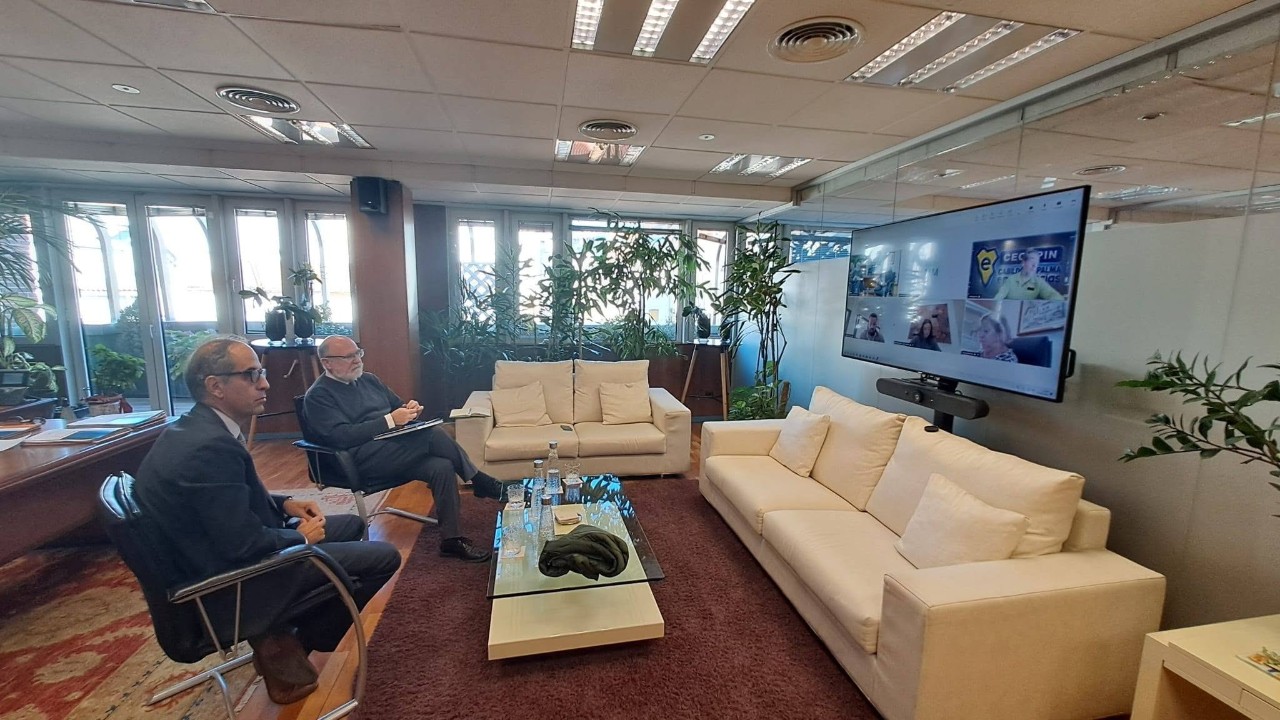
The proposal contemplates taking as reference the experiment carried out in Puerto Naos following the design of the Eduardo Torroja Institute of Construction Sciences, belonging to the Higher Council of Scientific Research (CSIC) - Ministry of Science, Innovation and Universities. The technical objective is to connect the extraction system with a network of pipelines that allows the gas to be transferred to a safe environment.
The planning foresees that the National Geographic Institute (IGN - Ministry of Transport and Sustainable Mobility) will fund other subsurface depressurization operations in Puerto Naos to drain carbon dioxide. And three other extraction points programmed in Puerto Naos are incorporated into the existing experimental system, until a network with four connections is configured. As established at the meeting, the project will be commissioned in November for channeling to Tragsa, as its own medium, and progress will be made during December in the design of the project. Subsequently, it is proposed to study the implementation of a similar solution in La Bombilla, adapted to the characteristics of this coastal core.
The action has an economic endowment included in Article 2.1 of the Royal Decree-Law 23/2026, of 8 September, which makes it possible to deal with certain measures related to the damage caused by the eruption of La Palma, including the CO₂ evacuation system.
After the eruption of 2021, in Puerto Naos and La Bombilla different measures have been deployed to study and manage the presence of volcanic gases. These include CO₂ monitoring and measurement networks, the installation of forced ventilation systems in certain buildings and garages, the sealing of construction elements and the application of specific coatings. These actions are complemented by studies and technical interventions aimed at knowing the behavior of gas and reducing its accumulation in the affected areas.