
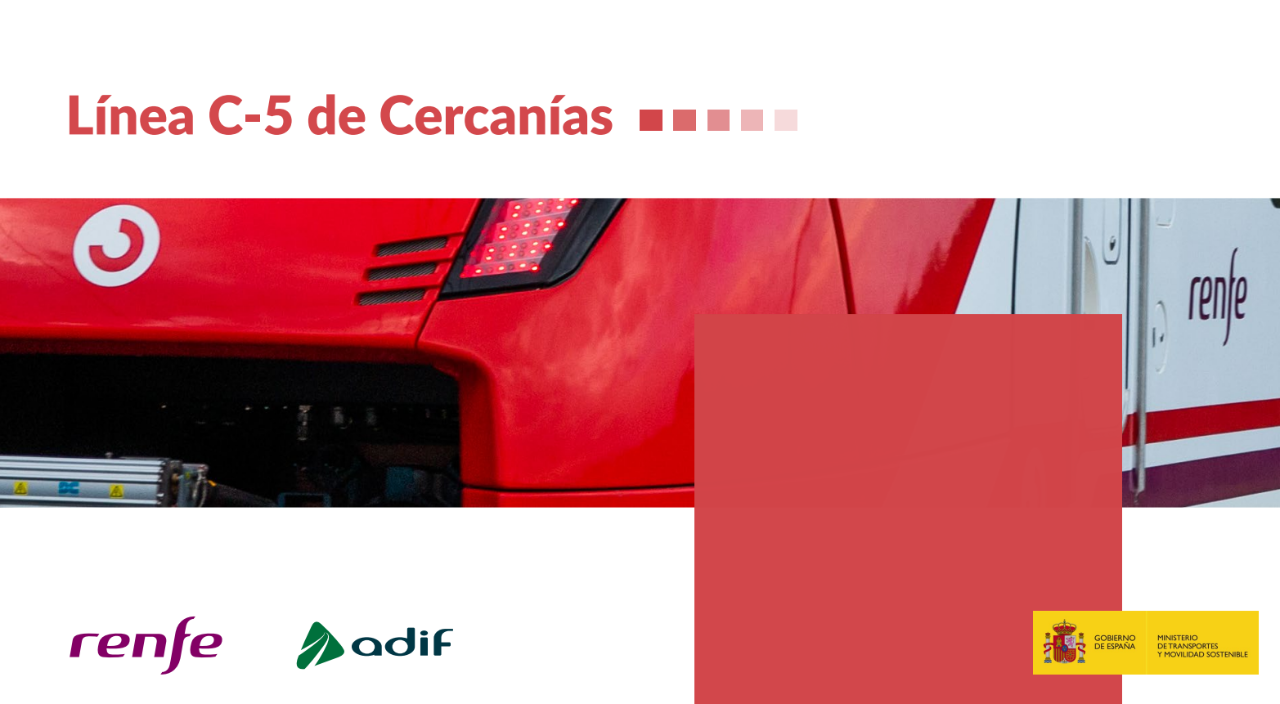
- The minister has presented the plan to renew the C-5 of Cerca de Madrid, “with a key investment for the future of mobility and public transport” of the citizens of Madrid.
- The head of Transport has defended that the C-5 is “the engine of the south of Madrid”, with more than 72 million passengers a year, and needs a “structural reform” to take on the increase in demand.
- The project includes 28 activities in infrastructure and equipment, new trains and workshops, as well as alternative plans for bus transport during the breaks of the service by works.
- Puente has assured that, after five years to undertake the transformation work of the C-5, “a more capable, more punctual, fully accessible line equipped with the most advanced technology in Europe” will be “delivered” to the citizens.
- Most of the interventions will be compatible with the provision of railway service, while the necessary cuts have been planned for the summers, when demand falls.
The Minister of Transport and Sustainable Mobility, Óscar Puente, has presented an investment of 1,350 million euros to modernize the C-5 of Cerca Madrid through a set of 28 planned actions that will increase the capacity of the line by 60%, as well as improve the accessibility of stations and trains, and their operational adaptability.
The head of the Ministry presented this Wednesday the action plan of the C-5 of Madrid and explained the milestones of the investment planned in infrastructures of this line for the coming years, which will revert “directly to the quality of life” of the users.
The minister has defended that this is a “key investment for the future of mobility and public transport” for the citizens of Madrid. “The C-5 is the engine of the south of Madrid and, after this transformation period, we will deliver to citizens a more capable, more punctual line, fully accessible and equipped with the most advanced technology in Europe,” he added.
The C-5 line of the Madrid Commuter Network has its headers in Mó -El Soto and Fuenlabrada/Humanes. It is estimated that around one million people use this route of the railway network, in which more than 72 million passengers a year are registered. In fact, of the approximately 250 million travelers registered by the entire nucleus of Cerca de Madrid, the C-5 absorbs 29% of the total.
Transformation of the C-5
This corridor, as justified by Puente, “requires a profound transformation that adapts to the real needs of mobility” of the population. First, the C-5 needs a “structural reform” because it requires greater capacity, taking into account that the demand for transport in the south of Madrid does not stop growing.
It also requires an improvement in the accessibility of stations and trains, as well as the operational adaptability of the line in the face of unforeseen events, and safety. Also, in this line, technological modernization must be undertaken to adapt to European standards through the European ERTMS N2 signaling system, as stated by the minister.
To meet these needs, the Action Plan is launched at C-5, a project that includes a total of 28 actions that include works to improve the infrastructure and the equipment provided by the service, as well as other alternative transport measures that will be implemented during the obras.El plan has a total investment of 1,350 million euros of which some 650 million euros correspond to the budget of Adif, which as administrator of railway infrastructures will execute the 28 actions planned, while the remaining 700 million correspond to Renfe.
Regarding the 28 actions by Adif, the minister said that there are currently three in the construction phase; five are approved, pending tender; ten projects in drafting; seven in the construction phase; and three in drafting tender. In particular, the minister has outlined some of the main ones:
- Adaptation of infrastructures, adapting the line with the extension of platforms (between 40 and 50 meters additional) and the extension of track handles in 200 meters.
- The modernization of signalling facilities, which reach the end of their useful life, highlighting the transition from the LZB system to the ERTMS N2 (European signalling system.
- The construction of the new Station of Mó -El Soto, as well as improvements in the accessibility of stations.
- Increased safety in case of evacuation, both in tunnels and underground stations.
- The improvement of the resilience and safety of line in case of incident, since the new signaling allows the indistinct circulation by each track.
- The reordering of the points of change of track between Atocha and Móstoles, locating them in stations with Metro, to facilitate transhipments in cases of incident.
- The construction of a new beam of complementary parking lanes for the adaptation of the Humanes workshop.
- The construction of the new maintenance base of Móstoles capable of attending to the maintenance of trains of 200 meters.
- In the area of Safety and Accessibility, the plan includes the improvement of safety in tunnels for evacuations and ensures that 100% of the network is fully accessible.
On the other hand, the investments in material and service by Renfe in the framework of this C-5 modernization plan, budgeted at 700 million euros, are broken down as follows:
- A total of 40 million euros for alternative bus transport plans: special services and EMT will be established to replace trains during the various planned cuts.
- A total of 60 million euros for the workshops of Humanes and Móstoles, the latter being the project of construction of a new Maintenance Base for trains up to 200 meters in which 53.5 million euros are to be invested.
- About 600 million euros of investment for the purchase of the 35 new Stadler trains.
SCHEDULE OF WORK
Regarding the deadlines for the start, execution and completion of the work, a timetable divided into strategic milestones until the end of 2031 has been designed. “We are talking about a five year period where the works that have already begun today will lead us to have a fully armoured and modernized C-5 for the coming decades,” Puente said.
As the minister explained, “the vast majority of interventions will be compatible with the railway service.” In fact, of the 28 planned actions, 15 of great significance will be executed without the need for cuts. Regarding the necessary cuts that will affect the line, they have been planned for the summers, when a fall in demand is expected, with the aim of minimizing the affectations and inconveniences to users.
Although the dates and deadlines are provisional, initially cuts are planned within four months (from June 2027) in the Atocha-Cuatro Vientos stretch to act on the underground infrastructure and the Laguna counter-dome. Also, in the second half of 2028, a second four-month window will be activated to complete the renewal of escapes and signaling systems in the critical sections towards Móstoles and Cuatro Vientos.
As early as April 2029, it is planned to start testing the ERTMS system, the essential precondition for the entry into service of the new large capacity trains with automatic driving in April 2030. And finally, the transformation process of the C-5 will culminate in October 2031 with the total implementation of the system of indistinct circulation to Humanes.
INSTITUTIONAL COLLABORATION
Finally, the minister alluded to the loyalty between administrations for the success of the modernization project. In this context, he recalled the delay of the works in the C-5 has been “deliberate” on the part of the Ministry so as not to collide with the A-5 subsidy carried out by the Madrid City Council. This delay has made it possible to strengthen the Commuter service to offer a real alternative while the road was under construction.
Thus, for the deployment and success of this plan, Puente has said that it is necessary for the City Council to comply with the deadline and end the A-5 subsidy in January 2027, at the same time that it has pointed out that it is essential to collaborate with the Regional Transport Consortium of Madrid during the necessary cutting intervals to modernize the network and “that the southern corridor never remains without a powerful transport alternative”.