
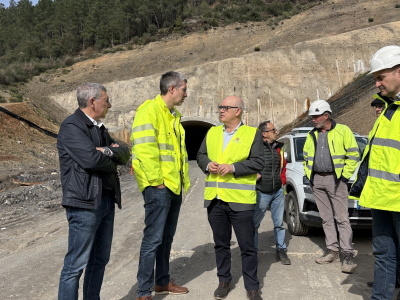
The deputy delegate of the Government in Ourense, Eladio Santos, today highlighted the commitment of the Government of Spain to promote new infrastructures in the province of Ourense. It did so during the supervision of the work of the new connecting road between the N-120 and the N-536, known as Circumvalación de O Barco de Valdeorras, in which the Ministry of Transport and Sustainable Mobility invests more than 60 million euros, including work, expropriations and technical assistance of project drafting and control and surveillance.
Accompanied by the mayor of " Barco de Valdeorras, Aurentino Alonso, the subdelegate of the Government stressed that this infrastructure will improve the quality of life of the neighbors and neighbors of Valdeorras. “This action will allow the population centers to be freed from heavy traffic, which will reduce noise, pollution and deterioration of the road, gaining road safety and space for daily activities,” he explained.
In addition, Eladio Santos said that this intervention is also a firm commitment to the competitiveness and efficiency of companies in the region, especially in the slate sector. “This route will have a suitable route for the transit of trucks, improving the safety of drivers, so it will be a real boost to the economic development of Valdeorras,” he said. Execution of the works
The subdelegate detailed that the progress of the work on the new road is greater than 65%, with the main viaducts of the work on the Sil River and the Cigüeño River and the O Serro tunnel being very advanced. He also recalled that the purpose of the works is to provide a fast and safe connection to the N-536 and N-120 roads in the vicinity of O Barco de Valdeorras, which serves as a variant to avoid the frequent passage of slate trucks from nearby quarries and other vehicles, through the urban center; improve the geometric characteristics of the route of the N-536 by increasing the road safety parameters, and finally, allow to improve the communications of the entire region of Valdeorras.
Technical characteristics
The new infrastructure, with a length of 5.6 kilometers, begins in Sobradelo at kilometer point 41.5 of the N-536, at the intersection with the O-122, and ends at kilometer point 453.4 of the N-120 in O Barco de Valdeorras. The performance consists of two distinct parts:
- A first subsection of the N-536 conditioning and improvement road from Sobradelo in a length of about 3.3 kilometres with a cross section composed of a 7-metre road, with 3.50 metre lanes per direction, and 1.50 metre external ends.
- A second sub-section of a variant road of about 2.3 kilometres, leaving the N-536 at the previous point, with a cross-section of 12 metres, lanes of 3.50 metres and external sides of 2.50 metres. This second stretch crosses the River Sil through a viaduct and the Serro mountain in tunnel to finally connect with the N-120 road through another viaduct over the Cigüeño river.
Two knots are projected: the first of them, at kilometric point 45 of the N-536, is designed as an intersection in T equipped with central waiting and speed change lanes. The second, at the end of the stretch, consists of a new diamond-like link with upper roundabout, which serves as a connection between the new variant and the N-120, located close to the existing one in that N-120, in the vicinity of the kilometric point 453.4.
This new link was designed and planned to accommodate the passage of the section of the future A-76 motorway: Ponferrada-Ourense, and it will also give access to the O-622 and other tracks of the Barco de Valdeorras core. Along the route, a total of ten structures are projected: six viaducts, three upper passes and a lower pass, where the viaduct stands out on the Sil river of 405 meters in length and section in drawer and the viaduct on the Cigüeño river, of 258 meters. Following the viaduct on the Sil River in the northwest direction, under Mount O Serro, the construction of a tunnel of a single bidirectional tube, of 490 meters in length and constant slope of 3% was projected.
As an important part of the project, it should be noted that it includes all the necessary measures of environmental integration and protection of the cultural heritage, such as the preservation of the old Ponte de Candiles and the Roman aurifer exploitation of A Veiga.