
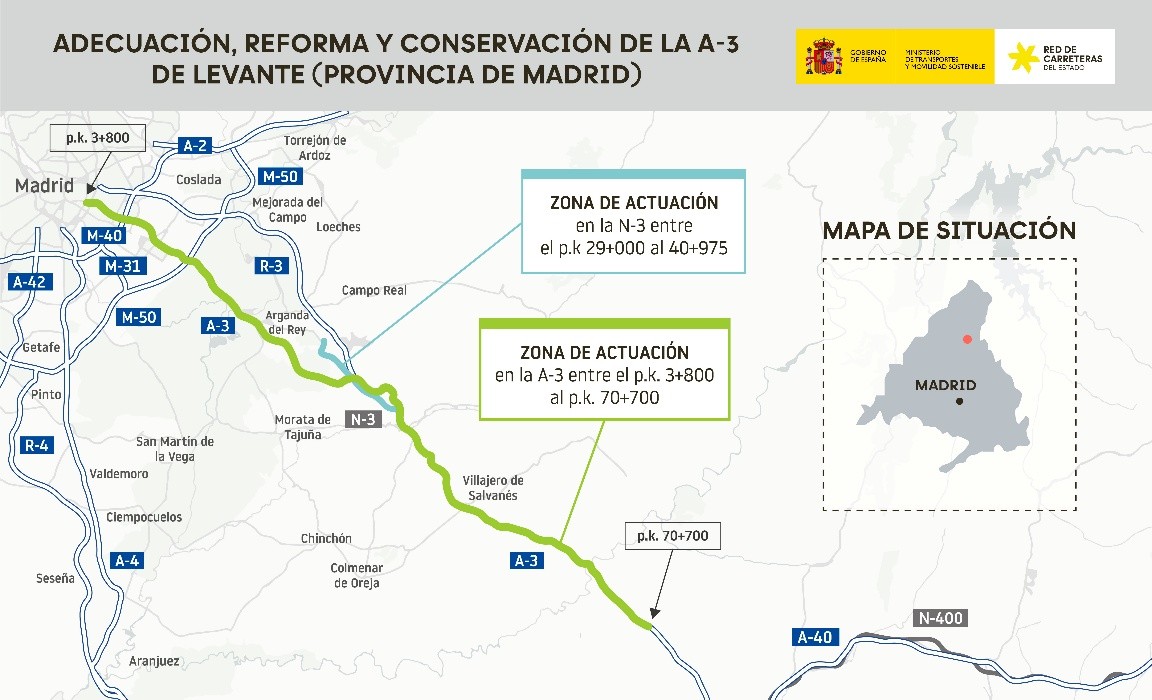
- Actions are proposed in about 67 kilometers of the A-3 motorway, from the M-30, in kilometer 3.8, to the provincial limit with Cuenca, in kilometer 70.7.
- Also included is the conditioning of a 12-kilometer stretch of the N-3 road, between kilometers 29 and 40,975.
- The works will improve the level of service and road safety in one of the main access and exit corridors of Madrid.
- Intelligent transport systems (ITS) will be incorporated to optimize traffic management and promote sustainable mobility.
- The preliminary project includes interventions in the firms, structures, drainage, signaling and containment systems.
The Ministry of Transport and Sustainable Mobility has approved the public information file and definitively the preliminary project of adequacy, reform and conservation of the A-3 in Madrid, in the stretch between the M-30 and the provincial limit with Cuenca. The basic budget for the tender of the works is 540.8 million euros (VAT included).
The length of the A-3 motorway section where improvement actions are proposed is about 67 kilometers. In particular, it ranges from kilometer 3.8 (intersection with M-30) and kilometer 70.7, on the provincial boundary with Cuenca. It also includes conditioning on a section of the N-3 road between kilometers 29 and 40,975, that is, along about 12 kilometers.
Planned actions
The announcement corresponding to the final approval of this preliminary draft will soon be published in the Official State Gazette (BOE). The purpose of this preliminary draft is to define, both from a technical and economic point of view, the actions to be carried out.
The actions studied in the study will be addressed in sections through independent projects. In the case of the A-3, the actions studied mainly were:
- Reordering of accesses.
- Expansion of current berms, to improve visibility and safety, accordingly.
- Relocation and/or improvement and adaptation of stops of collective transport vehicles.
- Replacement and improvement of drainage works.
- Rehabilitation of the existing firm (trunk, service routes, collecting routes, branches). In any case, the extension of a new rolling layer on the entire platform of the existing road is foreseen.
- Repertoire of the motorway.
- Rehabilitation of existing structures, pre-design of new structures to be executed and/or necessary modifications on existing ones (board extensions, battery displacement, board elevation to improve gauge, etc.).
- Replacement of all vertical marking elements and repainting of road markings.
- Replacement of the containment systems in those sections that have to be disassembled for reasons such as repertoires, extensions of cross-sections, trace rectifications, etc.
- Intelligent Transport Systems (ITS): it is proposed the location of the new capacity stations to be executed, as well as the need to install side panels and variable messaging banners, cameras and license plate detection systems for the control and management of the new specialized lane of public transport projected.
- Replacement of services: the existing services in the field of action have been detected, analyzing the affections to each of them, their possible replacement and estimating the economic valuation of the necessary replacements.
- Complementary works. The following elements are projected:
- Steps of median.
- Replacement of the perimeter enclosure of the motorway.
- Replacement of the lighting affected by the performances and replacement of the VSAP lamps with LED type luminaires in those cases in which there is no affection to the scales.
- Replacement roads.
On the other hand, in the case of the N-3, its conditioning has been planned in the aforementioned section through the rehabilitation of the firm and structures and the adaptation of the containment and signaling systems.
Improvements in a strategic axis
The planned actions will allow to increase the level of service of the corridor, reducing travel times and improving the fluidity of traffic in a strategic axis for the mobility of passengers and goods between Madrid and the Peninsular Levant.
Likewise, the improvement of the firm, the updating of the containment and signalling systems, the optimization of the visibility and the geometric adaptation of the track will contribute to significantly reinforce road safety and the comfort of the users.
The incorporation of intelligent transport systems and the modernization of facilities will promote more efficient and sustainable traffic management, increasing incident response capacity and improving real-time information to drivers.