
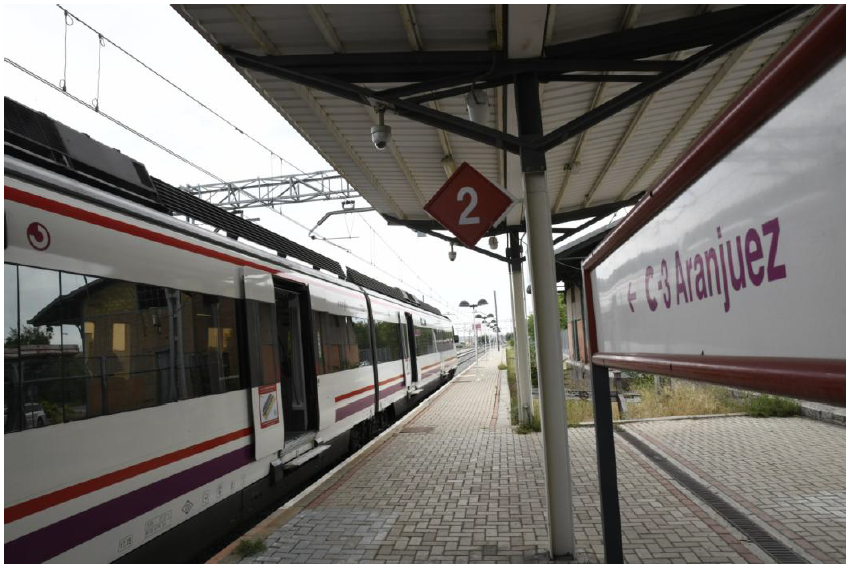
- The feasibility of quadrupling the railway infrastructure to relieve congestion on the line will be studied
- The study has been awarded for 363,000.00 euros (VAT included) and seeks to improve the functionality of the Madrid-Aranjuez corridor
The Ministry of Transport and Sustainable Mobility has awarded 363,000.00 euros (VAT included) for the services contract to develop the “Feasibility Study for the functional optimization and capacity increase of the C-3 line of Neighbourhoods of Madrid. Stretch: San Cristóbal Industrial – Aranjuez”. The editorial office has an initial term of 24 months.
Currently, in this line coexist traffic of Vicinity, Medium Distance and Goods, which entails a high level of saturation of the line in certain time slots of the day and a heterogeneity of speeds that hinders the reliability of the exploitation.
The stations or roadblocks included in the section under study are San Cristóbal Industrial, El Casar, Getafe Industrial, La Tenería (in execution), Pinto, Valdemoro, Ciempozuelos, Seseña (out of service) and Aranjuez.
Feasibility study
The study, which was published last December, will analyse possible actions to increase the capacity and reliability of the railway operation. To this end, all kinds of possibilities for action will be contemplated, from the implementation of improvements in signaling and security systems, including possible recantonings and optimization of signaling, to the implementation of a third and fourth track in the whole or part of the stretch.
The final objective will be to select those actions in the San Cristóbal Industrial-Aranjuez section that are ideal for the improvement of the global functionality of the Madrid-Aranjuez corridor. This, in addition, will have an impact on an improvement in travel times for other regional services.
Boosting sustainable mobility
These works will promote sustainable metropolitan mobility, through the Commuter service, and increase the levels of accessibility and social cohesion through a quality railway system. Operational safety in rail transport will also be enhanced through the implementation of measures aimed at improving operation.
The action responds to the objectives of the Sustainable, Secure and Connected Mobility Strategy 2030, aimed at improving social cohesion, economic growth and solving real mobility problems. The railway mode of transport aligns with these objectives and contributes to sustainable mobility from a social, economic and environmental point of view.
In addition, in 2022 the Ministry approved the Indicative Strategy for the development, maintenance and renewal of the railway infrastructure, framed in the current legislation of the Railway Sector. The main mission of this strategy is to establish a financial framework and priorities for railway planning, establishing a set of basic guidelines aimed at satisfying future mobility needs and the financial sustainability of the railway system. Within this strategic framework, the advisability of analyzing the viability of the actions arises.