
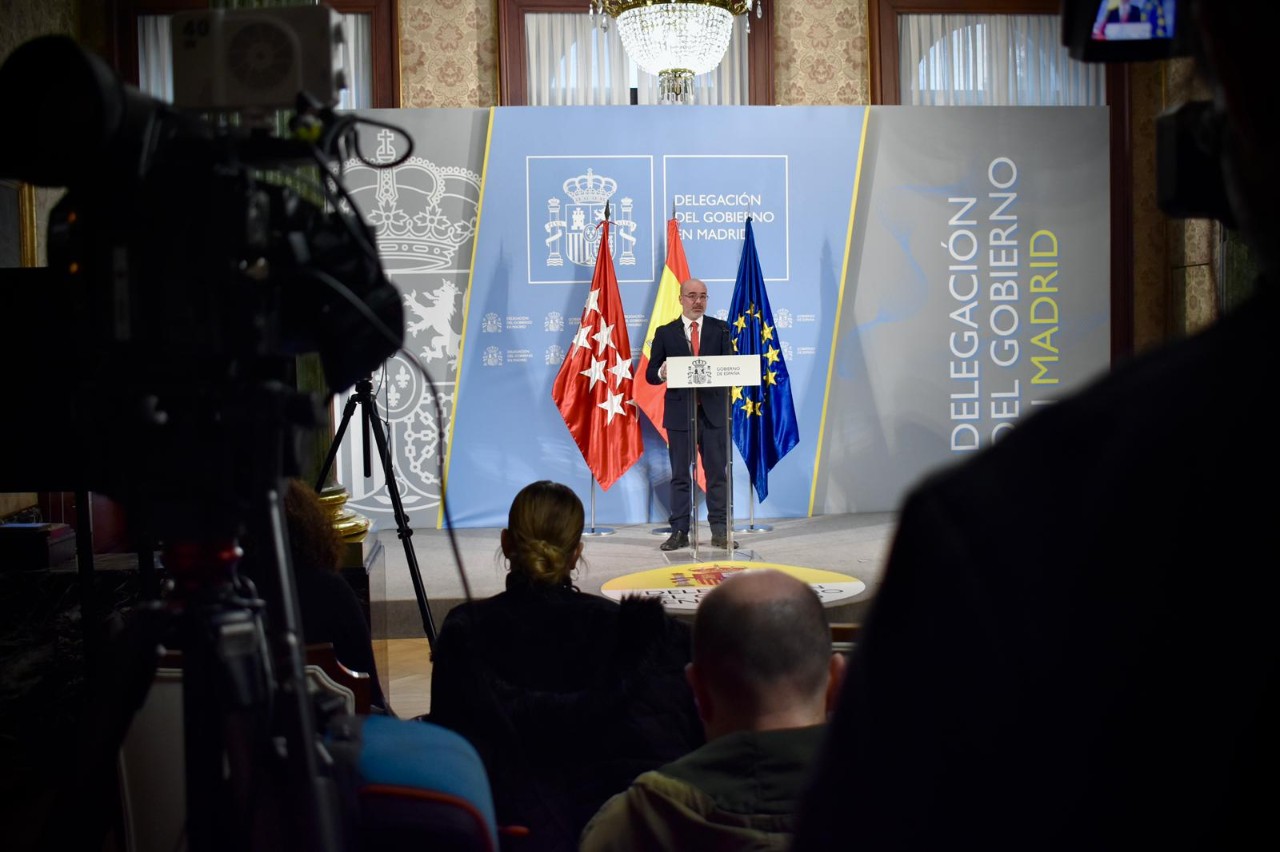
The delegate of the Government of Spain in the Community of Madrid, Francisco Martín Aguirre, has today assured the new model of autonomous financing proposed by the Executive will mean that the Community of Madrid receives 2,555 million more per year, from 2027, and is located as the community with the most resources per adjusted inhabitant, only behind Cantabria.
At a press conference, he explained how this increase in resources could materialize to strengthen public services in the region. For example, this increase almost doubles the budget for Family, Youth and Social Affairs, increases the resources of the Ministry of Housing, Transport and Infrastructure by 80% or multiplies the housing budget of 2026 by 4.6.
Likewise, it is equivalent to increasing the total budget of the region by 8.3%, 10.6% the social budget, 23% in Health or doubling the budget in Primary Care; if it were dedicated to Education, it would be equivalent to having 37% more, which would serve to cope with the current financial asphyxiation suffered by public universities in the region.
In short, investing in improving the quality of life of the people of Madrid through the strengthening of public services and “nobody could understand that the Autonomous Government refused to manage these greater resources that bring so many benefits”.
For this reason, he has described this as “a very important and positive day for Spain and the Community of Madrid” in which, finally, a financing model that had expired for 13 years has been updated.
Commitment to Madrid
He also defended that “the Community of Madrid had never received as many resources as with the Government of Pedro Sánchez”, as shown by the figures: 50% more resources in the last 7 years and more than 43 billion than with the governments of Mariano Rajoy; the offer of the cancellation of almost 8 billion and the largest transfers ever.
A trend that will continue in the new model that, in addition, takes into account the entrepreneurial uniqueness of the Community of Madrid being one of the main beneficiaries of the new VAT mechanism SMEs, by which the autonomous communities will be able to receive a part of the VAT collection generated by SMEs in their territory. This means An advantage for a community with a large and competitive business fabric of SMEs.
In this way, the reality of the productive fabric of the region is recognized and its effort in promoting and supporting small and medium-sized enterprises, while moving towards greater autonomy and fiscal co-responsibility and encouraging economic development.
Beneficiary of the new climate fund
Faced with the challenges of the climate crisis, the financing system will be provided with a climate fund of about 1 billion. Two thirds of it will be distributed among the autonomies of the Mediterranean coast, the most affected by its exposure to the warming of the Mediterranean Sea and its effect on the climate.
The remaining third will be received by the other communities, including the Community of Madrid.
Arming the Welfare State
In view of the reality of the figures, the government delegate stressed that this is a model that raises the resources of the autonomous system to protect the Welfare State and that benefits all the autonomous communities, since all of them will have the largest funding in their history.
In addition, it guarantees, strengthens and extends interterritorial solidarity. We are facing a model of solidarity, where there is a transfer of resources from rich communities to communities with fewer resources with a transparent, fair and clear methodology. Interterritorial solidarity increases by 3 billion.
On the other hand, it strengthens fiscal autonomy and co-responsibility by increasing the percentage of cession of the two main taxes: Income tax and VAT, and it is more equitable by reducing by half the current distances in financing per inhabitant.