
- Face-to-face appointments will be attended in more than 370 post offices, in more than 60 Social Security offices and in five immigration offices located in Madrid, Alicante, Valencia, Almería and Murcia.
- The prior appointment is essential to be attended in person and can be requested in three ways: with digital identification, through a form and on the phone 060.
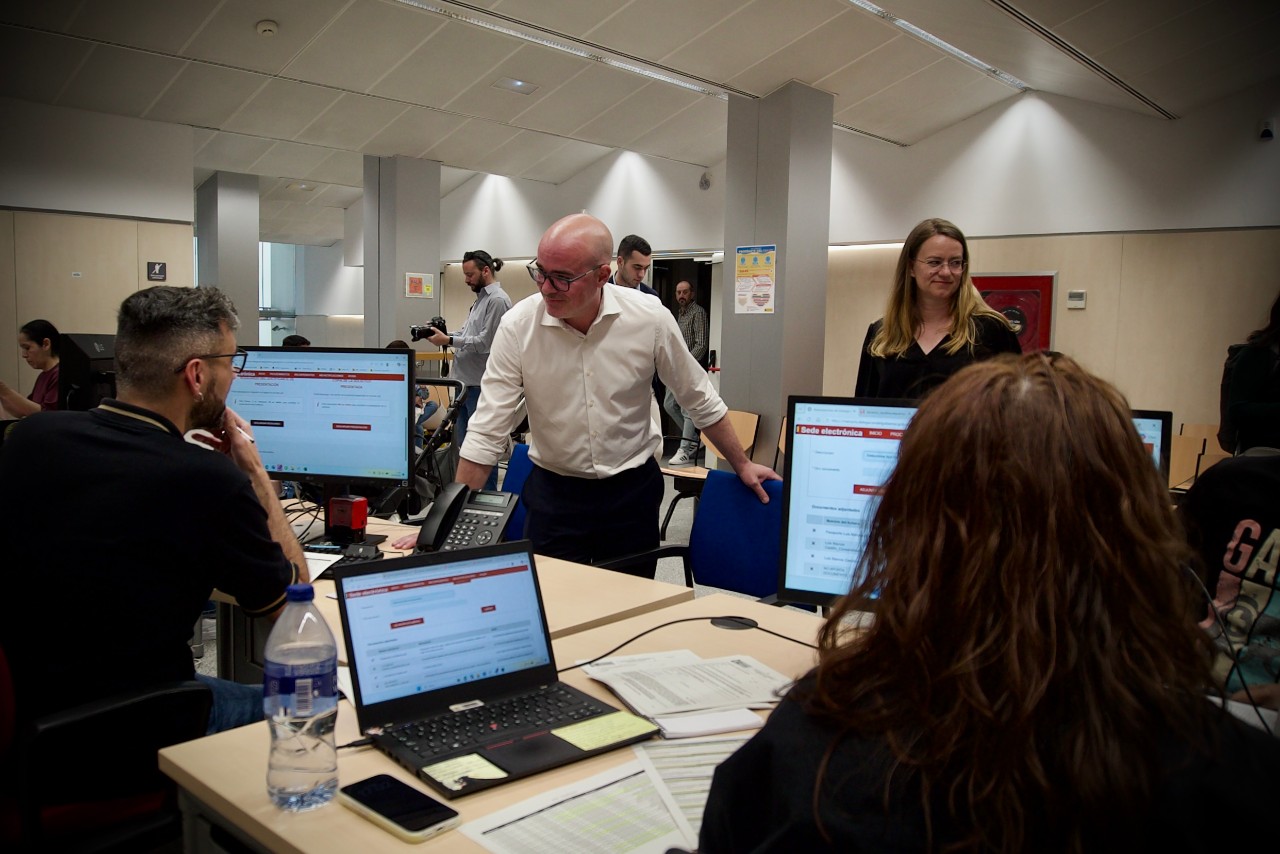
The delegate of the Government of Spain in the Community of Madrid, Francisco Martín Aguirre, visited today one of the offices for immigration procedures dependent on the Delegation of the Government of Spain in Madrid, coinciding with the beginning of face-to-face care for the process of extraordinary migratory regularization.
Accompanied by the director of the Work and Immigration Area of the Government Delegation in Madrid, Paloma Pérez Cortijo, he has been able to see in first person how care is provided to those who have opted for this route, by prior appointment, to submit their application for regularization.
The government delegate stressed that “the process of extraordinary regularization of migrants is a measure to guarantee rights and dignify the lives of thousands of people who are residing in Spain.”
The process began on April 16 and will be open until June 30.
During the visit it has been recalled that all the information on the procedure, as well as the forms and frequently asked questions, is available in the specific portal of the Regularization that has been enabled on the website of the Ministry inclusion.gob.es/regularizacion
The application can be made in two ways: face-to-face and telematics. The face-to-face form works only through a pre-appointment service. Meanwhile, the telematic route is available 24 hours a day, 7 days a week throughout the application period.
The application deadline began on Thursday, April 16, with the start of the processing of telematic applications. Meanwhile, for the face-to-face route, the system of prior appointment through the web was also enabled on the same day April 16 and has begun today, April 20. The application deadline for both channels will be open until June 30.
Prior appointment, essential for face-to-face care
In relation to the appointment, it can be requested by three ways: with digital identification (Cl@ve system), through a form and on the phone 060. The appointment calendar is opened gradually and it is a completely free procedure. According to data from the Ministry of Inclusion, Social Security and Migration, in the first 24 hours of the process 19,633 appointments were formalized and confirmed.
In the case of Cl@ve, the beneficiary can choose between the nearest offices; if the request is made by telephone or by form, the nearest one is automatically assigned to him based on his data preferences and his postal code. These face-to-face appointments are attended from today in more than 370 post offices, in more than 60 Social Security offices and in five immigration offices located in Alicante, Valencia, Almería, Murcia and Madrid, among which is the one visited today by Francisco Martín, dependent on the Government Delegation in Madrid, and located on Silva Street, 19.
The immigration and social security offices authorized will be open from Monday to Friday from 16:00 to 19:00 for these procedures and the post offices will attend this procedure from Monday to Friday, from 08:30 to 17:30.
Requirements and documentation
The extraordinary regularization process enables those people who are in an irregular administrative situation in our country and people seeking international protection to access a residence permit and legal work provided they meet the requirements. This permit will be valid for an initial period of one year. After this period, the beneficiaries will have to join the ordinary figures provided for in the Regulation on Foreigners, which allows a full and progressive integration into the system.
To do this, they will have to prove that they have been in the country since before January 1, 2026 and have remained in Spain uninterrupted at least five months before the time of submission of the application. In addition, it will be an essential requirement to have no criminal record and not pose a threat to public order, public safety or public health.
To justify the stay in Spain, both applicants for international protection and people in an irregular administrative situation may present public or private documents or a combination of both containing personal data that can prove their identity and that are dated.
People in an irregular administrative situation must also prove one of the following three assumptions: having worked with a legal contract for an employed or self-employed person in Spain; having a family unit composed of children under age, disabled adults or first-degree ascendants; or certifying their situation of vulnerability (model enabled on the Ministry’s website).
Accompaniment during the process
Potential beneficiaries will be able to count on the advice of qualified professionals through lawyers, social graduates or administrative managers who can act as representatives for the presentation of applications.
In parallel, the Ministry has launched the Register of Foreigners Collaborators (RECEX), made up of social entities and trade unions. They will offer free advice and can also act as representatives. The list of Collaborating Entities for Foreigners can be consulted on the website of the Ministry of Inclusion, Social Security and Migration: collaborating entities