
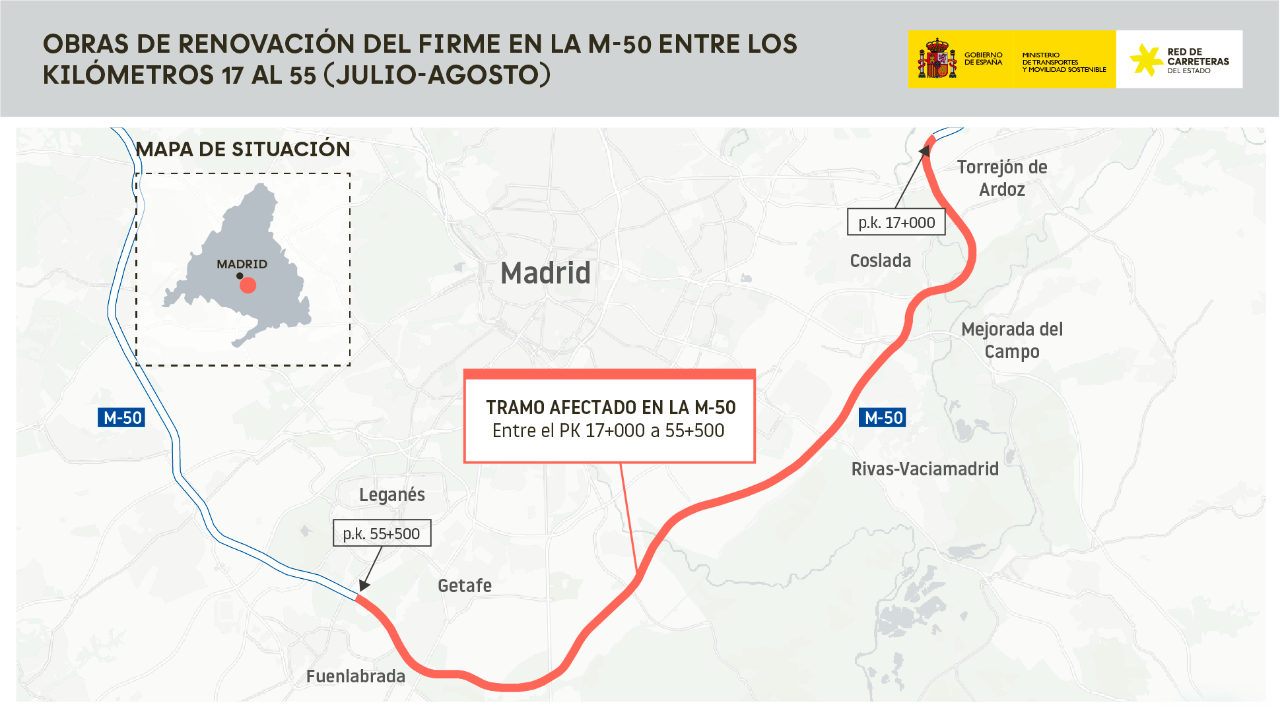
- The works affect both roads of the M-50, between kilometers 17 and 55.5 and will be executed at night and during the summer period to minimize the impact on the mobility of the Community of Madrid.
- The sum of the actions exceeds 52 million euros.
The Ministry of Transport and Sustainable Mobility, through the State Society of Terrestrial Transport Infrastructures (SEITT), continues with the rehabilitation and replacement of firmes on the M-50 ring road in Madrid, with the aim of guaranteeing road safety and prolonging the useful life of one of the most trafficked infrastructures in the Madrid road network.
The performances, which run for approximately 38 kilometres - from kilometre 17 to kilometre 55 - will take place between the months of July and August 2026.
The works for the improvement of these two sections were awarded in two contracts for a total amount of 52 million euros (VAT included). In the first of these, which affects the Culebro Axis, the works were awarded for an amount of 24.21 million euros (VAT included). The second, on the improvement of Stretch II of 29 km in length, the works were awarded for a total amount of 27.79 million euros.
Performances between the kilometers 17 to 45.9
On the right causeway:
- From July 6 to 17 (M-45 to M-31) in the stretch between the kilometer 24,55 to 37,5. The main cuts will be made in kilometer 23.5 (detour by M-45) and the permanent cut in the incorporation of R3 to M-50.
- From July 20 to 24 (M-31 to A-4), between kilometers 37.5 and 46, a total cut will be made by M-31 and will be cut in the incorporation of the M-301 to M-50.
On the left causeway:
- From July 27 to 31 (A-4 to M-31) from kilometer 46 to 37.5, the total cut of exit 46 will be made and it will be cut in the A-4 additions.
- From August 3 to 14 of the kilometer 37.5 to 26 (M-31 to M-45) the total cut of M-50 will be made (detour by M-31) and cuts will be made in the additions of A-3 to M-50.
On both roads:
- From the 17th to the 28th of August (M-45 to A-2)) will be performed in the section of kilometer 26 to 17, night cuts will be made (from 21 to 6 hours) and the detour will be performed by exit 17, direction A-2.
- Also from the 17th to the 28th of August (A-2 to M-45), it will be performed in the kilometers from the 17th to the 26th in the same night time and the detour in this regard will be performed by M-45.
The rolling layer works will be executed with permanent total cuts of road, executing the agglomeration works at night time and other works such as painting or the execution of the expansion joints during the first hours of the morning (to avoid high temperatures and thus comply with the current legislation on the prevention of occupational risks). During these cuts, the deviations that will be made mainly by the M-45 and the M-31 will be signaled.
Performances between the kilometers 45.9 to 55.5
On the right causeway:
- From July 6 to 18: from kilometer 46 to 48 it will be totally cut at kilometer 45 and the detour will be carried out by the service route (Nassica Shopping Center).
- From 20th to 28th of July. From kilometer 48.9 to 53.75 it will be totally cut and the link with A-42. The detour will be made through the left lane.
- From 29 to 31 July, the section from kilometre 53.75 to 55.5 will be completely cut at night from 21 to 6 hours and the detour will be carried out by Avenida Recomba.
On the left causeway (in a decreasing sense):
- On August 3 and 4, the section between 55.5 and 53.75 kilometers will be completely cut during night time, and the detour will be carried out by Avenida Recomba.
- Between 5 and 13 August: between the 53,75 and 48,9 kilometres, a total cut will be made and the link with A-42 will be cut. The detour will occur along one lane of the opposite roadway.
- Between 17 and 28 August, in the stretch between kilometers 48.9 and 46 there will be a total cut of kilometer 49 (the detour will be done by the service route through the Nassica Shopping Center)
Between kilometers 46 to 53.75, the rolling layer works will be executed with permanent total cuts of road, executing the agglomeration works during night time and other works such as painting, waterproofing of the structures, the execution of the expansion joints and the replacement of pretiles and other containment elements will be carried out during the first hours of the morning (to avoid high temperatures and thus comply with the current legislation on the prevention of occupational risks). During these cuts, the deviations that will be carried out mainly through the service road of the Nassica Shopping Center and through a lane of the opposite road will be signaled.
Between the kilometers 53,75 and 55.5 it will be executed with night cuts (from 21 to 6 hours), diverting traffic through Avenida Recomba and allowing normal circulation during the day.
Traffic management and alternative routes
SEITT has designed a comprehensive mobility management plan to minimize the impact of works on users. The detour signage will be installed sufficiently in advance in all the affected accesses, indicating the alternative routes available in each phase.
Among the measures planned are: the use of the M-45, M-31, A-42 and M-506 as main alternative itineraries; the enabling of changes of direction in strategic points (such as exit 55-B for the accesses coming from Avenida de la Hispanidad, Calle Isla de Easter and Calle Islas del Canal); and the diversion of traffic to the A-4 through the M-506 when the direct accesses in the environment of the Culebro Axis are cut.
Drivers who join the M-50 from the R-4 will have alternative routes through the service routes, as well as through the exits of the A-4 direction Madrid (S16) and A-4 direction Córdoba (S13). Also, for access to the Nassica Shopping Center and the C.E. Andalusia will enable exit 48 of the M-50.
The programming forecasts contained in this note are intended for guidance and are subject to regular updating. The development of the works will be monitored week by week, so that the expected deadlines, phases and deviations can be adjusted according to the actual execution rate, weather conditions and the effective performance of the equipment. SEITT will promptly communicate any relevant changes with respect to the initially planned schedule.
Commitment to road safety and sustainability
SEITT, as a state company responsible for the management of state-owned road infrastructures, faces these works with a double objective: to improve road safety conditions for the more than 100,000 vehicles that circulate daily through this corridor, and preserve the heritage of the infrastructure in a sustainable and efficient manner.
The scheduling of work in the summer period and at night time — when traffic volumes are significantly lower — is consistent with SEITT’s commitment to cause the least possible harm to users, to the surrounding municipalities (Leganés, Fuenlabrada, Getafe, Rivas, Vaciamadrid, San Fernando de Henares) and to the economic activity of the industrial estates and shopping centers in the area.
In addition, the summer programming of the works also responds to technical criteria linked to the properties of bituminous mixtures. The SMA-11 (Stone Mastic Asphalt) and BBTM 11B type rolling layers require that both the ambient temperature and that of the support—the existing firm—be maintained above certain thresholds during the extension and compaction of the material. The high summer temperatures ensure that the bituminous mixture remains in the optimal working range long enough to achieve uniform compaction and the percentages of voids required by the technical specifications. On the contrary, spreading this type of mixture with low temperatures accelerates the cooling of the material, prevents adequate compaction and compromises the durability and functional characteristics of the resulting layer —skid resistance, impermeability and structural capacity. The application of the firm during the summer period directly determines the quality and useful life of the performance.
SEITT’s Investment Plan
This work is part of the investment plan of the State Society of Land Transport Infrastructures, S.M.E., S.A. (SEITT), empresa pública dependiente del Ministerio de Transportes y Movilidad Sostenible.
The objective of this plan, endowed with 455 million euros until 2032, is to return to an optimal state of operation the motorways reverted to the State (such as the R-2, R-3, R-4, R-5, and others such as the AP-36, AP-41, AP-7 in Alicante and Cartagena, and the M-12), as well as the free sections managed by the entity, as is the case of the M-50.
The plan includes interventions in eight priority areas: firm rehabilitation, tunnels, structures, signage, Intelligent Transport Systems (ITS) and toll systems, noise reduction, lighting and capacity improvements. Specifically, the rehabilitation of firmes represents 50.8% of the total budget, being therefore the main axis of this modernization program.