
- The Ministry of Culture and the University of Alcalá, owner of the property, have reached an agreement for the recovery by the State of the property of the property
- The former Women’s Prison, adjacent to the General Archive of the Administration, has a built area of more than 8,000 m2 Distributed over five floors
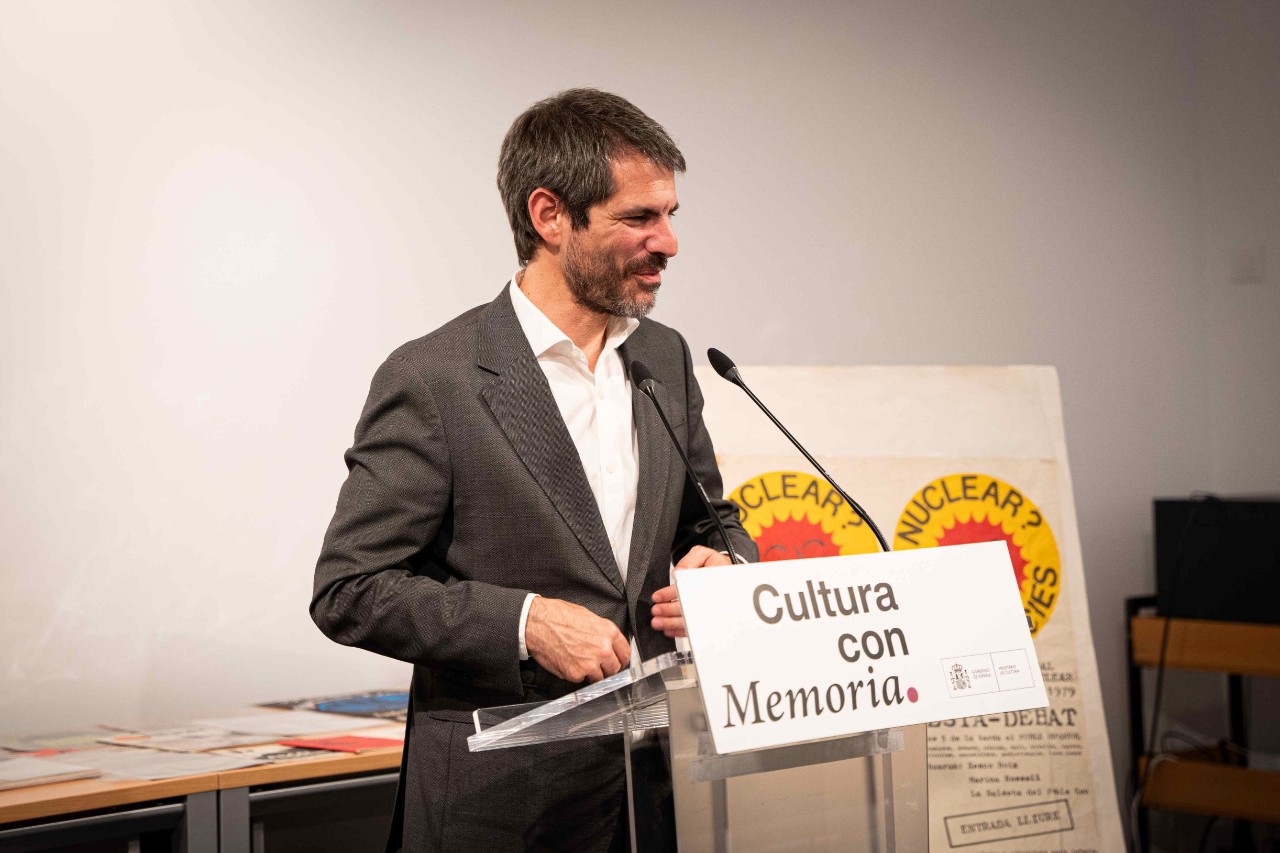
The Minister of Culture, Ernest Urtasun, and the rector of the University of Alcalá, Carmelo García, have today announced an agreement for the former Women’s Prison of Alcalá de Henares, currently owned by the University, to be re-owned by the State to be destined for use by the Ministry of Culture. This space, located in the town of Alcalá de Henares, will become the headquarters of the Historical Archive of Social Movements (AHMS). The announcement was made during a visit to the property this morning.
The former Women’s Prison, also known as La Galera or the college of San Cirilo, has more than 8,000 m2 built, and is located next to the General Archive of the Administration (AGA), between Santo Tomás, Carmen Descalzo and Luis Gómez the Student streets.
The Minister of Culture, Ernest Urtasun, has indicated that “for decades, this was a space of confinement, punishment and pain, and now we want to turn it into a space of memory, knowledge and democracy. Where there was silence, we want there to be memory; where there was confinement, we want there to be research, public access and democratic culture.” And he added that “there is a very powerful symbolic force in transforming a place of seclusion into a place open to citizenship.”
For his part, the rector of the University of Alcalá, Carmelo García, stressed that “it is an extraordinarily positive news for the University of Alcalá, for our city and for Spanish society as a whole” and added that the agreement is also important from a patrimonial and architectural point of view, since it means taking “a decisive step so that La Galera returns to have life, activity and a public function fully in accordance with its historical relevance”.
Currently the Historical Archive of Social Movements of the Ministry of Culture is located in the building of the AGA and its collection has not stopped growing since its creation in 2021. Today it has been announced that the historical archive of the confederation Ecologists in Action, gathered and guarded for 50 years by this entity, has become part of the funds of the AHMS.
Once the State has recovered the property of the building effectively, it will be reformed by the Ministry of Culture to adapt it to the needs and uses of an archive.
About the former Women’s Prison of Alcalá
The old Women’s Prison originated in the late sixteenth century in a school built outside the city of Alcalá de Henares, which in the nineteenth century was demolished to erect in its place a building used as a prison since 1852. In fact, this was the only prison for women that existed at that time in Spain and functioned as a prison intermittently for about a century, until 1978.
The building is an example of penitentiary architecture, organized in radial modules: a central body and three “T” shaped crunches. Some of its annexed parts were demolished, as in the case of the workshop buildings on which the Faculty of Documentation was later built. Recently, the University of Alcalá has undertaken works in its surroundings to guarantee the stability of the roofs and the building itself, which occupies a total area of more than 8,000 m2 distributed over five floors.
Historical Archive of Social Movements
Created in 2021, the Historical Archive of Social Movements of the Ministry of Culture is a fundamental institution for the study of the transformations of Spanish society in recent decades.
The Archive is made up of the documentary and bibliographic heritage generated and preserved by different organizations and social movements of contemporary Spain, as well as by their own militants, sometimes in exile. Its funds come from acquisitions made by the State and archives deposited or donated by its owners on a voluntary basis.
The objective of this Archive, which is part of the network of State Archives directly managed by the Ministry of Culture, is to recover, gather, disseminate and allow access and research to this essential part of the Spanish documentary heritage, reflecting our history and culture and the transforming power of citizenship.
In addition, the Historical Archive of Social Movements aims to be also a public space for participation, exchange of knowledge and meeting associations, communities, and citizenship, which fosters and promotes social cohesion, which visibilises and fosters diversity.