
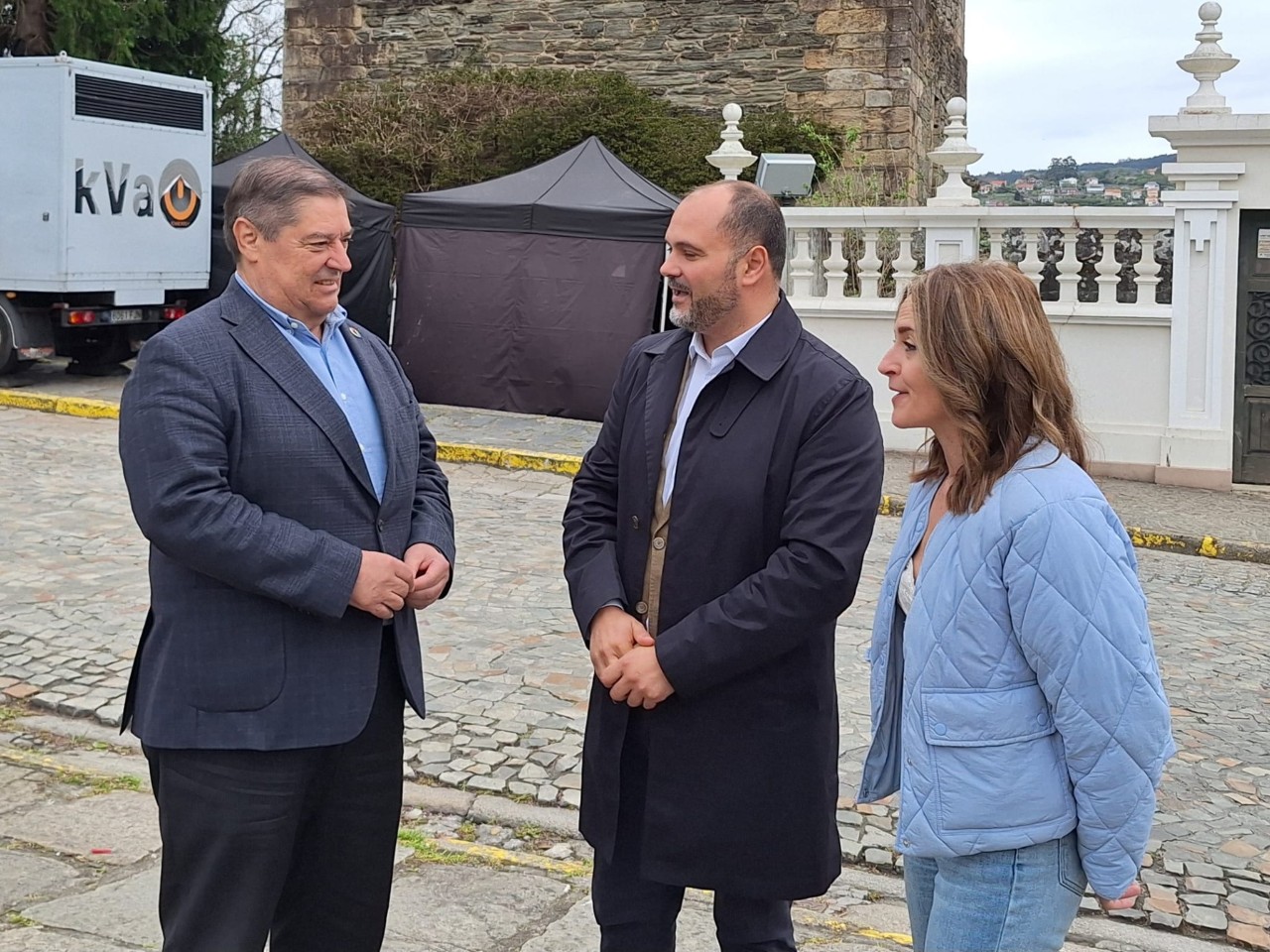
El subdelegate of the Government in A Coruña, Julio Abalde, met with him today mayor of Pontedeume, Bernardo Fernández, at the request of the City Council, to discuss the rehabilitation works that the Ministry of Transport and Sustainable Mobility is executing on the Pontedeume bridge, at kilometre 20.6 of the N-651 road, on the Ares estuary.
During the meeting, Abalde highlighted the importance of this action, which has an investment of 6.77 million euros, financed through the Next Generation funds within the framework of the Recovery, Transformation and Resilience Plan. The works aim to improve the safety, functionality and durability of a key infrastructure for mobility in the region.
Julio Abalde stressed that “this action responds to the firm commitment of the Government of Spain with the advance and conservation of road infrastructures, especially those that, like the Pontedeume bridge, have an important historical and strategic value”. In this regard, he stressed that “the Investment of more than 6.7 million euros will ensure greater security and accessibility for citizens, while preserving a fundamental patrimonial element for the region and for Galicia”.
The works include the execution of a new foundation, the replacement and expansion of the board and pedestrian sidewalks, the installation of new handrails and vehicle containment systems, as well as the reconstruction of the bridge armchair. In addition, the project includes the advance of the drainage system, the renovation of the foils and finishes of the balustrade and the optimization of public lighting. At the meeting it was agreed that efforts will be made to maintain the aesthetic treatment of this historic bridge.
In this phase of the works, action is being taken on the sidewalks on both sides of the bridge in a stretch of approximately 180 meters, from the intersection roundabout of the N-651 with the AC-564, in the municipality of Cabañas. Actions will also be carried out for the settlement of the structure. We are currently working on topographic rethinking.
Second was indicated during the meeting, from the City Council the need was transferred that within the different phases of the project, whenever technically possible, priority is given to the night hours of the work to minimize the affection to traffic. In addition, the municipal officials analyzed together with the subdelegate, the proposals made from the consistory to the State Road Demarcation, regarding the aesthetic finishes of the bridge, maintaining the current lighting, or using materials and designs for both the foothills and the balustrade, in accordance with a historical bridge.
No lane cuts are foreseen at this stage, although pedestrian traffic will be limited to one of the margins and the width of the circulation lanes will be reduced for a period of approximately two months, in order to ensure safety during the execution of the work. At this point, the subdelegate pledged that the works being undertaken should have the least possible incident in the traffic. Thus, the usual traffic density will be taken into account, avoiding the hours of greatest incident and, whenever the work allows it, they will be carried out at night.
Second was indicated during the meeting, no lane cuts are foreseen at this stage, although pedestrian traffic will be limited to one of the margins and the width of the circulation lanes will be reduced for a period of approximately two months, in order to ensure safety during the execution of the work. At this point, the subdelegate pledged that the works being undertaken should have the least possible incident in the traffic. Thus, the usual traffic density will be taken into account, avoiding the hours of greatest incident and, whenever the work allows it, they will be carried out at night.
The subdelegate highlighted the Government’s commitment to the conservation and modernization of infrastructures, stressing that this action will improve road safety and accessibility, while preserving the historical value of an emblematic bridge.
The bridge of Pontedeume is a structure of medieval origin built between the years 1380 and 1386, attributed to Fernán Pérez de Andrade. Although it was largely rebuilt in the 19th century, it retains its historical and functional relevance, connecting the municipalities of Pontedeume and Cabanas and constituting a key element in the road network of the entire region.