
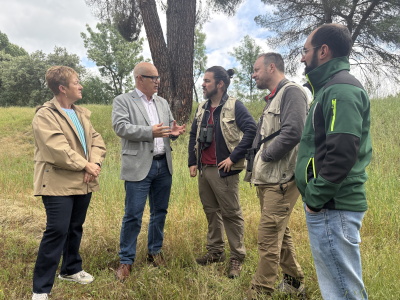
The subdelegate of the Government in Ourense, Eladio Santos, highlighted the scientific effort of the Superior Council of Scientific Research (CSIC) to care for ecosystems in the areas affected by the forest fires of 2025 in the province of Ourense. The subdelegate supervised today the fieldwork in Monterrei carried out by the Landscape Ecology group of the Biological Mission of Galicia (MBG-CSIC), accompanied by the researcher Adrián Regos and his team. There was also the deputy mayor, María Rosa González.
During the visit, Eladio Santos explained that the Ministry of Science, Innovation and Universities, through the CSIC, is committed to the "Galifire" project, which consists of the study of the immediate and long-term response of bird communities, important indicators of the health of ecosystems, in the areas devastated by last year's fires.
In this regard, the subdelegate stressed the commitment of the Government of Spain to the study of the environment "to protect the natural heritage and preserve the enormous environmental wealth of the province". "Ourense suffered last summer the worst wave of fires that we remember and every year coexists with a growing risk of fires the cause of climate change, so betting on science is also betting on safety and sustainability," he said.
STATE PLAN "RESFIRE"
"Galifire" is a citizen science project carried out by the MBG-CSIC until the end of June to analyze the impact of fires on bird communities. The researcher Adrián Regos specified that the study is based on the performance of bird censuses through listening stations. "It's interesting to be able to track in situ how birds respond over time and see if the same community recovers or the presence of species changes," he said.
This project is part of the State Plan “RESFIRE” that addresses the restoration of biodiversity in areas affected by forest fires. Specifically, in Galicia, the monitoring of bird communications is carried out in the Natural Park of the Baixa Limia-Serra do Xurés and in the Serra del Courel. "As a result of this work, the Galifire emerged due to the impact that the fires of brutal dimensions that occurred last year may have and we ask for collaboration to extend the observations to other burned areas such as this one of Monterrei," the researcher explained. Therefore, the group seeks social participation from groups linked to ornithology that can carry out sampling.
In particular, this week in the region of Verín, the Landscape Ecology group carries out a fieldwork that consists of the placement of bioacoustic devices that record the presence of birds and will subsequently be collected for the analysis of the data.