
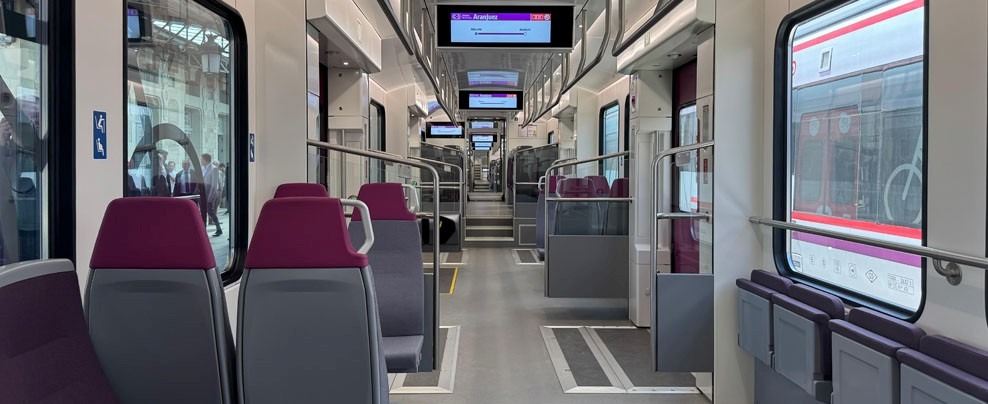
- Two units of the T100 and T200 trains manufactured by Stadler are already circulating on the C-7 line and will soon do so on other lines of the Madrid hub.
- Renfe’s investment in the acquisition of 79 trains to Stadler exceeds 1,306 million euros.
- The Fleet Renewal Plan envisages an investment of more than 3.5 billion euros for the acquisition of new rolling stock for Cerca and Rodalies.
- It also includes the reorganization of the fleet in Valencia, the Basque Country and Malaga.
The Ministry of Transport and Sustainable Mobility, through the public operator Renfe, has put into service the first new high-capacity trains in Cerca Madrid. After several months of testing, the first two units, manufactured by Stadler, —one T100, of 100 meters, and another T200, of 200 meters— have already begun to circulate with passengers on the C-7 line, thus initiating the progressive renewal of the fleet of the Madrid nucleus.
The incorporation of these units represents a qualitative leap for daily mobility in the Community of Madrid and for the Cerca de Madrid network, which operates an average of 730,000 travelers a day. The new trains increase capacity by up to 20% compared to the Civia fleet, which until the arrival of the Stadlers were the most modern trains in the Vicinity, and can carry up to 916 passengers in the T100 configuration and up to 1,883 in the T200.
Its entry into service takes place after the completion of approval tests, commercial simulations under different operating conditions and the training of driving personnel. During this first phase, the two units will serve on the C-7 to check their operational integration and facilitate the gradual adaptation of travelers and professionals.
More capacity and greater fluidity
The new trains combine single- and double-decker cars and feature a large number of doors and large lobbies, designed to speed up the ascent and descent of passengers and reduce stop times. The T100 units have four cars, while the T200 reach eight cars and become the largest single-composition trains in the Renfe fleet.
In addition, its design allows to adapt the length of the compositions to the evolution of the demand. This flexibility will make it easier to adapt the offer to the needs of the Cerca Madrid network.
Accessible, connected and sustainable trains
The new units incorporate walk-in level access in low-floor cars, spaces reserved for people with reduced mobility and multifunctional areas for bicycles, children’s strollers and luggage. They also have Wi-Fi installation, USB and 220 volt sockets, real-time traveler information systems and full coverage video surveillance.
LED lighting, efficient air conditioning systems, thermal insulation and electric braking with energy recovery contribute to reducing consumption and improving comfort. The trains, of Iberian width and fed at 3 kV, can reach a maximum speed of 140 km/h.
An investment of more than 1,306 million euros
Renfe has contracted to Stadler a total of 79 high-capacity trains for an investment of more than 1,306 million euros. The contract includes the supply of the units, spare parts and the maintenance of part of the fleet for 15 years.
After the first two trains are put into service, deliveries will continue progressively. During 2026, it is planned to incorporate nine T100 and eight T200 units, until completing the 79 trains contracted in the coming years.
The operation is part of Renfe’s Fleet Renewal Plan for Neighbourhoods and Rodalies, which includes an investment of approximately 3.5 billion euros in new rolling stock, which means the largest renewal of OSP (Public Service Obligations) trains. With this action, the company is undertaking a very profound transformation, with the largest investment in history, advancing in the modernization of the service, the improvement of capacity, accessibility, reliability and energy efficiency.
Renovation of Neighbourhoods Madrid
Proxies Madrid is an essential system for metropolitan mobility and the main showcase for this challenge. The network moves an average of 730,000 travelers a day and exceeds 200 million trips a year, connecting hundreds of thousands of people daily with their work, study, services and leisure centers.
In an environment with high demand and with obvious physical limitations in the infrastructure — such as the saturation of the urban tunnels of Recoletos and Sol — the only way to gain capacity is for each train to carry more passengers. The arrival of the new trains will gradually strengthen the offer, improve the travel experience and respond more efficiently to the mobility needs of the Madrid nucleus.