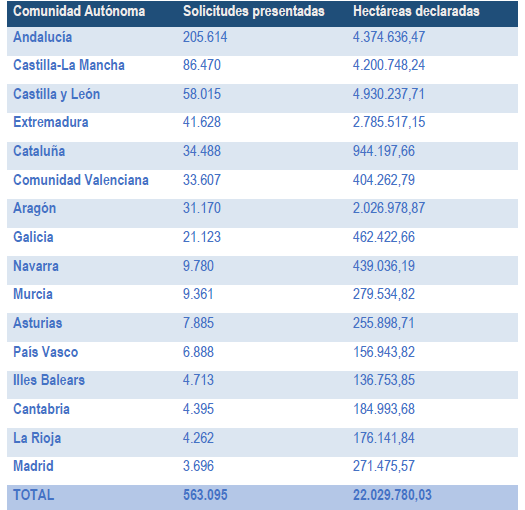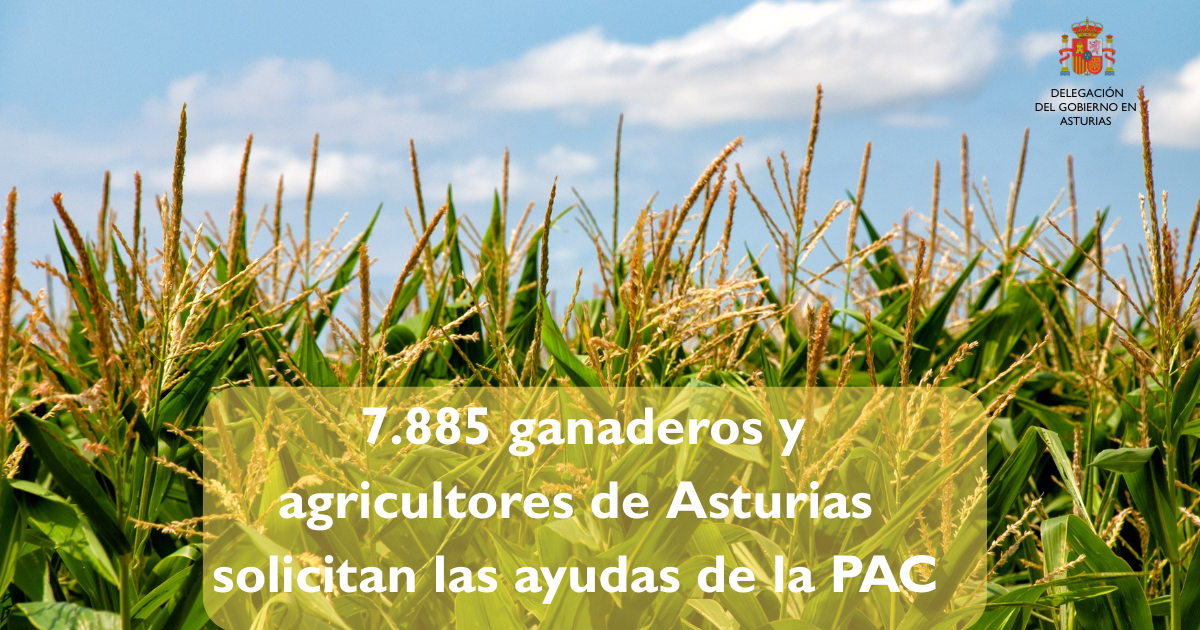
A total of 563,095 farmers and ranchers, 7885 of them in Asturias, have submitted the single application for Common Agricultural Policy (CAP) aid for the 2026 campaign, the fourth in which the Strategic Plan of the Common Agricultural Policy of Spain (PEPAC) 2023-2027 is applied. Eighty-two per cent of the applicants have applied for some sort of eco-regime, and it is confirmed, once again, that this practice is well received.
The declared area, with 22.03 million hectares, remains at a figure similar to that of 2025 when it added 22.07 million hectares. In Asturias the area declared corresponds to 255,898.71 hectares.
The total amount of direct aid for the 2026 marketing year is EUR 4,897 million. The Autonomous Communities will be able to initiate the payment of advances within the deadlines provided by the regulations, and almost all of the aid must be paid before 30 June 2027.
The number of applicants for aid, 3.3% less than the previous year, reflects the trend of recent years: a smaller number of farms, albeit larger, which reflects the maintenance of the economic and environmental activity of the sector, as well as its growing professionalism.
The single application is the procedure whereby applications for direct CAP aid and rural development interventions granted by area or head of livestock are consolidated.
The vast majority of applications include at least one direct aid provided for in PEPAC 2023-2027: basic income support for sustainability and its supplementary payments (redistributive and for young people), eco-schemes or associated aid.
Eco-systems and associated aids
The data from the 2026 campaign confirm the consolidation of eco-systems, the main novelty introduced by the CAP 2023-2027 to encourage voluntary agricultural practices beneficial to the environment.
According to information communicated by the autonomous communities to the Spanish Agrarian Guarantee Fund (FEGA), 82% of farmers who request basic income support for sustainability have also requested an eco-regime, one percentage point more than in the 2025 campaign.
In terms of area, eco-schemes cover 19.2 million hectares, equivalent to 88% of the area declared for basic income support for sustainability. This figure is very similar to that recorded in the previous campaign, although the Balearic Islands and Murcia present a decrease in the area covered by these interventions.
The widespread implementation of these practices contributes significantly to the fulfillment of the environmental and climate objectives of the CAP, by improving the structure and fertility of soils, increasing their carbon capture capacity and promoting the biodiversity of agricultural ecosystems.
The associated aid shows an increase in the area declared for protein crops and tomato for transformation. On the contrary, the area corresponding to sugar beet and, to a lesser extent, that of raisins, rice, nuts and cotton decreases significantly, while the declared surface of olive trees remains stable.
The published data are of a provisional nature. Detailed information on the single application and the advance of areas declared for the 2026 campaign, broken down by autonomous community and by intervention, can be consulted in the following link. Progress of single applications submitted and areas declared in the 2026 campaign | EAGGF Web Portal
Distribution of the unique applications of the CAP and of the area declared by autonomous community