
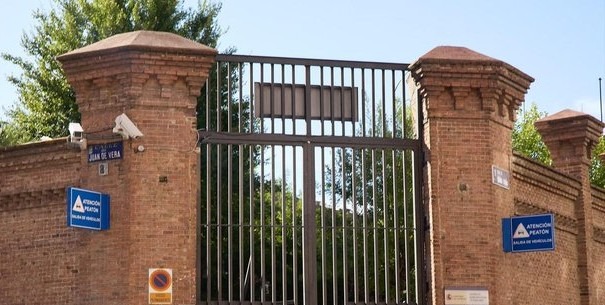
The demand for the former prison of Yeserías to be declared a Place of Democratic Memory has been promoted by memorialist associations and groups of former prisoners, who in recent years have promoted public acts of homage in this space to remember the women who suffered political deprivation of liberty during the dictatorship. The eventual declaration of this asset as a Place of Democratic Memory thus responds to the need to preserve a space associated with political repression, the violation of fundamental rights and the historical experience of hundreds of women who suffered imprisonment for their democratic commitment. The former inmates have insisted that the building should not become an anonymous space devoid of historical context, but a place capable of transmitting to future generations the reality of Franco’s repression and the struggle of those who defended freedom.
Place of detention of dictatorship fighters
The entry into Madrid of the rebellious army against the Republic triggered, since April 1939, a systematic repression of the new Franco regime characterized by torture, mass incarceration, summary trials without procedural guarantees and extrajudicial executions. The capital was in fact transformed into a huge political prison, with an estimated 90,000 prisoners for political reasons at the end of 1939, of whom more than 65,000 remained crowded in the main prisons of the city, such as Porlier, Ventas, San Antón or Yeserías, in addition to other penitentiary centers in nearby towns such as Alcalá de Henares or El Escorial.
The prison of Yeserías acquired a prominent role within the Franco repressive system. Initially conceived as a prison for men, it functioned from the end of the Spanish War and during the first years of the post-war period as a centre for the internment of political prisoners.
After its conversion into a women’s prison in 1974, the former Yeserías prison became one of Madrid’s women’s detention centres during the last years of the dictatorship and the first years of the Transition. Anti-Franco activists, trade union activists, students, members of clandestine political organizations and women persecuted for their opposition to the regime passed through its galleries. The prison became a space where the Franco repressive apparatus against women materialized, depriving them of their liberty for the exercise of political and trade union rights that today are part of fundamental democratic freedoms.
The women imprisoned in Yeserías suffered living conditions marked by overcrowding, lack of privacy, malnutrition and a particularly severe disciplinary regime, regardless of age or family circumstances. Former inmates have reported the existence of constant controls, censorship of correspondence, restrictions on communication with family members and frequent body searches.
The repression of women during the Franco regime responded not only to political motives, but also to a specific gender dimension. Many were arrested, tried or punished for their political or trade union militancy, but also for the mere fact of challenging social and family models imposed by the dictatorship. In the last years of the regime and during the Transition, the prison of Yeserías constituted a space where both forms of repression converged: the one directed against political dissidence and the one exercised on women who questioned the patriarchal order of Franco.
The testimonies preserved also show that the imprisoned women developed forms of solidarity and resistance to the conditions imposed. The political prisoners organized mutual support networks, cultural activities and training spaces, while publicly denouncing situations of abuse and violation of rights. Documented episodes include collective protests against vaginal and anal records considered humiliating by inmates, as well as allegations of poor prison conditions, facts that show how Yeserías was not only a place of imprisonment, but also a scene of resistance against the repressive structures of the state.