
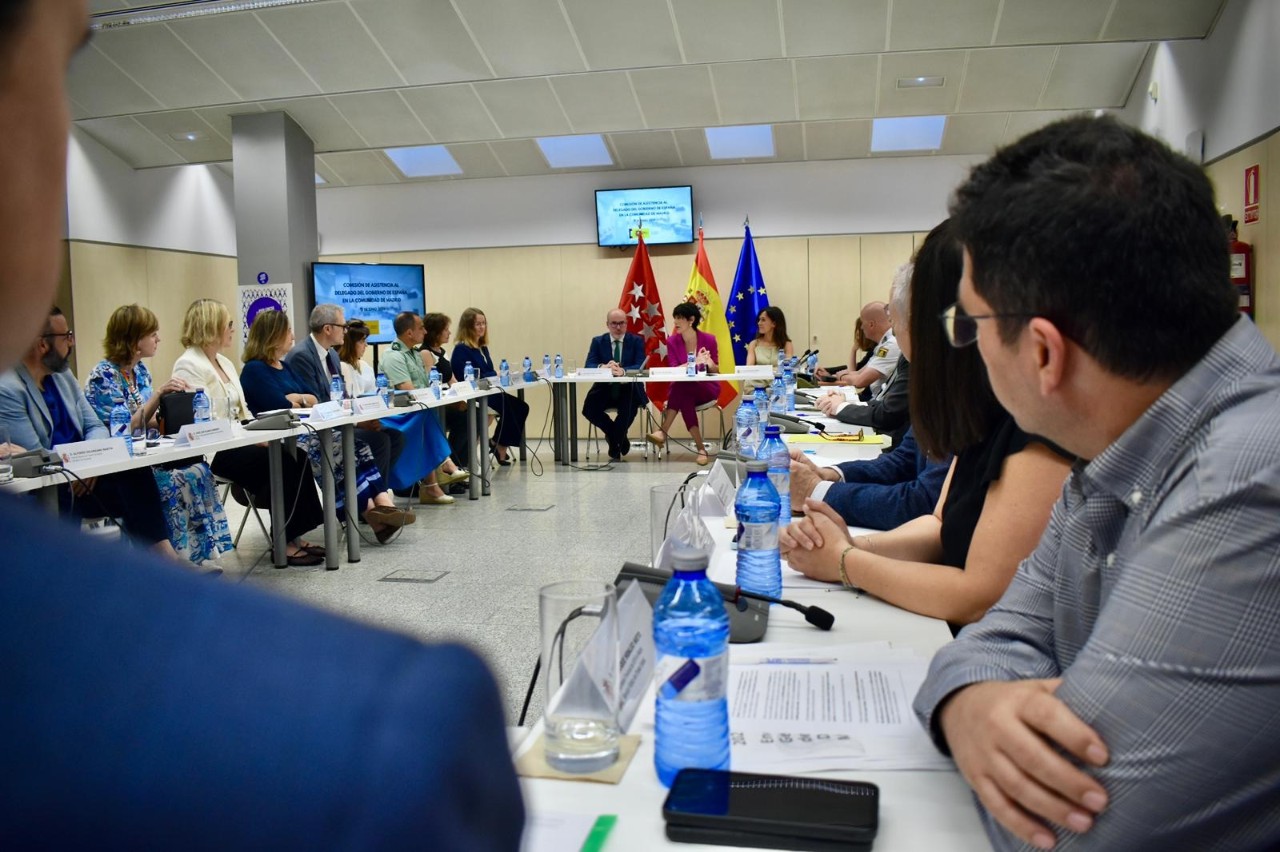
- Francisco Martín chaired the first Commission of Assistance to the Government Delegate of 2026, which was held at the headquarters of Silva Street of the Office of Foreigners.
- The Minister of Inclusion, Social Security and Migration, Elma Saiz, has made an initial intervention regarding the Extraordinary Regularization Process, which faces its final stretch and for which 900,000 applications have already been received.
- The Assistance Commission is a reference meeting that aims to share the progress of the services of the General Administration of the State and the coordination thereof.
The headquarters of Silva Street of the Aliens Office has been the chosen place for the celebration of the Commission of Assistance to the Government Delegate, the first of the year 2026. The location has been chosen to coincide with the final stretch of the Extraordinary Regularization Process, in the framework of which some 900,000 applications have been received, as provisional data before the end of the same.
This was the reason for the presence of the Minister of Inclusion, Social Security and Migration, Elma Saiz, who made an initial intervention in which she wanted to thank the officials of the Government Delegation who are giving “the best of themselves” to contribute to the “success” of the regularization process, as well as their “dedication and effort”. This recognition has been extended to the public employees of other agencies that collaborate in the efforts such as the Post Office, Social Security, Treasury or social entities.
With this, it is helping to “remove from the invisibility” to which thousands of migrants who already live, work and take their children to school in Spain were condemned, so that they regularize their situation “in rights and obligations”, and responds to a “much broader” migration policy of the Government that was demonstrated last year with the implementation of the new Regulation on Foreigners. Since its entry into force, 1.5 million cases have been resolved, 20% in the Community of Madrid (about 300,000), and 250,000 authorizations for foreigners have been granted, which is 40% more than the previous year.
These data are the result of “effective management and a committed Public Administration”, he added, a vision shared by the delegate of the Government of Spain in the Community of Madrid, Francisco Martín, who chaired the Commission accompanied by the subdelegate of the Government, Pilar Trinidad; the general secretary of the Delegation of the Government, Inés Represa; and the director of the Work and Immigration Area, Paloma Pérez Cortijo.
“It is the confirmation of the commitment of the Government of Spain to Madrid”, he stressed, at the same time that he has joined the congratulations to the staff of the Aliens Office, which has almost doubled its staff in the last year, which has allowed to give a better response to the demands of the foreign population.
In fact, the Madrid Office is the one that manages the largest volume of authorizations in the whole of Spain and, despite this, is managing to resolve in time the vast majority of procedures and responding to requests for information in just 2-3 days maximum.
Since April 19, it opened its doors, also in the afternoon, for face-to-face attention to the claimants of the regularization process and, in fact, the meeting of the Assistance Commission has been held precisely in this same space in which the migrants who come to present their applications are received.
Francisco Martín has welcomed the good progress of the procedure, which is being carried out “normally” and which will help migrants who already live in the region to participate “fully” and, in this way, continue to advance in “social justice and progress”.
Sharing, valuation and future
Together with the Extraordinary Regularization Process, which has been a prominent theme in this meeting, each of the representatives of the more than twenty agencies and services of the General Administration of the State with implementation in the Community of Madrid that have attended have presented the situation of the same, raised the most relevant issues of their work in recent months and pointed out the short- and medium-term challenges that they are presented with.
Special section also took stock of the Pope’s visit to Madrid, which, together with the State Security Forces and Corps, involved other services such as transport, and which has been reported in the corresponding interventions.
Francisco Martín has insisted that the shared objective of all those present is “to improve the quality of service to citizens of the Community of Madrid”, and has valued the commitment of public employees and employees of all agencies and services in the achievement of this objective.
The meeting was attended by: the regional chief of operations of the Superior Police Headquarters of Madrid, José Francisco González, and the head of the 1st Zone of the Civil Guard, General Francisco Almansa; heads of the Tax Agency (AEAT); Spanish Meteorological Agency (AEMET); General Secretariat of Penitentiary Institutions; RENFE; Provincial Labour and Social Security Inspectorate; General Directorate of Support for Victims of Terrorism; National Telecommunications Institute
Functions of the Commission
The Delegate Assistance Committee is a reference meeting that serves to share the progress of the AGE services and coordination thereof.
Law 40/2015 on the Legal Regime of the Public Sector provides that in the uniprovincial CCAA there is a Commission of Assistance to the delegate of the Government.
The functions of the Delegate Assistance Committee are: to coordinate the actions to be carried out at the level of the Community of Madrid, to standardize the development of public policies in the region through the establishment of common criteria and to advise the Government delegate in the elaboration of proposals for administrative simplification.
Statements by the delegate: https://we.tl/t-jRESEPXYjRHGwNGj
Resource images of the meeting: https://we.tl/t-Ej9NBg0mSsPydjAq