
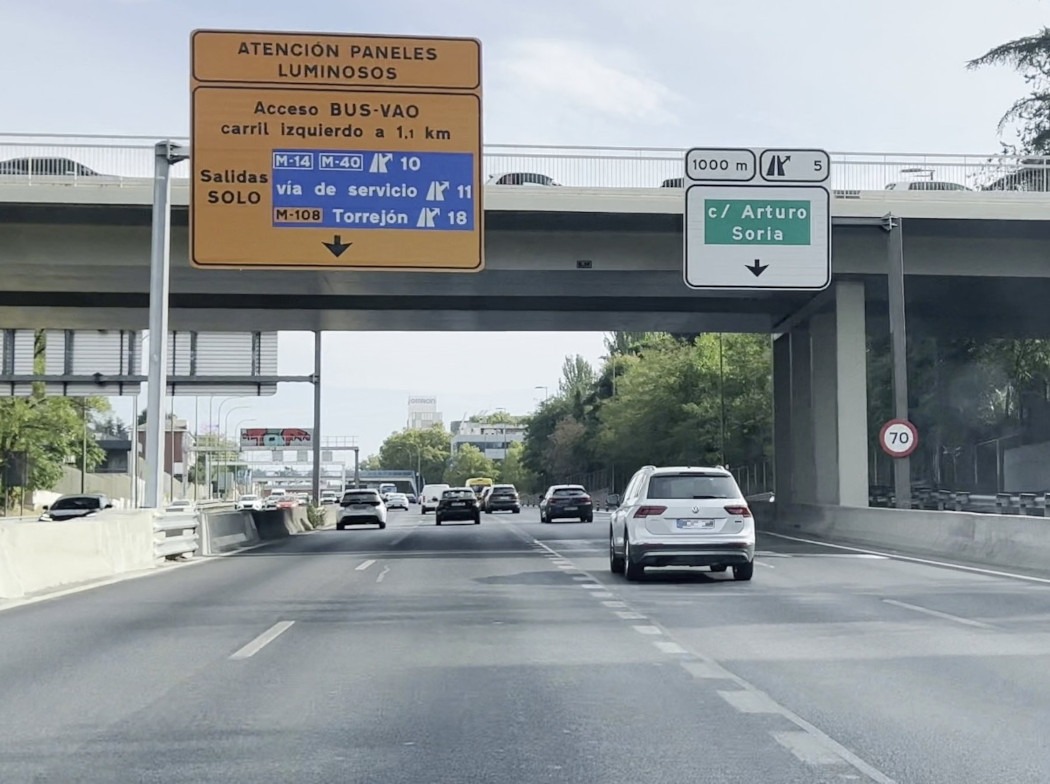
- It will be activated progressively during the month of August and the first week of September to check the operation of all installed systems and make it easier for drivers to familiarize themselves with the new signage and rules of use.
- It is not a lane with physical separation, but the left lane of each direction of the highway between Madrid and Alcalá de Henares has been technologically enabled so that, in peak hours, it is a Bus-VAO lane and, in the rest of the hours, it functions as a free circulation lane.
- The first week of August the Bus-VAO lane will remain operational between 7:00 and 9:00 hours in both directions. From the following week, and until the end of the testing phase, the lane will be activated between 7:00 and 9:00 hours in both directions and, in addition, between 15:00 and 17:00 hours in the direction of departure from Madrid.
- It may be used by buses, vehicles with two or more occupants (regardless of propulsion), motorcycles and authorised vehicles.
- The Regional Transport Consortium of the Community of Madrid will carry out a pilot test with intercity buses with express service to the interchange of Avenida de América that will begin to serve next Monday, August 3.
- The administrations call for the collaboration of all drivers so that, when the Bus-VAO lane is activated, even in the test phase, they respect variable signalling and specific rules of use at all times.
The General Directorate of Traffic (DGT), the General Directorate of Roads of the Ministry of Transport and Sustainable Mobility, the Regional Transport Consortium of Madrid and the City of Madrid will begin in August the testing phase of the new Bus-VAO lane of the A-2, once the works of implementation of this infrastructure have been completed.
This phase will make it possible to verify in real conditions the correct functioning of all the technological elements installed, as well as the operation and management of traffic, the response of the infrastructure, public transport and other users before its definitive implementation.
The project, fruit of the joint work of the three administrations since the signing of the collaboration agreement in 2019, is a new model of dynamic management of road capacity that will allow prioritizing public transport and high-occupancy vehicles in one of the main accesses to Madrid.
During the coming weeks, different operational tests will be carried out to verify the operation of all the elements that make up the new Bus-VAO lanes. These include the light beacons and variable message panels, which will indicate to the drivers when the lane is operational and the points enabled to access or leave it, as well as the control and monitoring systems that manage its operation,
The Directorate-General for Traffic will continuously monitor the behaviour of the systems and will analyse both the evolution of traffic and the degree of compliance with the rules by drivers. This phase will make it possible to validate the operation of the infrastructure in real conditions and make it easier for the users of the A-2 to become familiar with the new dynamic signalling and with the rules of use of the Bus-Vao lane, thus contributing to a safe and orderly implementation of this new traffic management system.
The first week of August the Bus-VAO lane will remain operational between 7:00 and 9:00 hours in both directions. From the following week, and until the end of the testing phase, the lane will be activated between 7:00 and 9:00 hours in both directions and, in addition, between 15:00 and 17:00 hours in the direction of departure from Madrid.
During these time slots in which the left lane acts as Bus-VAO, buses, vehicles with two or more occupants, motorcycles and authorized vehicles may use the lane. It is expressly recalled that electric vehicles will not be able to travel in the Bus-VAO lane if only the driver travels. Like other cars, they must meet the minimum occupancy requirement of two people when the lane is activated.
Outside of these periods, the lane will continue to function as a general circulation lane.
The three administrations call for the collaboration of all drivers so that, when the Bus-VAO lane is activated, they respect variable signalling and specific rules of use at all times.
Pilot test with the CRTM buses
In parallel and as part of this phase, the Regional Transport Consortium of Madrid will develop, from next Monday 3, a pilot test of the operation of public transport, with the aim of analyzing its effectiveness in real traffic conditions and evaluating the benefits for users of the A-2 corridor.
The objective is to improve travel times and make the offer more flexible so that the user can choose direct routes or with intermediate stops.
Ten interurban lines of the A-2 corridor will participate in this pilot phase: lines 223, 224, 224A, 226, 227, 229 and 261, coming from Alcalá de Henares, Torrejón de Ardoz and surrounding municipalities, as well as lines 281, 282 and 283, which connect Coslada, San Fernando de Henares and Amelia del Campo with Madrid.
The test will be carried out gradually and in coordination with the DGT, so that between 7:00 and 9:00 hours 107 expeditions will circulate to Madrid, of which 40 will be express services that will use the Bus-VAO lane, which represents approximately 37% of the available offer. In the direction of departure from Madrid, 83 expeditions have been scheduled, of which 32 will be express services. In addition, on Friday afternoons, between 15:00 and 17:00 hours, 75 expeditions will circulate, of which 30 will use the reserved lane.
The information obtained during the test period will make it possible to evaluate the operation of public transport, traffic behavior and interaction between all systems before the ordinary implementation of the Bus-VAO lane.
Operation of the lane
As has been said previously, this new Bus-VAO is not a lane with physical separation, but the left lane of each direction of the motorway between Madrid and Alcalá de Henares has been technologically enabled through dynamic management of the road capacity in real time so that, in peak hours, it is a Bus-VAO lane and, in the rest of the hours, it works as a free circulation lane.
In this first phase of exploitation, both in the trial period and when its operation is already ordinary, the operating section will reach only Torrejón de Ardoz, although the infrastructure is ready to implement it until Alcalá de Henares, already in a second phase.
As this is a dynamic management lane, the entry and exit can only be made at the specifically enabled points and when the signage indicates so. To do this, the system has:
· Light beacons installed on the road: green in the areas where it is allowed to access or leave the lane and amber in the sections where these maneuvers are not authorized. When the beacons remain off, the lane will function as a general circulation lane.
· Road markings, which delimit the areas of incorporation and exit.
· Variable message panels, located on the gangways of the motorway, which will report by pictograms when the Bus-VAO lane is operational and the conditions of its use.
In Madrid direction, the additions to the lane will be located at the height of Torrejón de Ardoz (pk 18+600), Rejas (pk 13+600) and Canillejas (pk 7+700), while the exit will be made solely on Avenida de América, with no possibility of leaving earlier.
In the direction of departure from Madrid, the accesses will be located at the height of Arturo Soria-Josefa Valcárcel (pk 5+850) and the Eisenhower node (pk 11+400), with departures in Canillejas (pk 9+100) and Rejas (pk 15+200), where the operational stretch ends.
The lane also has a surveillance system based on license plate reading and vehicle occupancy detection equipment, which will allow compliance with the conditions of use to be monitored.
In this link you can download materials explaining the operation of the lane:
https://drive.google.com/drive/folders/1nbGt02PsJR3a-e9ZT232lSMhyr7Q9nCn?usp=sharing