
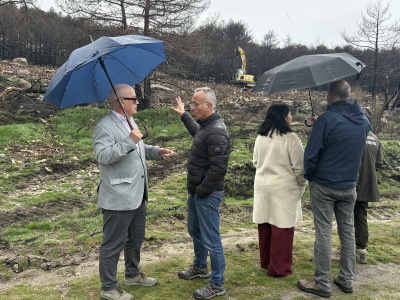
The subdelegate of the Government in Ourense, Eladio Santos, valued the response of the Government of Spain to give a new life to the Ourense mountains through the execution of forest restoration works in the areas affected by the fires of 2025, with an investment of 9 million euros. The subdelegate supervised in A Pobra de Trives the progress of emergency works for forest restoration funded by the Ministry for Ecological Transition and the Demographic Challenge (MITECO).
During the visit, the subdelegate explained that this is one of the 12 actions that the Government contracted in areas affected by the fire in the province of Ourense and that extend to 27 municipalities. “The objective of the works is the restoration of the forest surface to achieve an increase in biodiversity, the better protection of the soil and the advancement of the landscape environment, as well as the restoration of forest tracks to structure the environment,” he explained.
He was accompanied by the mayor of A Pobra de Trives, Patricia Domínguez, and staff of the General Directorate of Biodiversity, Forests and Desertification of the Ministry for Ecological Transition.
In this regard, Eladio Santos wanted to thank Minister Sara Aagesen for her sensitivity to the province of Ourense and her involvement in fire prevention and ecosystem recovery. “The commitment to restoration is the best measure for the prevention of fires. We cannot forget the tragedy we experienced last year because we have to prevent it from happening again and, for that, the involvement of all the Administrations is necessary,” he said.
Therefore, the subdelegate stressed the importance of institutional collaboration, since the Ministry of Rural Affairs located the points that it considered necessary to act and MITECO finances the work. “Help, action, work, cooperation and investment. This is how the Government of Spain responds to emergencies,” he said.
In addition, Eladio Santos stressed that the companies that are carrying out these emergency works are from the province of Ourense, which results in a boost to the local economy. “They are companies of the land, who know our mountains, and in this way, jobs are created in the affected areas,” he said.
Forest restoration work
Specifically, the actions consist of the elimination of burnt wood to facilitate possible natural regeneration and eliminate or reduce foci of pest infection, and the adaptation of anti-erosion infrastructures to prevent the dragging and loss of the soil, unprotected by the destruction of its protective vegetation cover as a result of the fire. On the other hand, forest tracks are also restored as an essential infrastructure for structuring the rural environment, improving access to the mountain for restoration, management and even prevention of future fires.
34.5 million
MITECO mobilized, through the General Directorate of Biodiversity, Forests and Desertification and the hydrographic confederations, 34.5 million euros to restore the areas affected by last summer’s forest fires in Spain. Of this imposition, 24 million were allocated to the forestry work of four autonomous communities following requests for support submitted by their respective governments, pursuant to article 50 bis of the Forestry Law.
Thus, the General Directorate of Biodiversity, Forests and Desertification allocated a total of 9,499,304.49 euros to Galicia, for 13 interventions, of which 12 are in the province of Ourense, with an exact investment of 8,826,672.23 euros. On the other hand, MITECO invested 10.5 million euros through the affected hydrographic confederations in crash plans to protect water resources in the burned areas.
With regard to the province of Ourense, the Mi⦅⦆ -Sil Hydrographic Confederation invested 3 million euros to prevent the pollution of rivers and reservoirs and the Douro Hydrographic Confederation allocated 5.1 million euros to its plan in the provinces of Ourense, León, Zamora, Palencia and Ávila.