
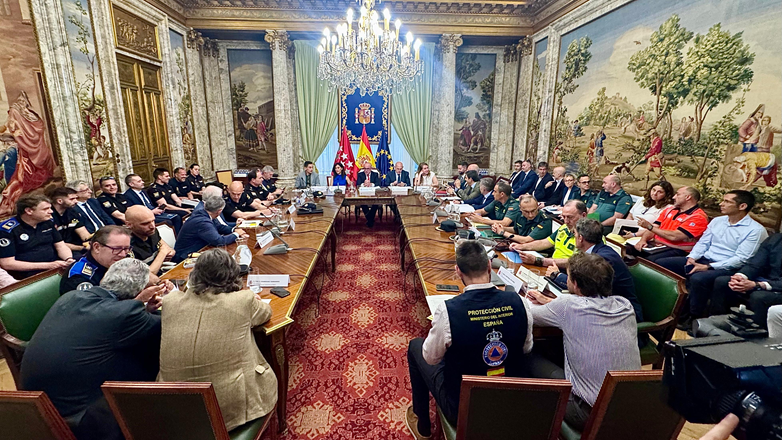
- The devices are prepared to respond to any situation of risk that may arise, derived from the very multitudinous nature of the event or the international terrorist threat.
Security during the 96 hours and 40 minutes that Pope Leo XIV will spend in the Community of Madrid, between June 6 and 9, within the itinerary of his visit to Spain, will be supervised by 10,300 agents of the National Police and the Civil Guard, in what will be the largest police deployment of the democratic stage.
This is how the Security Board discussed the visit of the Pontiff, presided over by the Government delegate, Francisco Martín, who was accompanied by the Government’s deputy delegate, Pilar Trinidad, and the heads of the Citizen Security, Javier López, and Civil Protection units, Fabián Bejarano.
“We are working hard and we are doing well,” said the government delegate, who said that this visit will be “another success for Spain” as an organizing country for major events, thanks to the fact that the collaboration between all institutions and public services with the Organizing Committee is being “close”.
The devices designed have taken into account the risks associated with an event of this nature, such as the threat of international terrorism or the action of radical groups, to be able to respond to them. Francisco Martín recalled that, at present, Spain is in the reinforced level 4 of anti-terrorist alert, which will be maintained during the visit of the Pontiff.
The meeting was attended by: heads of Casa Real; Presidency of the Government; of the Ministry of the Presidency, Justice and Relations with the Courts; of the Ministry of Foreign Affairs; of the National Police and Civil Guard; of the Military Emergency Unit and of the General Directorate of Civil Protection and Emergencies.
Also of the Organizing Committee of the Archdiocese of Madrid; responsible for security, emergency and mobility of the Community of Madrid and City Council; the General Directorate of Traffic, ENAIRE, Renfe, ADIF and Metro of Madrid.
The meeting began with a review of the planned agenda by the Organizing Committee.
Next, the representatives of the National Police and Civil Guard have explained their devices. The National Police (which will mobilize 9,700 troops) is working in several areas (intelligence and cybersecurity; public order and external security; protection, citizen security; accreditations, volunteers, transport and internal and external support), in whose design and execution is involved both the General Commissariat of Security and the Superior Police Headquarters of Madrid, which will mobilize its units and vehicles, helicopters, drones and contradrones system.
Coordination and Command Centre
The CECOR (Coordination Centre) will be installed at the headquarters of the National Police Headquarters in Madrid as appropriate, in the area of security management, by the Ministry of the Interior and the Secretary of State for Security. It will be represented by Casa Real, Presidency of the Government, Security Forces and Corps and emergency services who, from a unified and strategic command post, will be responsible for managing, supervising and coordinating operational security in real time during the visit.
The National Police also participates in the coordination, together with the Civil Guard and Municipal Police of Madrid (which will deploy some 4,000 agents), of the movements that the Pope makes in the Mobile Pope.
The need for those attending the events to have their accreditations/invitations and to know the area where their seat is located has also been stressed. In addition, the complaints units of police stations have been strengthened in anticipation of an increase in certain offences such as theft and robbery as a result of crowds.
The contribution of the Civil Guard (which will deploy 625 agents) focuses mainly on the strengthening of security in the State Pavilion of the Barajas airport as in the Royal Palace.
The Ministry of Defense will collaborate in the deployment of the air defense system, and the Military Emergency Unit has offered its special capabilities, such as the detection and decontamination RNBQ, if necessary.
Mobility
With regard to transport, Francisco Martín recalled that Renfe and Adif are going to increase the number of places available on trains to facilitate the arrival of pilgrims by public transport.
However, the security device will contemplate cuts and closures in some stations, both in Cerca and the Madrid Metro, and the diversion of bus lines, which are not yet known. For this reason, he has urged the Madrid City Council to clarify these issues as soon as possible in order to give citizens a transfer.
Coordination meetings
This Security Board completes the work done in the previous meetings that have been held to design the operational plans that are going to materialize in the different locations of the papal visit.
On the part of the Government Delegation, three previous meetings have been convened: the first, on 31 March; the second, on 27 April; and a third, on 14 May. In parallel, the Government Delegate has attended many others organized by the Presidency of the Government.