
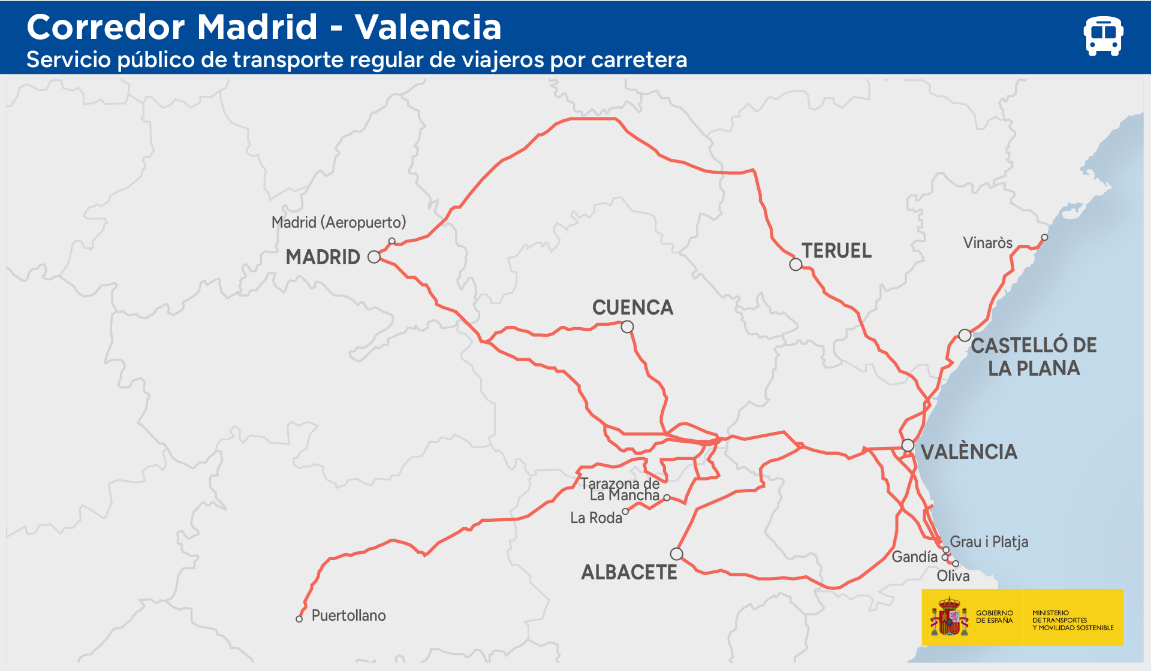
- It will connect 130 municipalities of Albacete, Castellón, Ciudad Real, Cuenca, Guadalajara, Madrid, Teruel and Valencia through 22 routes and 275 stops and potentially serving 6.2 million citizens.
- This is the third runner to be put out to tender, following the trail of the Bilbao–Castro Urdiales and the Madrid–Zaragoza–Catalunya.
- The new corridor maintains the structure of the previous one and adds new stops, new connections and an average price reduction of 12%.
- The preliminary drafts of the 31 corridors that are missing to complete the new concession map will be released to public information before the summer to be approved before the end of 2026.
- The Ministry continues to work to modernize the concession map, maintaining the essence of the current system and adapting it to the new mobility needs of citizens.
The Council of Ministers has today given the green light, on the proposal of the Ministry of Transport and Sustainable Mobility, to the project of establishing the public service of regular transport of passengers for general use by road between Madrid and Valencia. This is a new step in the definition of New Concessional Map of state bus routes, after the approval two weeks ago of Madrid-Malaga-Catalonia corridor and the one made in November for the Bilbao – Castro Urdiales.
This new corridor will potentially serve more than 6.2 million citizens of 130 municipalities in the provinces of Albacete (12 municipalities), Castellón (12 municipalities), Ciudad Real (4 municipalities), Cuenca (30 municipalities), Guadalajara (25 municipalities), Madrid (7 municipalities), Teruel (13 municipalities) and Valencia (27 municipalities). Specifically, it unifies the concessions VAC-051 (Madrid-Badajoz-Valencia con hijuelas), VAC-248 (Puertollano-Tomelloso-Cuenca -Albacete-Valencia) and VAC-255 (Madrid-Molina de Aragón-Teruel-Valencia) through 22 routes and 275 stops optimized by demand and accessibility criteria. In total, the routes add up to about 7,240 km.
The Ministry of Transport and Sustainable Mobility thus maintains the spirit of the reordering of the concessional map, preserving all current routes and stops with the aim of reducing tariffs, renewing fleets and improving services. In this way, it responds to the great demand for mobility between Madrid, Cuenca and Valencia, connecting capitals and municipalities of economic and tourist relevance such as Madrid, Valencia, Gandía, Castellón, Requena or Sagunto. It also includes routes between the cities and towns of Madrid and Guadalajara with Teruel and the latter with Valencia. In addition, the connection between Ciudad Real and Valencia and between the latter and Albacete is contemplated.
News
The new arrangement of the service will bring with it the following improvements:
- New stops in Sisante and Villanueva de la Jara (Cuenca), allowing the connection of these towns with the neighbors of the Valencian Community.
- New connections: Arganda del Rey-Valencia; Gandia-Tarancón; La Alcami-Valencia; La Alcami-Madrid; Madrid-Sagunto.
- Tariff improvement, with a reduction of 12% compared to the weighted average of the current tariffs of the services that currently make up the corridor.
The bus passenger mobility forecast for this new corridor has been estimated at 503,472 passengers by 2025 and 524,300 by 2034.
As will happen in all corridors of the new concession map, the concessionaire must have an Operation Assistance System (SAE) based on satellite geo-positioning systems and state-of-the-art data communications that allows the proper management of the operation and offers real-time information about the bus fleet.
The preliminary draft for the provision of the public service of regular passenger transport between Madrid and Valencia It has been subject to the public information procedure for 30 days since its publication on January 16, 2026. The next step of the Ministry will be to tender the new contract for the operation of the service, after obtaining the relevant reports.
31 runners to finalize the concessional map
The Ministry of Transport and Sustainable Mobility continues to make progress on the definitive definition of the new concessional map, which will be completed with 31 new corridors that were announced in November 2025 in the Official Journal of the European Union. Thus, the publication of the respective preliminary drafts is planned for the month of June, to begin the public information process and thus be able to definitively approve in December the new map, once the allegations have been received and analyzed.
Once the projects have been approved, the 31 corridors will be tendered throughout 2027 and 2028, thus complying with the provisions of the Sustainable Mobility Act.
Updating and reordering the concessional map
The current concession system serves nearly 2,000 municipalities throughout the country, being an extensive and vital network for inter-urban mobility. This system originated in the 40s of the last century, and over the decades it has proven to be an effective model to guarantee connectivity and accessibility through regular bus services, considered to be of public interest.
The Ministry of Transport and Sustainable Mobility, aware of the current challenges, has decided to move forward in the reordering of the current concessional map without losing the essence of the system that has worked.
This means that it is the Ministry that maintains all current stops and routes, guaranteeing the continuity of the services that users know and value, but allowing progress to be made in the renewal of state concessions, an issue that has also been marked as a priority within this scheme.
To this end, the necessary tender procedures will be launched that will respect the legal conditions in force and promote fair competition between concessionaire companies. This strategy will allow us to meet several objectives, such as the generalized reduction of tariffs, the empowerment of direct routes while maintaining current coverage, greater legal security for companies, improvement of sustainability through fleet renewal, and improvement of services through new channels of communication and ticket marketing and the implementation of intelligent transport systems that provide information to the user.
The Ministry will continue to work with the autonomous communities for the next advances that require their involvement, in the spirit of collaboration that it has maintained to date.