
- The initiative responds to the increase in complaints in the latest crime balances of the Ministry of the Interior.
- The plan is a territorialized roadmap to strengthen prevention, improve victim protection, optimize institutional coordination and move towards comprehensive, specialized care focused on women, girls and adolescents victims of sexual violence.
- The document is structured in 3 strategic axes, 6 objectives and 20 operational measures.
- It is part of a participatory work process with 53 meetings and meetings with social entities, administrations, State Security Forces and Bodies, professional associations, experts, political parties, trade unions and business organizations.
- The Government Delegation will promote a technical follow-up table with the participation of FCSE, competent institutions, legal operators, specialized resources and third sector entities.
- The delegate has announced that from today Tuesday, he will address the president of the Community of Madrid, the Federation of Municipalities of Madrid, the High Court of Justice and the High Prosecutor’s Office of Madrid to ask them to join the plan.
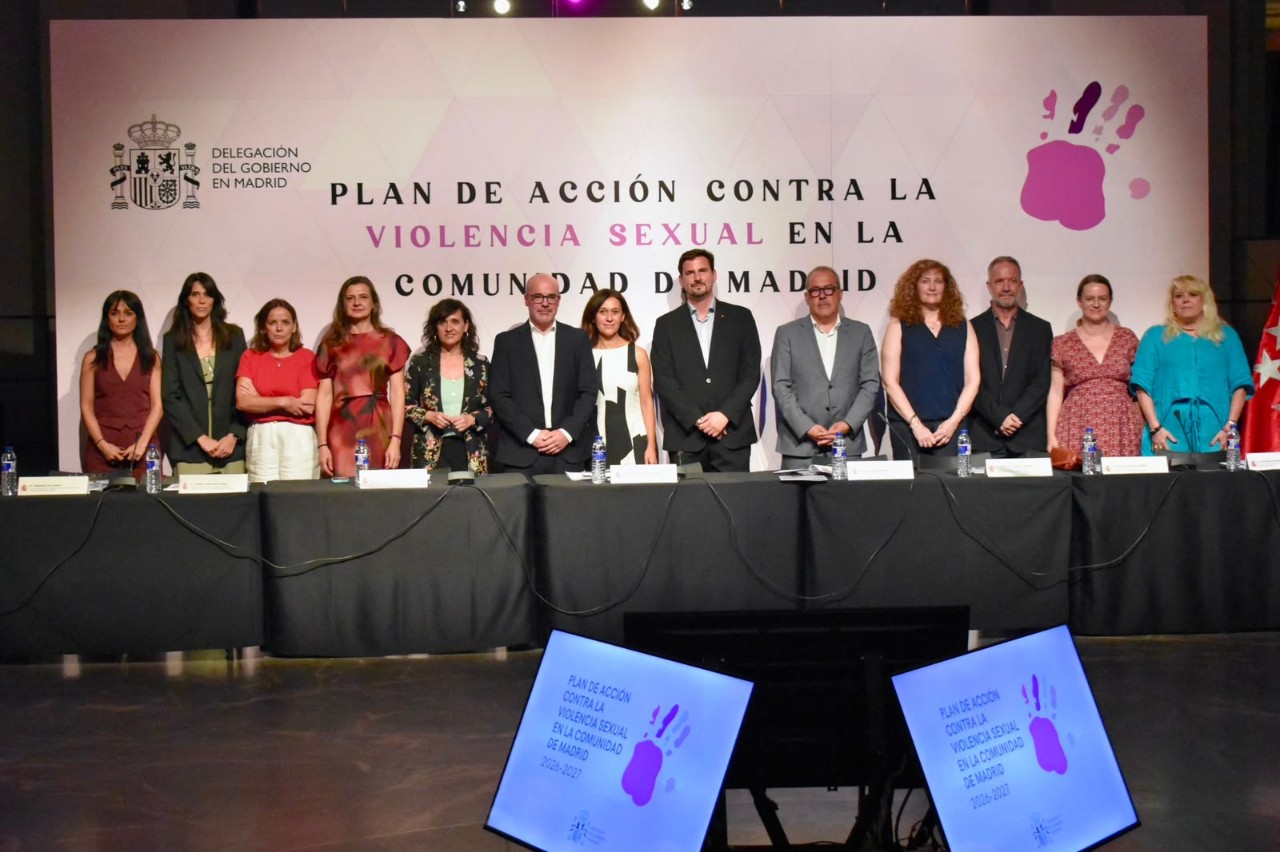
Given the increase in reports of sexual assault in the region that has been recorded in the latest crime reports of the Ministry of the Interior, yesterday afternoon, Monday, July 6, the Plan of Action against Sexual Violence 2026-2027 was presented in the Community of Madrid, an initiative promoted by the Government Delegation in Madrid to strengthen prevention, improve care and protection for victims and strengthen the coordination of the institutional response to this form of violence.
“Tomorrow marks a decade of the brutal and atrocious sexual assault committed by La Manada in Pamplona.” said delegate Francisco Martín, in the presentation of the Plan, “In 2017, the first year of which we have comparable data, 368 complaints of sexual assault with penetration were registered in the Community of Madrid. At the end of 2025, a total of 685 complaints of rape were registered in our region. In just 8 years, an increase in complaints of 86%, which undoubtedly reflects greater awareness and confidence of women in our institutions, but also persists a terrible number of facts that obliges all of us to be aware of the obligation that lies ahead and, therefore, to multiply our actions against machismo. And that is what the Government Delegation in Madrid presented today the Plan of Action against Sexual Violence in the Community of Madrid 2026-2027”.
The Plan is the result of a participatory work process with 53 meetings and meetings with social entities, administrations, State Security Forces and Bodies, professional associations, experts, political parties, trade unions and business organizations. This was evident at the end of the working session chaired yesterday by the Secretary of State for Equality, María Guijarro; and the delegate of the Government of Spain in the Community of Madrid, Francisco Martín Aguirre, in the Círculo de Bellas Artes, which was attended by around half a hundred participants in the elaboration of the plan, as well as new additions to the process.
Participating entities, institutions and profiles include State Security Forces and Bodies, National Office against Sexual Violence, Government Delegation against Gender Violence, Secretary of State for Equality, Secretary of State for Justice, Secretary of State for Security, Secretary of State for Territorial Policy, Superior Prosecutor’s Office of the Community of Madrid, Superior Court of Justice of Madrid, Ombudsman, Madrid City Council, feminist associations, children’s entities, victim care organizations, professional associations, trade unions, business organizations and experts in sexual violence.
“The Plan of Action against Sexual Violence in the Community of Madrid promoted by the Government Delegation, created from the participation of professionals, entities and institutions that have wanted to join in this cause, arises to try to promote and coordinate a clear, forceful and urgent social and institutional response to face the reality of sexual violence in Madrid and drastically reduce its impact from the combined intervention in the field of prevention, protection and care for victims. Only by combining objectives and efforts can we be effective in the face of a challenge as complex as the one we face,” said the delegate.
In his speech, Francisco Martín stressed that “Today we present an ambitious transversal plan, which challenges the whole of society and, of course, the institutions of Madrid. Therefore, in order to promote their direct participation, tomorrow I will first address the president of the Community of Madrid to ask her to take a step forward in the face of machismo. They did not want to participate in the previous phase, that is it; now it is essential that they add proposals, efforts, and contribute directly to the development and implementation of the plan against sexual violence. In spite of everything, our best disposition for it. I will also address the local level, starting with the Federation of Municipalities of Madrid, as well as the High Court of Justice and the Superior Prosecutor’s Office of Madrid. Only together, institutions, entities, professionals and citizens will we be able to build a response like the one that ending machismo in our region deserves.”
Regional singularities and the need for coordination
The Plan is formulated as a territorial adaptation of the First Strategic Plan for the Prevention of Sexual Violence 2023-2027 of the Ministry of the Interior. However, the Madrid adaptation does not mechanically reproduce the state plan, but translates it into the reality of the Community of Madrid: high absolute volume of known facts, specific weight of the city and metropolitan area, municipal diversity, presence of large events and nightlife, relevance of digital environments, needs for coordination with the Community of Madrid and the City of Madrid, and existence of specialized regional and municipal resources that require greater operational integration.
According to the indicators analyzed, the Crime Balance of 2025 showed an increase in complaints of crimes against sexual freedom in the Community of Madrid of 5.6% compared to 2024, going from 2,982 to 3,149 known facts. An increase that occurred in a context of a decrease in the total number of criminal offences in the region by 1.7%. In this annual evolution, reports of sexual assaults with penetration grew by 3% and the rest of crimes against sexual freedom by 6.3%. In the country as a whole, crimes against sexual freedom grew by 2.3% in 2025, so the increase in Madrid exceeded the state average.
A trend that also reflects the Report on crimes against sexual freedom in Spain referring to 2024, which placed Madrid as the second province with the highest absolute number of known facts, with 3,212 crimes against sexual freedom. The same report shows that 85% of the victims are women, 32.5% of them minors. Meanwhile, the profile of the aggressor is mostly male, since 95.4% of those arrested or investigated are men.
In addition, special attention should be paid to the digital environment, since in 2024 229 known cases of cybersexual crime were recorded in the region, with an increase of 12.3% compared to the previous year, especially affecting young women between 16 and 20 years of age.
3 strategic axes, 6 objectives and 20 operational measures
In response, the Plan focuses on 3 strategic axes, 6 objectives and 20 measures, all associated with baseline data and monitoring indicators to allow a semi-annual evaluation.
• Axis 1: Prevention. Prevention is primarily aimed at young people, educational centers, families, digital spaces, leisure, work environment and municipalities with less access to resources. Among other measures, it contemplates the obligatory affective and sexual training in schools; or the elaboration of a countermeasure against digital misogyny.
• Axis 2: Protection. Madrid recorded 2,668 facts clarified and around 2,080 people arrested or investigated in 2024. This volume requires stable coordination between FCSE, local police, judicial bodies, forensic medicine, health and social services, laboratories and specialized resources. Therefore, the Government Delegation will promote a technical follow-up table with the participation of FCSE, competent institutions, legal operators, specialized resources, third sector entities and, where possible, victim listening mechanisms.
• Axis 3: Attention. The documents and work indicators identify diffuiculties such as saturation, waiting lists and the need for integral itineraries. Among other measures, the Plan provides for the reinforcement of specialized resources to reduce waiting lists by guaranteeing free legal, psychological and social assistance from the outset. Special importance will also be given to proximity care for the rural environment, foreign victims and minors.
20 measures against sexual violence
AXIS 1. PREVENTION
M1. Madrid’s public campaigns of prevention and consent.
Design and deploy, in coordination with the Government of the Community of Madrid, the municipalities of Madrid and the social and business fabric of the region, sustained public campaigns on consent, sexual violence, harassment, digital sexual violence, dating apps, non-consensual dissemination of intimate content and rejection of the negationism of male violence, adapted to young people, families and the general population. These actions will incorporate the disability perspective in a transversal way.
M2. [Counter-narrative strategy against digital misogyny].
Promote audiovisual messages and formats for social networks, with direct and verifiable language, that contest discourses of normalization of sexual violence, misogyny, discrimination based on sex and the banalization of consent.
M3. Reinforcement of the Master Plan for Coexistence and Improvement of Security in Educational Centers and their Environments and of affective and sexual education.
Make mandatory the sessions of the Master Plan on Equality in all schools covered by this program and promote specific modules in schools on consent, healthy relationships, pornography, equality, cybersexual violence, grooming and early detection, with priority attention to secondary and vocational training within the said Master Plan.
M4. Formation of the educational community, families and professionals of the school environment.
To train teachers, management teams, canteen staff, guidance, families and municipal resources, recovering the spaces of equality as instruments of prevention and community accompaniment. These actions will incorporate the disability perspective in a transversal way.
M5. Programs of new masculinities and prevention with young men.
Generate work and reflection spaces with adolescents and young men on sexuality, power, consent, pornography, group pressure, co-responsibility and rejection of violence in all municipalities of the Community of Madrid.
M6. Prevention of sexual violence in the workplace, teleworking and nightlife areas, with special attention to women with disabilities.
Promote compliance by the Labor Inspectorate with protocols of sexual and gender-based harassment, with actions on digital harassment, internal channels of complaint and protection against retaliation. Promote collaboration with the nightlife sector for the design and implementation of preventive measures in premises and employee training. These actions will incorporate the disability perspective in a transversal way.
M7. Territorial map of risks and annual report of Madrid.
Prepare a risk map and an annual report on sexual violence in the Community of Madrid, with indicators by municipality/district and studies on hidden numbers, minors, disability, leisure, sport, tourism, workplace, rural environment and digital violence.
AXIS 2. PROTECTION
M8. Territorial technical table.
To form a technical panel with the participation of FCSE, competent institutions, legal operators, specialized resources, third sector entities and, where possible, victim listening mechanisms.
M9. Flow charts of action and derivation from any entrance door and safe spaces.
Creation of safe spaces in all health, social, educational, labor, municipal, police, judicial, public administration and third party entities and approval of clear and coordinated circuits for the cases detected, defining response times, responsible, data protection safeguards and their transfer to the FCSE.
M10. Police coordination and training on crimes against sexual freedom.
Promote, in coordination with the competent bodies of the State Security Forces and local police, training actions, exchange of good practices and improvement of police attention in matters of crimes against sexual freedom.
M11. Improved coordination in the preservation of evidence and forensic response.
Promote coordination spaces between State Security Forces and Bodies, forensic medicine, accredited laboratories, judicial bodies and health resources to promote a more homogeneous and effective action in the collection, custody, analysis and preservation of evidence in cases of sexual violence.
M12. Connecting the Plan of Action against Sexual Violence with the Onvios System.
To collaborate, when requested by the competent bodies, in the development of the Onvios System through the provision of territorial information that may be of interest to improve knowledge of the phenomenon and support the development of the analytical capabilities foreseen in the I Strategic Plan for the Prevention of Sexual Violence 2023-2027.
M13. Reaction protocols in risk spaces.
Promote the “violet points” and activate specific devices in nightlife, festivals, popular festivities, large events, campus, transport, tourist spaces and municipalities with a high concentration of young or visiting population, in coordination with the entrepreneurs of the sector, private security companies and local entities.
AXIS 3. ATTENTION
M14. Reinforcement of specialized resources and reduction of waiting lists.
Expand and strengthen resources for victims of sexual violence, especially minors, including CIASI, Barnahus, 24-hour crisis centers, municipal networks, psychological care and local and regional resources.
M15. Specific revision of the VISEM Protocol in Madrid.
Revision of the VISEM Protocol (Protocol of urgent and coordinated health care for women victims of sexual violence in the Community of Madrid) and its connection with state resources, guaranteeing access to data, effective participation of FCSE in its review and Government Delegation in the spaces of monitoring and periodic evaluation.
M16. Legal, psychological and social assistance from the first moment.
Ensure that all victims of sexual violence receive, from their first contact with any public service, clear information, immediate accompaniment and referral to the available resources of free and specialized legal assistance (in the terms already provided in the current regulations on free legal assistance), psychological care, social support and health care, without conditioning such attention to the filing of a complaint.
M17. Universal accessibility and specific supports.
Ensure physical, cognitive, communicative and personal accessibility in information, care, reception and transport, incorporating sign language interpreters, facilitators, mediators, easy reading and other supports for women with disabilities or specific needs.
M18. Proximity care for the rural environment, foreign victims and minors.
Develop proximity formulas in municipalities with less access to resources, clear information on rights, interpretation, safe referrals, collaboration with municipalities and safe telematic care when appropriate.
M19. Care evaluation system and agenda with specialized entities.
Implement a system of quality monitoring of care, with indicators of time, accessibility, satisfaction, results of intervention and periodic participation of associations, foundations and specialized organizations.
M20. Integral accompaniment, repair and prevention of revictimization.
Establish comprehensive support routes for victims of sexual violence, ensuring continuity in psychological, social, legal, health, educational and labor support, as well as coordination between administrations and specialized resources to avoid unnecessary repetition of the story and prevent any form of institutional revictimization.
Technical table, monitoring and evaluation
The implementation of the Plan will be carried out sequentially for three semesters, with continuous monitoring, partial evaluations and final evaluation. The 20 measures will be concretized through scheduled actions, evaluable and adapted to the corresponding territorial or sectoral scope.
The Government Delegation will promote a technical follow-up panel with the participation of State Security Forces and Bodies, competent institutions, legal operators, specialized resources, third sector entities and, where possible, victim listening mechanisms. The purpose of this panel will be to specify actions, evaluate their implementation, incorporate new proposals and adapt the Plan to the evolution of sexual violence in the Community of Madrid.
Implementation
A first phase of public and institutional presentation and pooling is planned between July and September 2026; a first semester of development between July and December 2026; a first partial evaluation in January 2027; a second semester of development between January and June 2027; a second partial evaluation in July 2027; a third semester of development between July and December 2027; and a final evaluation with presentation of results between January and March 2028.