
- The EU-funded project is an improvement in the quality of the school and university environment.
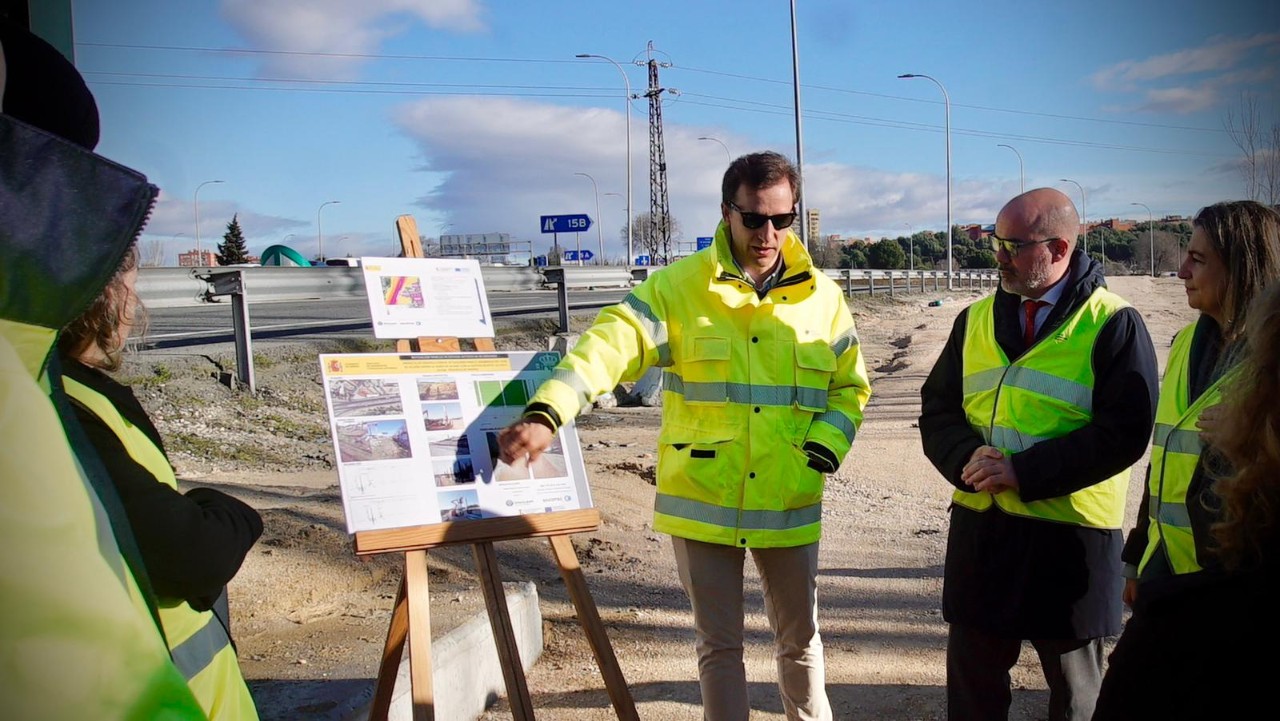
The students, teachers and other workers of the educational centers located in the stretch of the M-40 in the northwest of Madrid have seen reduced the impact of traffic noise in their daily lives thanks to the metallic acoustic screens installed in the area by the Ministry of Transport and Sustainable Mobility and which today has visited the delegate of the Government of Spain in the Community of Madrid, Francisco Martín.
In this way, it has highlighted how the Government of Spain, through European funds, promotes projects “clearly aimed at improving the quality of life, especially of those who need it most”, such as, in this case, the students and neighbors of that area of Vallecas, at the same time as responding to a “long-sought” request on their part.
In particular, the screens are located at km 16,450 on the left margin, south of the M-40, between the districts of Puente and Villa de Vallecas, in the city of Madrid, and represent an improvement in the quality of the environment of the Public College of Special Education (CEE) Vallecas; the Institute of Secondary Education Palomeras -Vallecas or the Polytechnic University of Madrid (UPM), Campus Sur.
The intervention, carried out by the Ministry of Transport and Sustainable Mobility, is included in the development of the Phase II Noise Action Plan on the M-40 motorway, and is included in the Recovery, Transformation and Resilience Plan (PRTR), financed with European funds.
In addition, they serve to comply with the current European regulations on the assessment and management of environmental noise, which establishes a series of objectives among which the creation of a common framework for the assessment and management of exposure to environmental noise stands out.
During the visit, the government delegate was accompanied by the Vice President of Infrastructure and Sustainability UPM, Maribel Mas López; the director of the IES Palomeras -Vallecas, Paula González Labrador; and the president of the FAPA Francisco Giner de los Ríos, Carmen Morillas Vallejo and the head of State Road Demarcation in Madrid, Gloria María Ramos Palop.
Details of the project
The action consisted of the installation of an anti-noise screen section intended for acoustic insulation on the M-40, specifically between the M-40 and the Polytechnic University of Madrid (UPM), Campus Sur.
The total length of the screen is 241.75 m, with a screen of 3.5 m height above the height of the height of the road of the aforementioned motorway. It is a metallic screen on a piled foundation whose trace runs parallel to the M-40 almost completely, except in a stretch where it separates from the road to enable a perpendicular crossing on a collector of the Canal de Isabel II.