
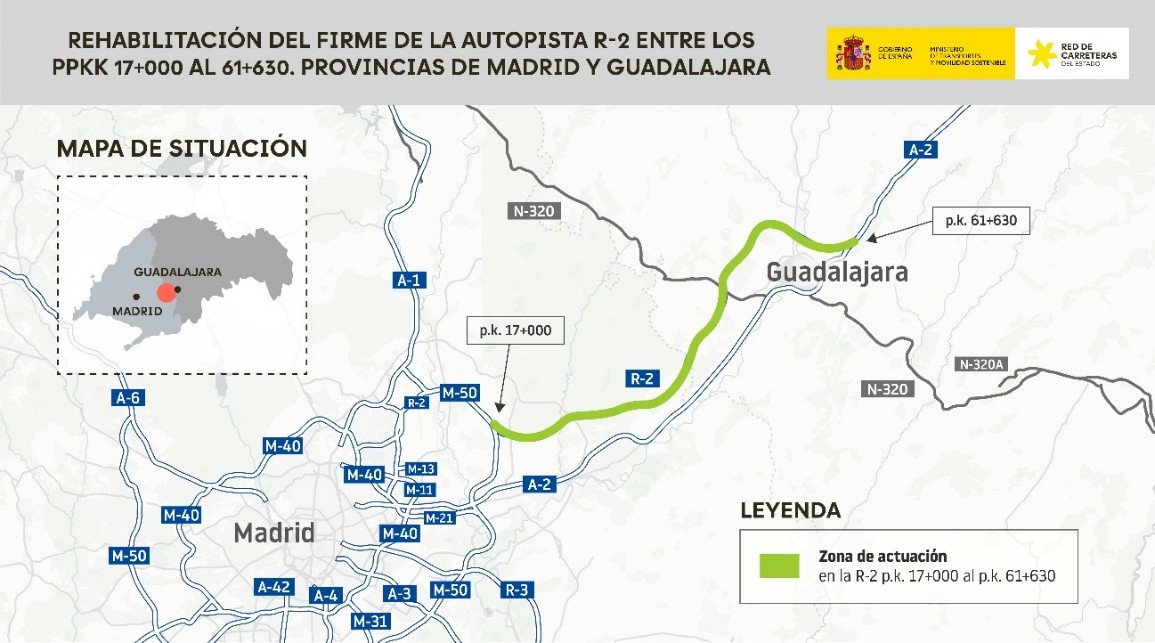
- The Council of Ministers has given the green light to this work that will be carried out between kilometers 17 and 62 of the highway.
- Road safety, the capacity of the firm will be improved and the public road heritage will be adequately preserved.
- The work is part of SEITT’s investment plan, which has 455 million euros to rehabilitate the motorways reverted to the State and some free sections such as the M-50.
The Council of Ministers has today authorized the Ministry of Transport and Sustainable Mobility to tender for an estimated value of 21 million euros (VAT not included) a contract for works to rehabilitate some 45 kilometers of the R-2 highway, between the airport of Torrejón (Madrid) and Taracena (Guadalajara).
The section of action, which crosses the Community of Madrid and the province of Guadalajara, starts at the semi-link of connection with the M-50 motorway, at the height of kilometer 17 of the R-2, and runs in a northeastern direction until it connects with the A-2, at the height of kilometer 61,630 of that road.
In this stretch of the R-2 are located five complete links, a semi-link, two trunk toll beaches, four side toll beaches, two service roads (one on each road) and 24 medium passes. All these existing elements are included in the work to be carried out along the line of action.
Description of the works
The works consist of the milling and replacement of the rolling layer with discontinuous bituminous mixture, in order to significantly increase the structural capacity of the firm to adapt it to the actions of the traffic and thus expanding its useful life period.
Additionally, the replacement of the horizontal signaling and the beaconing elements has been planned. There will also be the restoration of the coils of the six aphore stations existing in the section and of the expansion joints of some of the structures located in the scope of action.
Key action within the SEITT Investment Plan
This work is part of the investment plan of the State Society for Land Transport Infrastructure (SEITT), endowed with 455 million euros. The objective of this plan is to return to an optimal state of operation the motorways reverted to the State, such as the R-2, R-3, R-4, R-5, and others such as the AP-36, AP-41, AP-7 in Alicante and Cartagena, and the M-12, as well as the free sections managed by the entity, as is the case of the M-50.
The plan includes interventions in eight priority areas: firm rehabilitation, tunnels, structures, signage, Intelligent Transport Systems (ITS) and toll systems, noise reduction, lighting and capacity improvements. The rehabilitation of firmes represents 50.8% of the total budget, being therefore the main axis of this modernization program.