
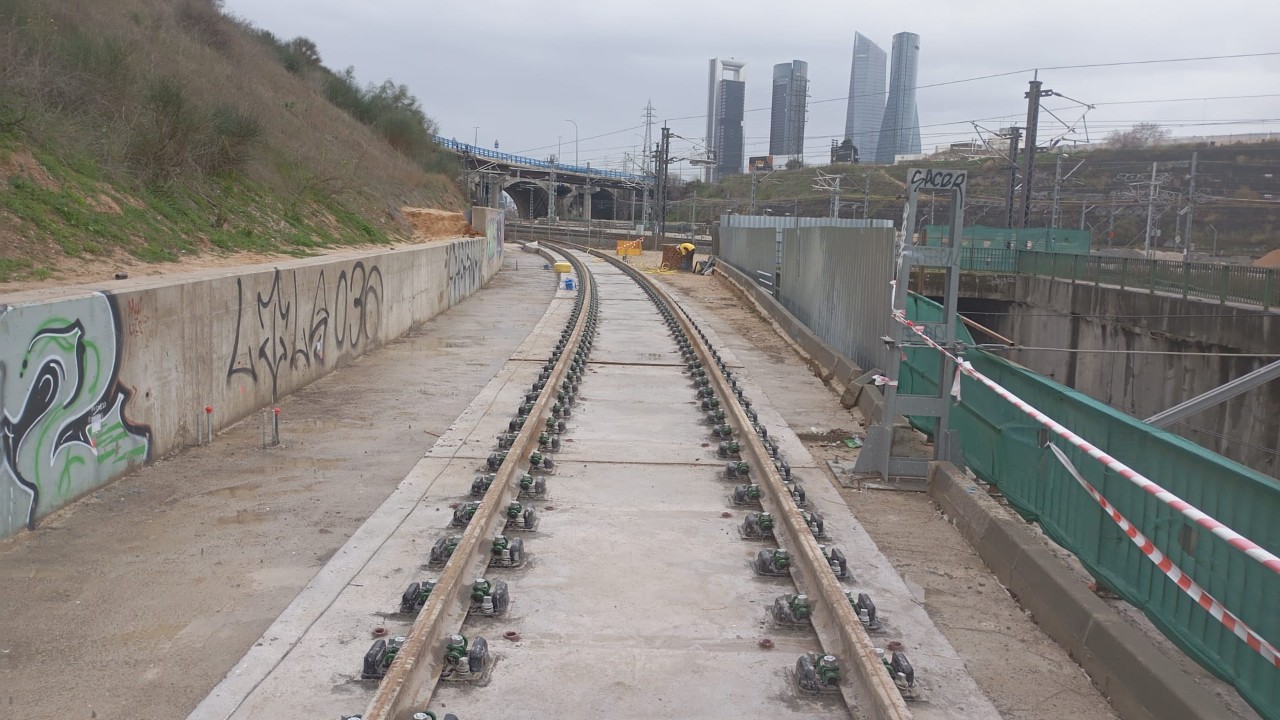
- The work is now focused on railway installations, signalling systems and electrification.
- The access consists of a new line of standard width from the station of Chamartín to the tunnel of access to the airport, where it connects with the service of Proxies.
- The high-speed connection to the Adolfo Suarez Madrid Barajas airport has an investment of 61 million euros.
The Ministry of Transport and Sustainable Mobility, through Adif AV, begins the final phase of the work of the new high-speed rail access that connects the Chamartín-Clara Campoamor station with Terminal 4 of the Adolfo Su⦅⦆ -Madrid Barajas airport, a strategic infrastructure that will strengthen intermodality and improve rail accessibility to the country’s main airport.
On the new layout, in standard width, the platform works have already been executed, which have included the construction of walls, a new lower pass in the Engineer Emilio Herrera street and the reinforcement of the Cerca tunnel in the surroundings of the A-1 through metal beams in a stretch of 130 meters.
In addition, the replacement of affected services and the extension of sub-ballast have been carried out. Also, the extension of ballast and the assembly of track and apparatuses in standard width have been carried out, leaving the final batting of the track pending.
In parallel, the electrification work progresses, with the assembly of catenary posts executed in about 60% of the new route, as well as the installation of gutters, arches and wiring lines linked to the control, command and signaling systems (CMS).
Advances in the technical station of Hortaleza
On the other hand, in the environment of the technical station of Hortaleza, actions of great complexity have been carried out to adapt the infrastructure to the future high-speed operation.
Thus, the shearing and reconfiguration of the standard width tracks has been executed with the aim of adapting the infrastructure to the new configuration. The actions have included the lifting of an exhaust and a track device, as well as the renovation of approximately 550 meters of track on board to implement a three-wire system that allows the circulation of trains of different widths in the same stretch.
The work has been completed with the installation of new crossings (needle-free crosses) and mixed-width devices, the installation of gangways and electrification lines according to the new track arrangement, and the updating of security and communication systems. A new step under tracks has also been executed for the train drivers in the technical station of Hortaleza.
All these actions have been carried out while keeping the Neighbourhoods service operational, which is a major technical and planning challenge.
Next performances
In the coming months, it is planned to carry out the levelling, profiling and welding work on about 2,100 meters of double track, the placement of the remaining catenary posts and the laying of the overhead contact line (LAC) in this section.
The software load in the high-speed interlock (the device that facilitates railway circulation by controlling the correct operation of all the elements installed on the tracks), the installation of safety and communications equipment in the section in standard width and the corresponding finishing works will also be addressed.
Next, Adif will undertake the installation of the new connecting needle with the high-speed network, along with the definitive software load in the High-Speed interlock, a key step for the commissioning of this new rail connection with the airport.
Strategic project for intermodality
The high-speed connection with the Adolfo Suarez–Madrid Barajas airport, promoted by Adif AV, with a mobilised investment of 61 million euros in civil works and signage, will strengthen the role of Madrid‑Chamartín Clara Campoamor as a multimodal railway node and will facilitate direct access by high-speed trains to the main airport of the country, making it compatible with the existing Neighbourhoods services.
This connection to the airport takes advantage of part of the platform already executed in the construction of the Cerca line between Chamartín and the T-4, in service since 2011 with a length of 8.8 km. Thus, from the northern head of Chamartín to the tunnel of the A-1, the new route is made in a single track of standard width, which becomes a double track once the A-1 is exceeded (from Hortaleza) and to the access tunnel to the airport, which already has a mixed track of 3 wires (suitable for conventional and high-speed trains).
Likewise, the track is adapted inside the northern tunnel of Barajas, adopting in its entirety a mixed-width format. In addition, the security and communication facilities are adapted to the new configuration.
On the other hand, it advances in a future pure high-speed connection between the Madrid Chamartín station and the Barajas airport by building a new high-speed platform. This project is currently under supervision and, once approved, the works can be tendered.
European funds
This project contributes to the fulfillment of several of the Sustainable Development Goals (SDGs) such as 9 (promotion of reliable, sustainable and quality infrastructures) and 11 (access to safe, accessible and sustainable transport systems).
The construction of the standard wide access to the T4 terminal of the Madrid-Barajas airport has European funding through the Recovery, Transformation and Resilience Plan. Funded by the European Union-NextGenerationEU.