
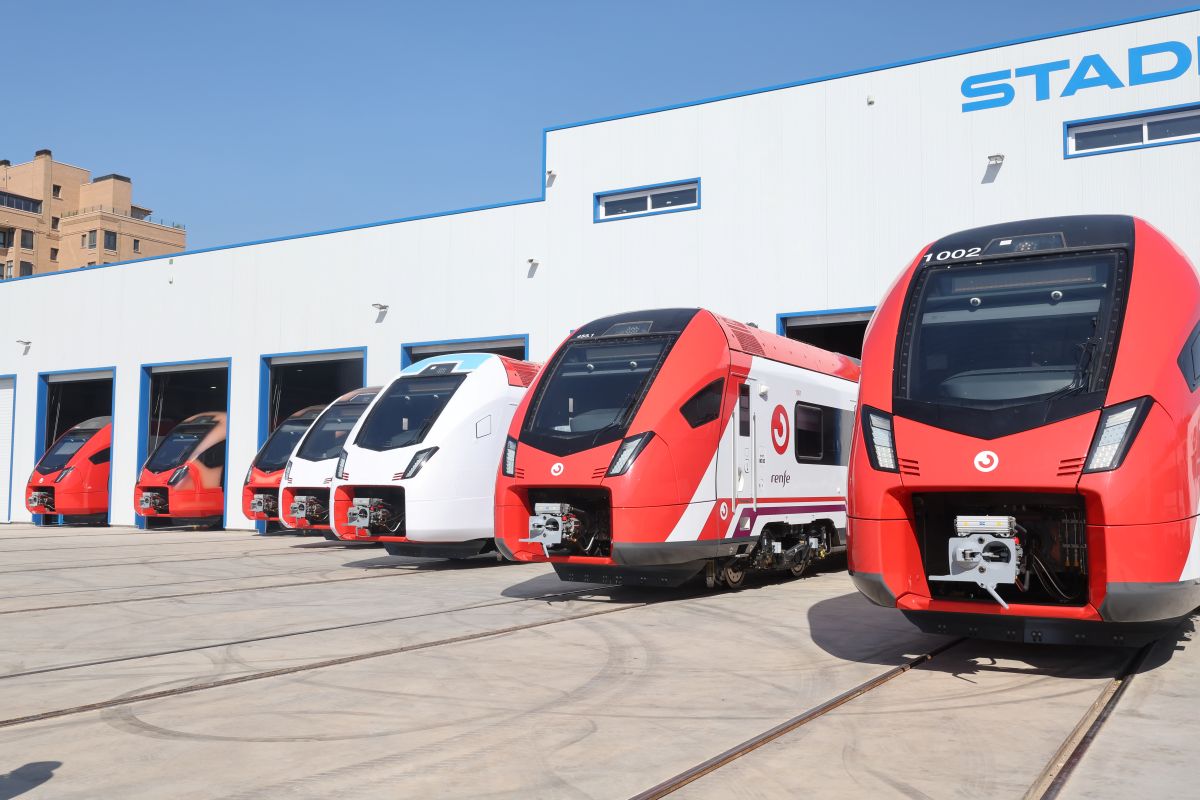
- These first five units will come into service at the end of the summer, after the corresponding first commercial simulations and the training of train drivers.
- Of the 79 Stadler T100 and T200 trains purchased by Renfe for the core of Madrid, 17 will gradually be incorporated into the fleet throughout 2026.
- This is the first renewal of the train fleet for local services in almost two decades, in which around 3.5 billion euros are being invested.
- The new trains will have lengths of about 100 and 200 m, increasing the capacity on the current fleet by 20% with up to 912 and 1,884 seats respectively.
The Minister of Transport and Sustainable Mobility, Óscar Puente, has today attended the Stadler Testing Centre in Albacete, where the latest tests are carried out before handing over to Renfe the first five units of the T100 and T200 trains. These trains will be incorporated into the Cerca de Madrid fleet and will enter into service at the end of summer, after the corresponding simulation tests and the training of train drivers.
These are the first units out of a total of 79 that Renfe has contracted with the manufacturer for 1,306 million euros, and which will be the largest in the company’s fleet: up to 912 seats in the case of the T100 and 1,884 in the T200 models, which means an extension of the capacity of Renfe trains of up to 20%. Once these first five units are received, trains will continue to be received each month to complete nine T100s and eight T200s throughout 2026. The delivery of trains will continue month by month until the 79 trains purchased are completed.
This operation is part of Renfe’s fleet renewal plan, which foresees an investment of approximately 3.5 billion euros for the acquisition of new rolling stock for the entire national territory. The incorporation of state-of-the-art trains and large capacity in the Renfe Commuter fleet “will have a direct impact on the quality of life of passengers and demonstrates our commitment to improving daily mobility” the minister congratulated during the visit.
The commissioning of these five trains (three T100 of 100 metres and two T200 of 200 metres) is planned for the end of summer, once the relevant homologation, commercial simulations and tests have been carried out under different operating conditions, as well as the training of train drivers.
The trains will start on all the lines of the core of Cerca Madrid except the C9. This service transports more than 730,000 travelers daily, 55% of public service trips in Spain.
Characteristics of the new trains
The Stadler units are large capacity trains, which combine one and two-storey cars and adapt to changes in occupancy, since they can be extended in both modes if necessary, thus adapting to the changing reality of demand.
Thus, the T100 allows its evolution to T120, of five cars, and will be mixed with 2 low-floor cars and two other two-floor power plants. For their part, the T200 will be adaptable to type T240, of 10 cars, or reduced to 160 meters. Specifically, the T200s are the largest in Renfe’s single-composition fleet, with four low-floor cars and four double-decker cars.
These trains will also represent a great advance in daily mobility, since they have the latest advances in accessibility and comfort, with access and space for people with reduced mobility, all the doors of single-storey cars at level, as well as areas for bicycles (multifunctional areas with capacity for up to six bicycles in T100 and 18 bicycles in T200) and children's carts. Also, the platform level entries of 6 of the 10 doors of the T100 (12 of 20 doors for T200) will not have steps, so the time of boarding and lowering of passengers will be reduced.
On the other hand, the trains have USB charging sockets and plugs in the seats, a modern passenger information system and a CCTV video surveillance system with full coverage. The lighting of the cars is LED, and they have an efficient heating and air conditioning system and thermal insulation that guarantee a comfortable environment while contributing to the sustainability of transport.
Finally, these trains have passenger information systems, are of Iberian width and can reach a maximum speed of 140 km/h.