
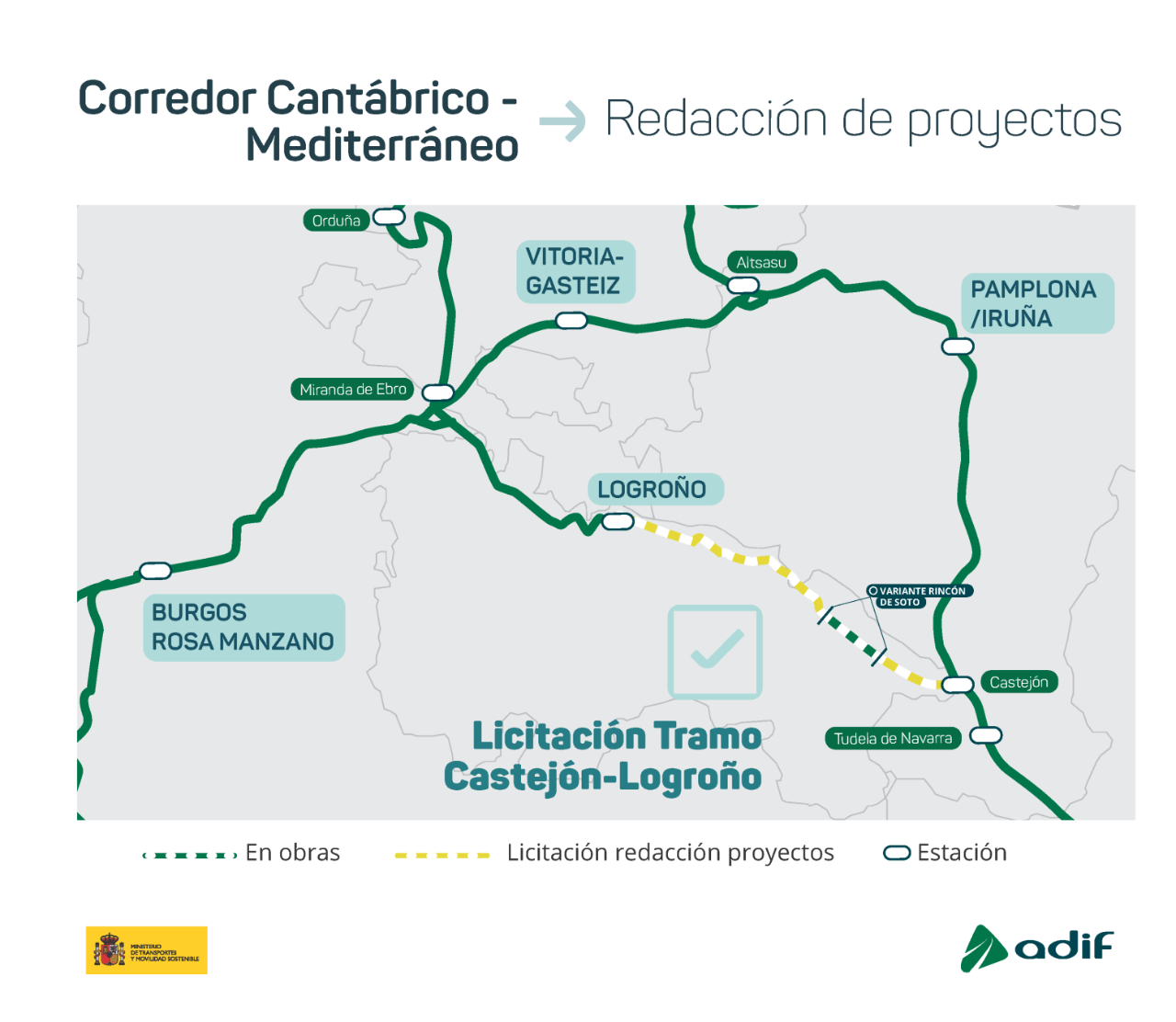
Adif has listed, for 18.2 million euros, the drafting of the projects of the Castejón-Logroño section of the Cantabrian-Mediterranean Corridor as it passes through La Rioja.
The projects will define all the necessary actions to adapt the current railway corridor, of 70.5 km and single electrified track in conventional width, to maximum speeds of 200-220 km/h (compared to the current 140 km/h), which will allow more competitive travel times.
The contract is divided into three lots that correspond to the subsections defined in the Informative Study approved in 2024: Rincon de Soto, Alcanadre (where a variant of the double track route has been planned) and Logroño.
The projects will include the complete renovation of the track (with multipurpose sleepers that will allow the width of the track to be changed to standard in the future), the treatment of trenches and embankments, the adaptation of drainage systems, actions in those bridges that require it and the elimination of the 13 steps at the level existing in the route. In addition, section tracks of 750 meters will be enabled at the stations of Calahors and Arrúbal, a measure that gives greater versatility to the infrastructure and is especially beneficial for the traffic of goods.
Key piece in the Cantabrian-Mediterranean Corridor
This action is part of the protocol signed by the Ministry of Transport, Adif and the Government of La Rioja in 2020 to improve rail connections with this autonomous community, both for passengers and goods.
In addition, it is a key element in the connection between the Atlantic Corridor and the Mediterranean Corridor of the Trans-European Transport Network (TEN-T), through a high-performance corridor for mixed traffic (passengers and goods).
The planned improvements on the Castejón-Logroño line are completed with the Rincon de Soto Variant (9.3 km), which already has the civil and railway work (platform, track and electrification) under way, with an investment of approximately 65 million euros. For its part, the deployment of signalling systems and equipment is in tender for 23.8 million euros.
European funding
The drafting of the basic projects and construction of the Castejón-Logroño section can be co-financed by the European Union’s Connecting Europe Facility (CEF).