
The Secretary of State for Transport and Sustainable Mobility, José Antonio Santano, showed today, in his visit to Extremadura, the commitment of the Government to the infrastructures in this Autonomous Community.
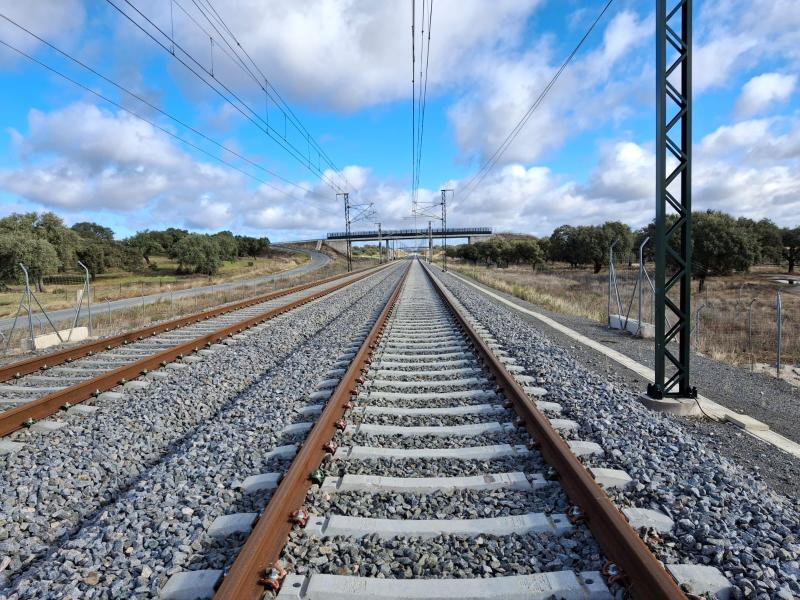
Santano has been able to see, in the route he has carried out in a test train from the station of Montijo to Cáceres, the functionality of the baipás of Mérida, whose implementation will bring greater flexibility to the line, with the possibility of direct services, as well as greater comfort for the traveler and an alternative route in the event of incidents.
Regarding the opening of the Merida bypass, Santano has stated that in mid-March the State Railway Safety Agency will have the relevant documentation to be able to carry out the appropriate verifications and subsequently issue the authorization of the entry into service of the aforementioned bypass. This is one of the main milestones in the high speed to Extremadura, as it will mean the completion of the Plasencia-Badajoz section of the Madrid-Extremadura High Speed line. In addition, its completion will mean an overall improvement in travel times, said the Secretary of State.
Regarding the station of Mérida, due to its strategic position, the Secretary of State has reported that it is a regional railway hub and the main link for the railway routes of Extremadura. This station will also have a new high-performance relationship with Madrid, adding 12 weekly circulations to existing services, which will increase the offer by 3,100 places, as well as adapting the afternoon and evening schedules to the needs of users. This new Alvia service will also stop at the Plasencia station, which will allow indoor high-speed connection between all the main cities in the region.
The Secretary of State has assured that the works of duplication of track between Mérida and Aljucén constitute an essential action to improve the access of the High Speed to Mérida, which allows the crossing of trains and exponentially increasing the capacity in the stretch, which will reduce the connection times between the new line and the Emeritus station.
Santano wanted to remember that yesterday the Council of Ministers authorized the tender for 18.21 million euros to renew the road in a stretch of 18 km of the conventional wide line Méida-Los Rosales (Seville), as it passed through the province of Badajoz.
Visit to Zafra
Santano, who visited yesterday the works of the variant of Zafra, said that the new variant of the N-432 road as it passes through Zafra will help to clear the traffic in the urban center that currently supports 13,000 vehicles a day of which 1,200 are heavy.
The new variant will mean an increase in road safety and a considerable environmental improvement by reducing noise and pollution, which will result in an improvement in the quality of life of the residents of the area and will capture long- and medium-distance traffic by shortening transit times with respect to the crossing.
The Secretary of State verified the quality of execution of the works that are progressing at a good pace with a degree of execution of 60% and a budget of 30 million euros and that generate a great consensus between the different actors involved, from the technicians to the citizens for the benefits they contribute to the municipality.
Technical characteristics
The variant will run through the municipal terms of Zafra, Los Santos de Maimona and Puebla de Sancho Pérez, and will have a length of more than 8 kilometers.
Three links have been projected:
- The link of North Zafra, which will connect the variant with the current N-432 to give access to Zafra from the north.
- The link to the EX-101 road, through which you will be able to access the town of Los Santos de Maimona and Zafra by the Northeast.
- The South Zafra link, which will connect the variant with the current N-432 south of Zafra.