
- The project is part of the Commuter Plan of Cantabria, which has a global injection of 1,599 million euros to increase the capacity of the network and increase the frequency of trains.
- With this action, the line will be duplicated and electrified, a metal bridge will be built for the second track and the accessibility of the stations will be improved.
- A service cut has been scheduled between November 3 and the beginning of March 2026, due to the incompatibility of the end of these works with the railway service.
The Ministry of Transport and Sustainable Mobility, through Adif, faces the last phase of the works for the doubling of the track and electrification of the Astillero-Orejo stretch, 6.8 km long, which is part of the Bilbao–Santander metric width line.
This is a project included in the Commuter Plan of Cantabria, which has involved an investment of close to 50 million euros and which includes both the construction and electrification of a new track that allows to duplicate the route, as well as the adaptation and improvement of the current track. All this makes it possible to increase the maximum speed of the line and the comfort of the passengers.
Duplication of the track
The duplication of track in the Astillero-Orejo section requires operations such as the construction of the platform and the assembly of the different elements of the superstructure (ballast, rail and sleepers) of the new track, to connect it later with the previous and subsequent section. The current route of the stretch is significantly modified at several points such as the exit of the station of La Cantábrica.
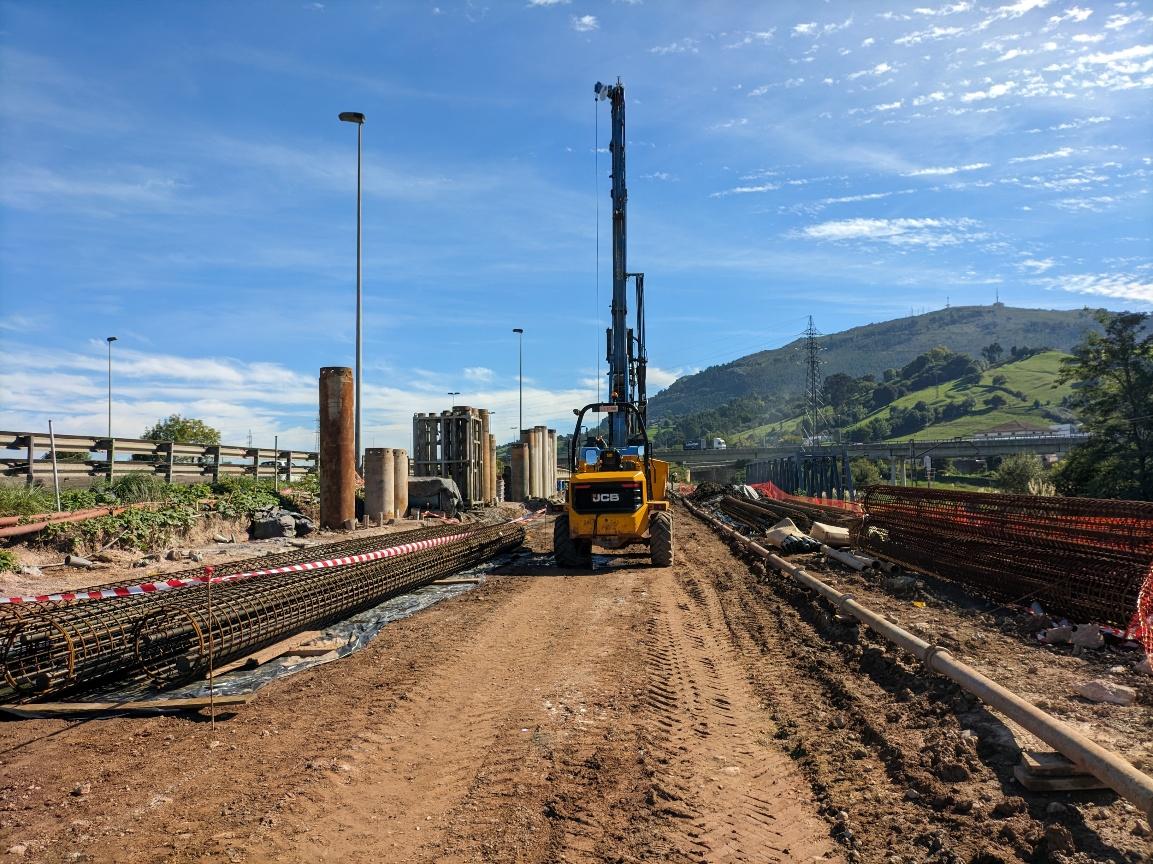
Also, to double the stretch that crosses over the Used estuary, it is necessary to maintain the current single-track bridge while executing a new 114 m long steel metal bridge for the assembly of the second track. This new bridge will be launched from the first stirrup in the direction of Orejo, and will consist of a metal lattice board with four vanes (two of them 35 meters long and another two 22 meters long) and three concrete stacks supported in the course of the Used estuary. The typology will be from track to plate.
With regard to the electrification of the section, the work focuses on the foundation of the posts and anchors of both the new track and the areas in which the current track layout is modified, and on the assembly of the compensation equipment and the bracket, suspension and bracing equipment that support the catenary. Likewise, the catenary is assembled and adjusted, consisting of the holder, the contact wires and the pins, as well as the installation of protection elements (ground cables, signs, etc.). and feed (disconnectors, section isolators).
Upper and lower steps
The work of the duplication project also includes the implementation of two new upper steps to replace the current ones, which are located at kilometre points 544,500 and 547,100. In addition, various performances will be undertaken in lower steps of the stretch.
In particular, it is planned to extend the lower passes of the kilometres 542,408 and 544,111, which will serve as drainage works for the Vitoña Stream. Likewise, the lower passage of km 545 will be extended to accommodate the new road, and that of km 546,075 to give way to the Cubón stream. The steps below the height of the 546,100 and 546,500 kilometers will be demolished to make a new one.
Other performances
Adif also carries out important accessibility improvement works in various stations of the stretch. The station of La Cantábrica, located in the municipality of Astillero, will have new platforms on both sides of the tracks and a new access gateway. For its part, the station of San Salvador will have a new access gateway, while in the station of Heras the lower passage between platforms is improved.
In addition, the project includes the erection of four retaining walls of the land, as well as several transversal and longitudinal drainage works.
On the other hand, track duplication involves the installation of new signalling systems on the route: interlocks (devices that manage signalling and detours and establish safe itineraries for the circulations), train detection and protection system and fixed and luminous signalling. All this will be integrated into the Centralized Traffic Control (CTC) system, which allows to manage the lines remotely.
All these measures will make it possible to increase the reliability of the infrastructure, considerably increase the versatility and capacity of the railway network and increase the frequency of traffic flows.
Temporary cut of the line
The last phase of the works is incompatible with the railway service and will require the total cut of the Astillero-Orejo section temporarily to be able to finish the works and terminate the proceedings. In this regard, a service cut has been scheduled between November 3 and the beginning of March 2026.
The works of duplication and electrification of the Astillero-Orejo section are part of Adif’s commitment to renew and preserve the conventional network and constitute a new impulse to the development of the Proximity Plan of the region, which has a global injection of 1,599 million euros and which has already mobilized around 94% of the global investment budget.
All these actions contribute to the achievement of Sustainable Development Goal (SDG) 9, which promotes reliable, sustainable and quality infrastructures.
European funding
This action will be financed by the European NextGenerationEU funds of the Recovery, Transformation and Resilience Plan.