
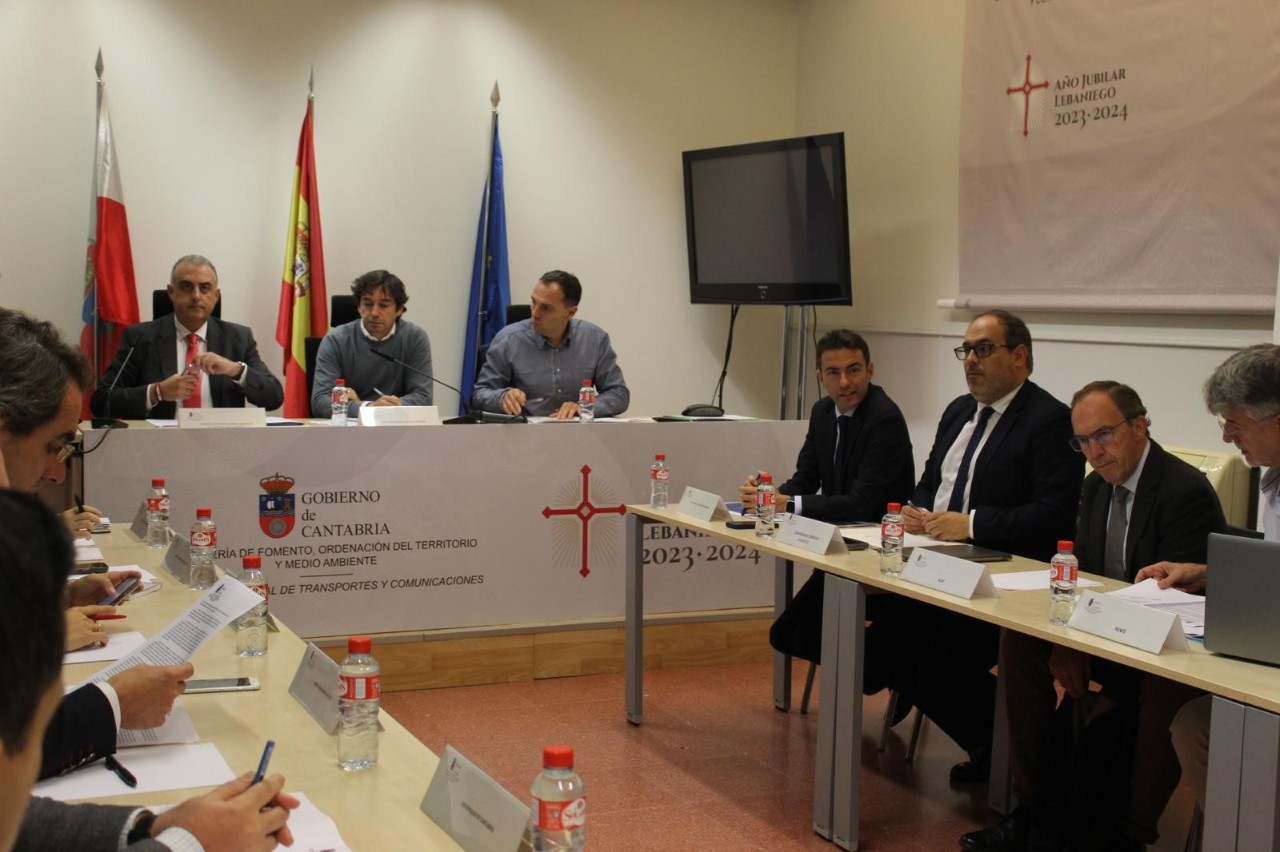
• The government delegate in Cantabria has participated in the Railway Table together with the commissioners of the Proximity Plan and the Atlantic Corridor, as well as representatives of Renfe
The government delegate in Cantabria, Pedro Casares, has claimed “the before and after” of the railway in the autonomous community with the government presided over by Pedro Sánchez, with which all the projects claimed “historically” by the region are becoming “a reality”.
Casares said so this Tuesday after the meeting of the Railway Table convened by the regional government and in which he participated together with the commissioners of the Proximity Plan in Cantabria, Antonio Berríos, and the Atlantic Corridor, José Antonio Sebastián, and representatives of Renfe.
The representative of the State defended in this regional forum, in which political parties, trade unions and user associations also participate, that today there is talk of projects such as the integral improvement of the vicinity, railway rearrangements, the arrival of the high speed or the Santander-Bilbao train is “because there is a Government of Spain committed to the railway in Cantabria”.
On the Proximity Plan, he explained that the Government has tripled the investment of this planning of actions to 1,600 million euros, of which 700 million are already executed or in execution and, in addition, 94% of the Plan is mobilized with the processing of the different projects.
In that plan, Casares recalled that the 165 million investment is included for the renewal of the entire fleet of commuter trains in Cantabria (21 units) and that it has trusted that the first units will be in 2026 as contemplated by the Government’s contract with the manufacturer company.
At this point, he insisted that “the commitment of the Government of Spain is that until those trains arrive, the free transport of local rail transport will be maintained”.
“Everything is under way and that will translate into an improvement in the service, the travel experience, a reduction in times, greater safety, greater reliability and an increase in the demand for rail transport,” said the government delegate.
HIGH SPEED, INTEGRATIONS AND SANTANDER-BILBAO TRAIN
On the other hand, Casares has highlighted the steps taken by this Government for the arrival of high speed to Reinosa, the most recent with the signing of the protocol that contemplates local railway reorganization both in the Campurrian capital and in Campoo de Enmedio.
In addition, the delegate has pointed out that the government has everything “in place”. “All the sections for the arrival of the high speed that pass through the province of Palencia, with 800 million euros of investment, are in execution and we are also working on the rest of the sections until the arrival to Reinosa with the drafting of the projects and the environmental impact,” he added.
He then highlighted that, thanks to this Government, “there is no going back” in the railway rearrangements and integrations of Santander, Torrelavega and Camargo and pointed out the tender for the first performances in the Cantabrian capital. This same Tuesday it was published in the Official State Gazette (BOE) for more than 41 million euros (VAT included).
“The Council of Ministers has also already authorized the tender of the project for the coverage of the roads in Camargo and today we continue to give an account of the actions in Torrelavega, which is the investment that goes faster because we did not lose the last legislature as happened in Santander,” he added.
He also referred to the project of the Santander-Bilbao train which is “a firm commitment of the Government”. “If today we are discussing whether it is done in tranches or when it arrives, it is because there is a government that wants to do it,” said Casares.
The delegate of the Government has evidenced the “magnitude” of both the actions and the investment of this project, whose study will be sent to the regional executive this week.
Finally, Casares has also claimed that the Government of Spain has introduced Cantabria into the Atlantic Corridor “after other governments left us out”.