
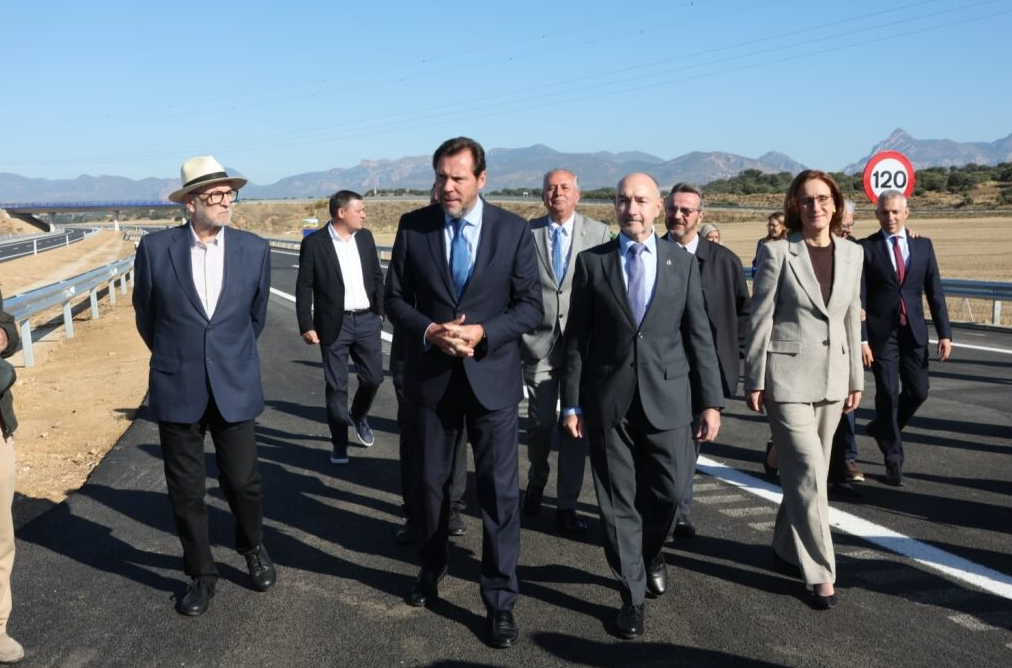
Huesca.- The Minister of Transport and Sustainable Mobility, Óscar Puente, has today presided over the implementation of the section of the A-22 that connects Siétamo and Huesca and that has had an investment of almost 69 million euros (VAT included). With these 12.7 kilometers, the connection between Huesca and Lleida by motorway is completed.
Óscar Puente has highlighted that having the complete A-22 makes this motorway “the great alternative to the Ebro valley; Navarre, the Basque Country, Aragon and Catalonia are connected by a modern, safe and efficient infrastructure”.
In addition, the minister has announced that the tender for the works of the Variant of Jaca will be published on the contracting platform before the end of the year. The minister also said that the A-21 is moving towards completion with the drafting of the project of the Puente La Reina – Fagus section, which will be formalized soon.
During his visit, the head of Transport highlighted that “between June 2018 and August 2025, the Government of Spain has invested 1,830 million euros in the road network of Aragon, of which 53% of the investment has been in conservation and maintenance”. Within the investments of the Ministry, Aragón is the autonomous community “leader in total investment in roads in relation to GDP and per inhabitant”.
He also stressed that “Aragon is the leading region in total investment in roads, only surpassed by Castilla y León, which is also the one with the most km per inhabitants”.
Section Siétamo-Huesca
This last stretch of the A-22 put into service today has a double carriageway, two lanes per direction, 2.5 meters of arches; 16 structures, including the viaducts on the Bottle and Flumen rivers, and four links: Siétamo, Loporzano, Montearagón and the connection with the A-23.
“Every metre of this motorway has required precise technical decisions and coordination that did not allow improvisation, so it is important to highlight the complexity of the execution and to do pedagogy,” explained Minister Puente.
After an investment of almost 69 million euros, this infrastructure is another step in the construction of a large backbone between Pamplona, Jaca, Huesca and Lleida that includes the A-21 and A-23 motorways, on which this Ministry continues to work, and which will constitute an alternative axis to the Ebro corridor for long-distance traffic.
Among the technical difficulties that it has been necessary to face in order to carry out this action are the minimization of the affectations to the traffic in the vicinity of a city such as Huesca, the numerous affected services that occur in peri-urban environments, or the affectation to the Roman archaeological site of Ayareces, which has affected 3,000 m² of surface of the motorway and has been carefully excavated.
In this sense, Óscar Puente has stressed that “a well-designed motorway is not only safer and faster, but is more sustainable than a conventional road saturated with dangerous stops and overtaking”.
In the case of the A-22, the minister said that it is “a bet to avoid depopulation, to facilitate companies in the agri-food sector to move their products, to bring tourism closer and to connect the Pyrenees with European markets.”
Technical characteristics of the performance
The route crosses the municipal terms of Siétamo, Loporzano, Quicena and Huesca. In the first 8 km a new route is built, maintaining the old conventional N-240 road as a service road; while for the rest of the route an unfolding has been carried out on the north side of the N-240 along the Northern Round of Huesca, until the connection with the A-23 motorway, for which it has been necessary to adapt the peralte and the firm of the original road so that it can function as a motorway road.
The section has the following links:
-Siétamo link: it was already partially in service, having been necessary to complete the construction of two branches to allow all movements.
-Link of Loporzano: of new construction and typology of diamond with two weights, will allow the connection with the natural environment of the Sierra de Guara, from where the Castle of Montearagón and the Salto de Roldán are seen.
-Link of Huesca East: an existing upper step has been taken for the construction of the same, being its diamond typology with two weights.
-Polygon Link: an adaptation of the existing link has been made.
-Link of Huesca Norte: it is an existing link for the connection with the A-23, in which only the connection of the new section has been made.
On the other hand, in order to save the geographical conditions, it has been necessary to execute several outstanding structures:
-Viaduct in replacement of the N-240, which allows the route of the motorway under it. It is a curved structure with 4 vanes and 72 meters in length.
-Twin viaducts on the river Bottle, of 3 vanos and 45 meters in length each.
-Viaducts on the river Flumen, of 103 and 97 meters in length respectively.
Territorial permeability is guaranteed by the construction of transversal roads, for which it has been necessary to execute 10 upper and lower steps, in addition to maintaining the conventional road as a service road.
Within the Ministry’s commitment to the sustainability of the territory, an environmental integration has been designed that includes revegetation treatments through hydroseeding and the planting of tree and tree species in the environment of the entire route, as well as the use of sustainable bituminous mixtures, which will also contribute to reducing the noise generated by road traffic.
The total investment made is about 69 million euros and reinforces the commitment of the Ministry of Transport and Sustainable Mobility with the sustainable structuring of the territory, mobility, security and economic development.