
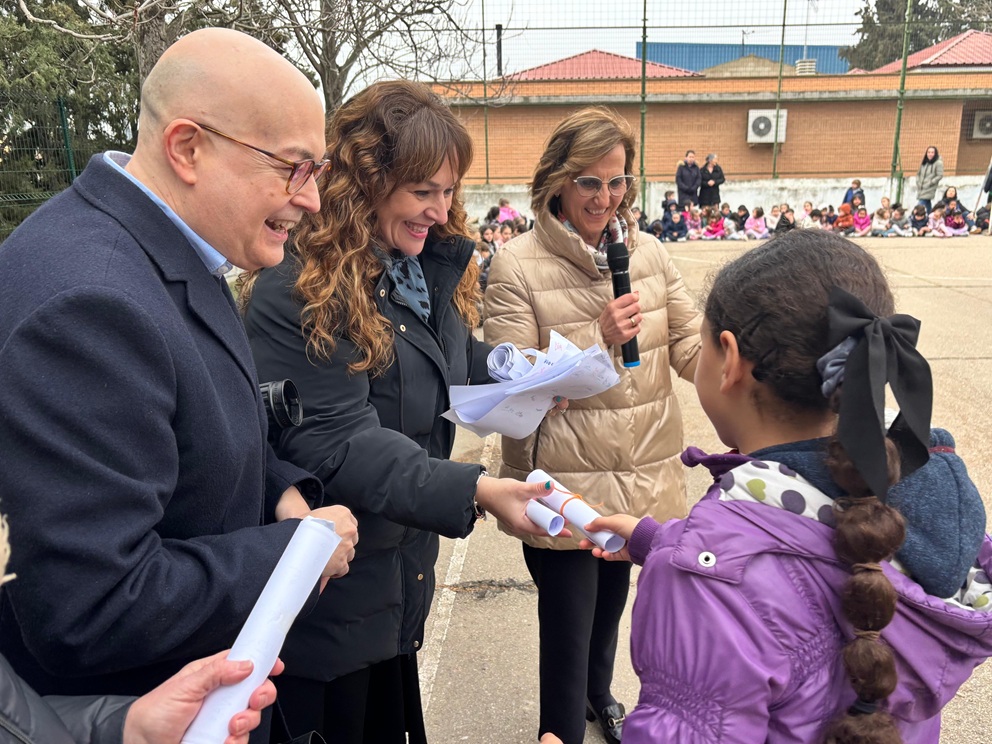
Zaragoza.- The more than 400 Infant and Primary students of the CEIP Luis García Sáinz, from Fuentes de Ebro (Zaragoza), are the ones who have spoken today about equality. The Subdelegate of the Government in Zaragoza, Noelia Herrero, accompanied by the head of the Unit against Violence against Women, Rosa Tomás, and the mayor of the town, Pilar Palacín; has visited the educational center to participate in the creation of a very special time capsule.
The activity has revolved around the concept of equality, on the occasion of the week of 8M. Previously, in the classroom, students have worked on the idea of equality in our society: what it is, how it is present in its day to day and in what way we can expand and improve it. All of this has been reflected in letters addressed to the children of the future. Today, these texts have been introduced into a time capsule that has been buried in a specific recreation point, which has been marked with an alabaster plate, material with a long tradition in this town. The intention is to open it in 20 years and for future generations to read first hand and through the eyes of these little ones what our society was like.
“The desirable thing is that, after that time, we see that the equality we have today was good and that we have been able to expand and move forward. And it is important that they are the ones who write these letters because with their way of seeing the world on many occasions they discover or remind us of the adults key aspects of the world. Her gaze can be much more accurate than ours,” said the deputy delegate.
Herrero wanted to highlight the daily role of the educational community (families and teachers) so that children grow up in an education of equality, “under the immovable idea that they deserve the same treatment and the same opportunities as them”. “But it’s true, too, that it’s a generation that’s inevitably growing under the influence of screens. And there in recent years has been a challenge that has not been easy: that of equality in the digital space,” he said.
On average, in Spain, the age of access to mobile phones is below 11 years. Three out of 10 minors maintain their profiles in public networks and 80% follow a influencers.
In these digital media is taking place, for example, a phenomenon in which, precisely, the campaign of the Ministry of Equality this year for the 8M is focused: the calls tradwives “Traditional wives” and “high-value” women are profiles of young people who promote an ideal woman model linked to submission, return to home orbit, and certain conservative and traditional values.
In addition, in the digital context, girls and adolescents are particularly exposed to new forms of male violence, such as digital harassment, sexual violence, the non-consensual dissemination of intimate images or the generation of pornography through artificial intelligence systems. Therefore, it is essential to strengthen the prevention, detection and protection mechanisms, as well as the appropriate channels of denunciation, as stated in the Draft Organic Law for the Protection of Minors in Digital Environments, in addition to promoting the improvement of digital skills and training related to digital citizenship.
The Subdelegate of the Government in Zaragoza has insisted on the need to promote a critical, conscious and responsible society in the use of social networks since, far from being a marginal phenomenon, 70% of the complaints in specialized channels correspond to digital violence against women.
“Digital violence is also gender violence and the commitment of the Government of Spain is to work for a life free of violence, inside and outside the network. Faced with this reality, the road map we propose involves the application of the State Pact, preventive education and the regularization of platforms whose algorithms reward polarization, noise and insult under addictive dynamics.”