
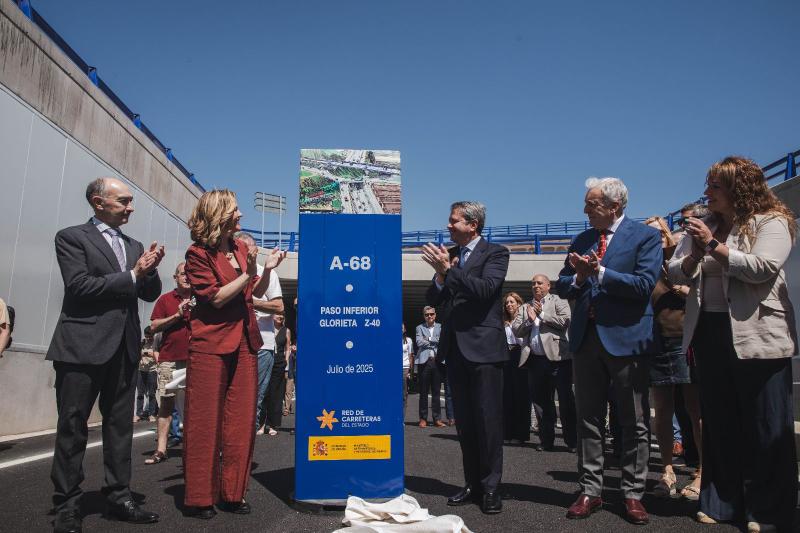
Zaragoza.- The Ministry of Transport and Sustainable Mobility has today put into service the lower pass under the roundabout of the link of the A-68 motorway with the Z-40, in the municipality of Zaragoza, an action that has an investment of more than 22 million euros and that will increase the road safety of the infrastructure and improve the capacity of the link.
The Secretary of State for Transport and Sustainable Mobility, José Antonio Santano, attended today the opening ceremony of this new lower step, which was also attended by the Minister of Education, Vocational Training and Sports and Government Spokesperson, Pilar Alegría.
During his speech, Santano assured that this action will not only improve the day-to-day mobility of the residents of Zaragoza and the entire province, which will result in their well-being, but also, “by giving access to both peripheral populations and numerous industrial sites, both economic and social benefits will be obtained.”
In addition, he explained that the new step reduces travel times on the A-68 and increases comfort for the thousands of users who use this route daily. In particular, it will allow vehicles that want to continue driving on the A-68 no longer need to cross the roundabout, which will be reserved for vehicles that join the Z-40 or want to change direction within the A-68.
In his speech, the Secretary of State stressed that the Government’s commitment to Zaragoza, its province and to Aragon is “firm”. In this regard, he has stressed that the total investment made in the province of Zaragoza by this Government amounts to almost 1.2 billion euros. Specifically, so far in 2025, the investment already exceeds 107 million euros.
He also referred in particular to investment in roads, to which the central executive has allocated more than 900 million euros in the province.
Technical characteristics
One of the complexities of the work to build the lower pass under the roundabout of the link of the A-68 motorway with the Z-40 has been that it is an action on an existing infrastructure in a fully consolidated urban environment and in a very constrained space to which the proposed solution of the project has had to adapt.
Another of the main conditions has been the foundation of the batteries of the Z-40 viaduct, which has required an analysis of the horizontal gauges between the batteries, to ensure the execution of the screens without affecting their foundation.
The stretch, of 1.4 kilometers, consists of two roads with two lanes of 3 meters each with an outer wing of 1 meter and an inner wing of 0.50 m. In this way, the projected section in the initial section is adapted to the existing section in a smooth manner depending on the space arrangement. Once the most restrictive section has been overcome and outside the area between screens, it is passed to 3.5 meters wide lanes until reaching the section of the final section where it also fits the existing section.
Two structures have been executed in the work: the lower pass itself and the replacement of the Escorredero de San Antonio.
On the one hand, the lower passage is materialized by the execution at both margins of continuous screens of reinforced concrete of 1m thickness, with variable depth, which allow the execution of the excavation.
In the lower part of the screens, under the flush, a bottom slab of 50 cm of thickness of reinforced concrete is generated that acts as a lower strut.
On the screens, in the area coinciding with the roundabout, a board is built formed by prefabricated beams of 80 cm double T type concrete plus a 25 cm thick slab.
On the other hand, the San Antonio Escorredero is replaced with two tubes of diameter 2500 mm that cross the entire corridor of the A-68, the execution and replacement of these tubes has been built by micro tunnel drilling or shield and hydraulic thrust system of the reinforced concrete tubes. This directed drilling passes under the driveway of the lower pass and has been conditioned by the slope required by the outlet level of the waters, which has made this work of great precision.
Two large archetons have been executed for the capture of the existing escorredero and with load breaking function, due to the difference in height with the frames to be replaced.
The execution of the works has affected numerous services that have had to be replenished, such as: medium-voltage power lines, telephone network, supply network, sanitation network, traffic pipeline (DGT), San Antonio’s Escorredero and public lighting network.
Given the typology of the action, the characteristics of the project and its location in urban environment, it has been intended to give an aesthetic integration of the infrastructure in the environment through the finishes of the same.
The finish of the lower passage is characterized by the smooth concrete walls seen and the placement of a coating by vitrified panels that provide a regular surface that improves the user's perception by improving the luminosity and that in turn also allow easy maintenance and cleaning in an area with a high IMD.
In the roundabout, a white arid finish has been made that highlights the protagonism of the structure of the Z-40 viaduct. The environmental integration is completed through the extension of vegetable land and hydrosowing of the slopes and especially the adaptation of the vegetation to the exit of the San Antonio escorredero.