
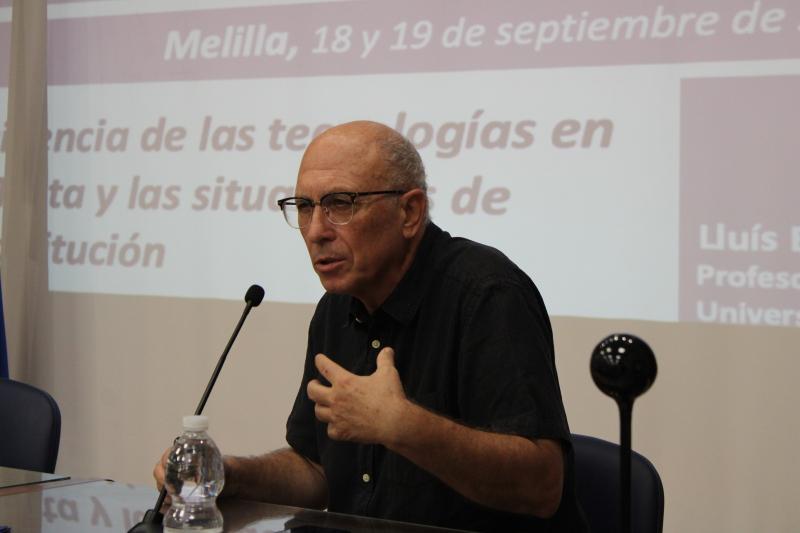
The prostitution system is now more hidden, digital and with greater impact on minors.” The Professor of Research Methods at the University of the Balearic Islands, Lluis Ballester, was the speaker on the first day of the III Conference on Trafficking and Sexual Exploitation’, which is being held at the UNED.
A conference that has been inaugurated by the Delegate of the Government in Melilla, Sabrina Moh, and the Head of the Unit of Coordination against Violence Against Women, Laura Segura, and that in this edition focuses on the new realities in the comprehensive approach to the fight against trafficking in human beings and sexual exploitation.
The highest representative of the Government of Spain in the city has expressed that these days are intended to create a space for reflection to work on the prevention of trafficking. “I wish we didn’t have to carry out these kinds of acts, but unfortunately this scourge continues to persist,” he said. Segura has stated that it is important to treat victims of trafficking for sexual exploitation with a gender perspective: “Around 90% of those affected are women.”
The Head of Unit has said that trafficking is one of the cruellest forms of violence. The Unit has explained that Spain continues to be a space of transit, destination, capture and exploitation. “We are the first country that consumes prostitution in Europe and the third in the world,” he said and recalled that this problem violates human rights and that it is a way to enslave human beings by turning them into merchandise.
Impact of the digital environment
In his speech, Lluis Ballester addressed the impact of new technologies on trafficking and prostitution. “Now the prostitution system is more hidden. The technological change has led to organizations that are in countries where access to the entity’s research and information about victims is difficult,” he explained.
Ballester has expressed his concern about these practices in other spaces such as social networks or communication networks, which means that “these practices are paid directly to the web and not to the victims.”
The professor also spoke about the impact pornography has on sexual exploitation, including the increase in risky practices, sexual violence, or the reduction of the ‘culture of protection’.
The university professor has expressed “the disturbing” data of the increase in sexual exploitation of minors. “Online reports of sexual exploitation of children and adolescents have increased from 23,000 in 2010 to more than 725,000 in 2019.” He also mentioned that the profile of new prostitutes is younger and more violent.
Unaccompanied minors
After the presentation, the first table of this day was given on the situation of unaccompanied minors and accompanied minors in the city of Melilla in which the Director of the Area of Work and Immigration of the Delegation of the Government in Melilla, Elena Nieto, participated; the Coordinator of Doctors of the World Melilla, Silvia Madejón; the Legal Officer Area of Women and Fight Against Trafficking in Diaconía Spain, Cristina Puigdengolas; and one of the members of the team of Migration, Frontera Sur and the Unicef Area of Studies.
Nieto has started to introduce the impact of the latest regulation on unaccompanied minors in Melilla and what happens when they reach the age of majority. She has also reported that women victims of sexual or gender violence can apply for residency for herself and her children. “Since 2019, the number of residence permits for minors in Melilla has dropped,” he added.
Madejón has highlighted the paradigm shift that the border crossing between Melilla and Morocco has entailed in recent years. “There was a major change from 2021, as entry is now much more difficult and therefore there are more risks for people coming in.” Like Ballester, she believes that the trafficking is less visible, but that does not mean that it has disappeared, but that its access is more complicated.
Puigdengolas recalled that the European Parliament recently spoke out in favour of promoting legislation on prostitution of an abolitionist nature throughout Europe: “234 votes in favour, 175 against and 122 abstentions,” he said. The lawyer has commented that the capitalist consumption system influences the immediate visualization of pornography: “The digital environment has changed and fosters the lack of development opportunities for vulnerable people.”
Hidalgo has summarized the historical journey of advances in children’s rights and has insisted on raising awareness of the rights that children have in the world. He regretted the growing migratory phenomenon of migrant children without family references and the small number of Spanish children who have experienced a traumatic event and who then, between the ages of 18 and 24, have had full autonomy. She has ended up inviting attendees to attend a course on Mental Health and Migrant and Refugee Childhood, within the framework of the course Mental Health and Psychosocial Intervention in Migrant and Refugee Children and Adolescents organized by UNICEF.