
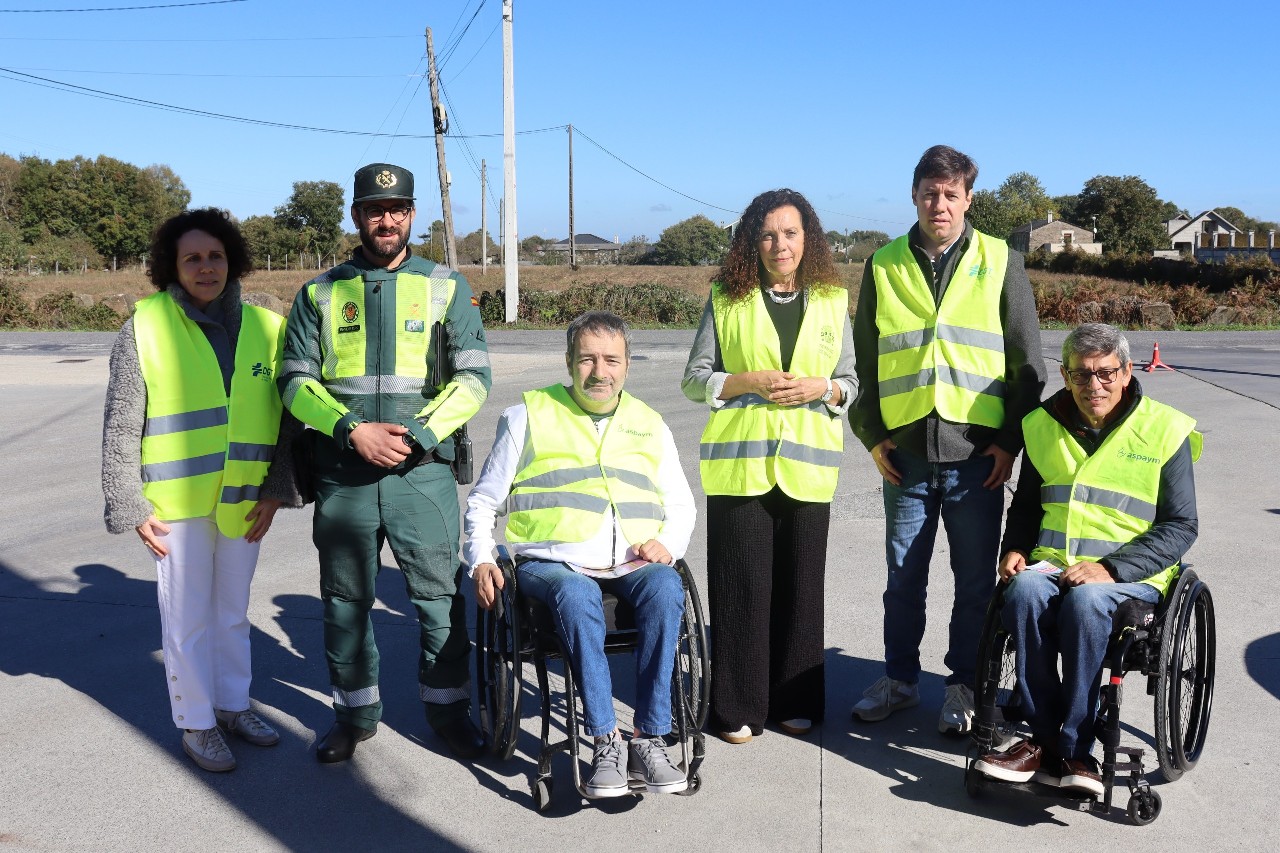
- The government sub-delegate in Lugo oversees one of the controls of the special campaign of the DGT, which will run until October 11
- Distractions are, since 2017, the most frequent concurrent factor in traffic accidents and were present in 406 fatal accidents in 2024
- Dialing a number on the phone can multiply the risk of a loss by 12 and read or write messages by six.
Olimpia López, deputy delegate of the Government in Lugo, supervised this morning one of the controls of the Special Surveillance and Control Campaign on Distractions at the Wheel that the General Directorate of Traffic develops between October 5 and 11. The campaign, in which the Civil Guard Traffic Group participates, is intensifying surveillance this week on behaviors that divert attention from driving, especially the use of the mobile phone.
Olimpia López; who was accompanied by Alberto González, provincial head of the DGT in Lugo; stressed that “a distraction of a few seconds is enough to lose control of what happens on the road and put at risk both our lives and those of other users.” The subdelegate recalled that distracted or unattentive driving has been maintained since 2017 as the most frequent concurrent factor in traffic accidents. In 2024, it was present in 18% of accidents and 30% of accidents with fatalities, with a total of 406 cases.
In this regard, López mentioned the use of the phone while driving: “The mobile can wait. A call, a message or a notification never justifies looking away from the road,” he said. The data collected by the DGT indicate that 24.7% of drivers recognize reading messages or consulting social networks while driving and 22.2% admit to making calls without using their hands free.
The risk increases significantly when distraction obliges to combine visual, manual and cognitive actions. Dialing a number on a mobile device while driving can multiply the risk of a crash by 12.2; reading or writing a message by 6.1; and locating or reaching the phone by 4.8.
“We’re not just talking about stopping looking at the road. By manipulating a phone, we reduce our ability to perceive what is happening, we react later and we lose the margin to respond to any unforeseen event,” explained Olimpia López. Speed also aggravates the effects of a distraction by reducing the time available to react. Among the most frequent accidents associated with a lack of attention are road exits, collisions with the previous vehicle and atrocities.
The mobile, the main distraction sanctioned
The misuse of the mobile phone continues to be the most frequent distraction of those that imply a sanction. In the campaign conducted in October 2025, the Civil Guard Traffic Group controlled 404,258 vehicles and reported 7,993. In 3,283 cases, 41.07% of the total number of complaints, the violation was related to the use of the mobile phone. The campaign was also joined by 397 municipalities in 42 provinces, whose local police controlled another 119,841 vehicles.
Olimpia López finally called for individual responsibility and recalled that “driving requires all our attention. Avoiding a distraction is a simple decision that can prevent a disaster and save lives.”
The regulation considers driving using headphones or manipulating mobile phone devices, browsers or other communication systems to be a serious infringement. Holding the mobile phone with your hand while driving is a fine of 200 euros and the loss of six points of the permit.