
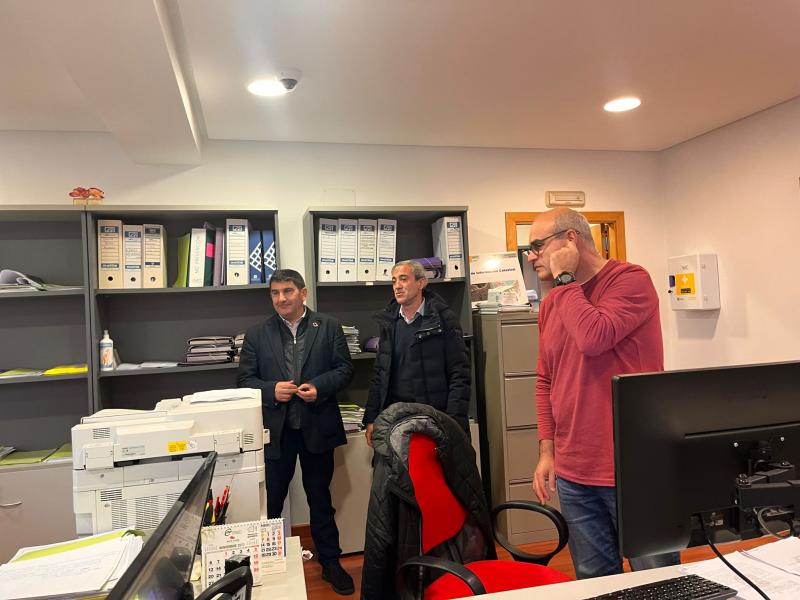
Amoeiro (Ourense), November 12, 2023.- The government delegate in Galicia, Pedro Blanco, highlights the "great reception" in the second call for the INECO RuralTic program of the Ministry of Transport, Mobility and Urban Agenda of the Government and the improvement that it will mean in the digital literacy of the Galicians.
The government delegate encouraged the municipalities of Galicia to integrate into this program and stressed that "for municipalities with a smaller population it is a magnificent opportunity to end the digtal gap and promote social cohesion". In addition, Pedro Blanco stressed that RuralTIC is a program from which small and medium-sized enterprises of municipalities can also benefit "through advice on new technologies provided by agents who move to the municipality."
In Galicia there are 17 concellos of less than 10,000 inhabitants benefiting from this second call which will begin the program of visits of the digital nomads of the Ministry in this month of November: 5 concellos de A coruña, 6 concellos de Ourense, 4 concellos de Lugo y 2 de Pontevedra.
The Ineco Rural ICT Programme
The objective of this program is to contribute to the social and economic degradation of society living in rural environments, breaking down the possible barriers that move these nuclei away from new technologies. In this way, to be able to guarantee that the population can maintain communication with the families of the isolated areas or carry out administrative activities through a mobile device.
This initiative is based on two fundamental axes: social digitalization and economic digitalization.
In terms of social digitalization, the agents provide training and support in the use of new technologies to neighbors and neighbors, with special attention to the elderly population. The staff of the Ineco develops different face-to-face workshops, such as the management of the online service for the execution of administrative procedures: medical appointments or electronic banking.
They also provide training to learn about aspects of internet or fingerprint security and offer personalized attention based on the specific needs of the participants.
The second axis, economic digitalization, provides support and assistance to the rural business fabric, through digital positioning, with support for the creation of online services that can improve the activity of SMEs, such as the opening of a website or the use of profiles in social networks for positioning in the digital world.
More than 400,000 euros in government investments in the City of Amoeiro
The delegate put Amoeiro as an example of the Government’s commitment to small town halls, "thanks to the investment and commitment of the Government it is possible that in the last 3 years fiber optics and internet connection have reached each of the parishes of the city hall reaching 100% of its digitization breaking the digtal fenta in the rural in moments as complex as the past pandemic"
Adding the projects in progress to the one that will be executed with the current call, the Government will bring the ultra-fast connection to internet through fiber to 236,154 homes and companies in Galicia before the end of 2025. In total, the three calls represent an investment of 90,900,000 euros.
Pedro Blanco went to the City Council of Amoeiro where he held a meeting with the mayor, Jose Luis González López, to supervise the state investments in this municipality, in which they also highlight the more than 220,000 euros they have received from the IDAE for the renovation and purification of wastewater from the City Council and the improvement of lighting and energy efficiency for a low carbon economy; as well as to know the projects for the remodeling of the sports facilities of the City Council such as the Football Field and the municipal swimming pools.