
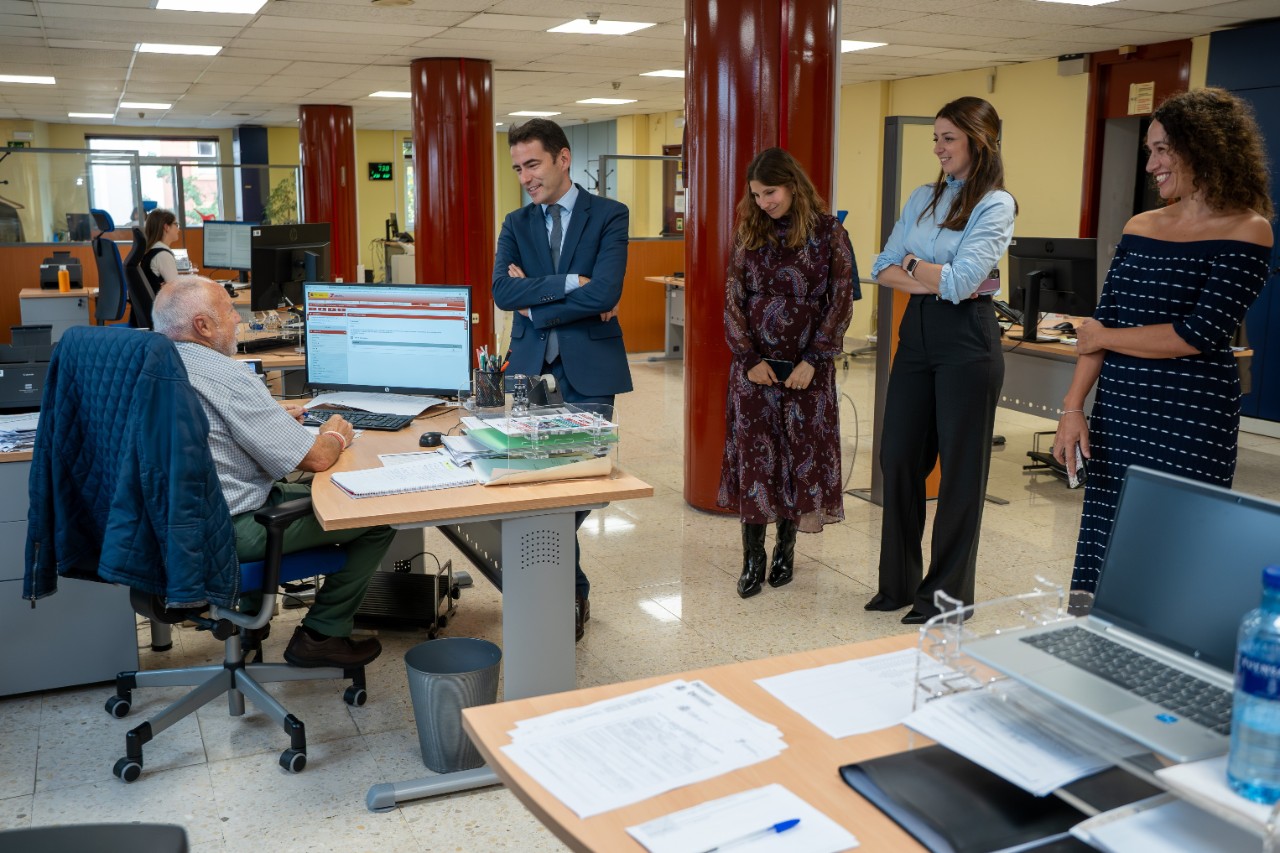
• The government delegate in Cantabria has visited the central offices of the National Institute and the General Treasury of Social Security in the community, located on Calvo Sotelo Street in Santander
The government delegate in Cantabria, Pedro Casares, thanked the Social Security personnel for their involvement in the autonomous community, approximately 300 people in the service of both the National Institute (INSS) and the General Treasury (TGSS), and who lead the average number of citizen attentions per official throughout the country.
Casares has highlighted that, with the data until the end of August, Social Security officials in Cantabria perform an average of 25.1 attentions per day, almost six more than the national average. “Our public employees have one of the highest percentages of attention which places them month after month at the top of the ranking of offices in the country,” he added.
He stressed that this would not be possible “without the great involvement and vocation of public service” of the entire staff of the INSS and the TGSS, to which he thanked his work during the visit he made this Wednesday to the headquarters of both agencies in the community, located in Calvo Sotelo Street in Santander, and in which he was accompanied by the provincial director, Eva Suárez, and other leaders of both State agencies.
He recalled that Cantabria has eight care centers for citizens of Social Security, the two of Santander (streets Calvo Sotelo and César Llamazares), and those located in Castro Urdiales, Potes, Reinosa, Santoña, San Vicente de la Barquera and Torrelavega.
Casares has valued the work carried out in these last six located outside the Cantabrian capital and that comply with “the commitment to bring the General Administration of the State closer to the citizens, live where they live” and facilitate access to essential services, such as procedures with Social Security, to many points of the community.
COMMITMENT TO THE PUBLIC SERVICE OF PROXIMITY IN THE TERRITORY
The government delegate has assured the commitment of the Government of Spain to these offices of citizen care of the INSS in the regional territory and from which “a very close public service is provided, of which we must be proud”.
“We have professionals with an enormous vocation for public service and, in addition, with significant quotas of preparation and experience,” said Casares, who has also valued the continuous training and adaptability of officials.
In addition, it has evidenced the “essential role of Social Security in the lives of thousands of citizens” that relate to the agency for retirement, maternity or paternity or for needing to collect a benefit or the “right of citizenship that is the Minimum Vital Income”.
This is what the government delegate has transferred to the heads of the different departments of both the INSS and the TGSS, with whom he has held a working meeting to know the activity they carry out and also their needs.
He has highlighted the importance of the attention to the public of Social Security and that in Cantabria it is the “flagship” of the agency, with 85,739 people attended until the end of August, of which 71.2% were face-to-face and the remaining 28.8% by telephone.