
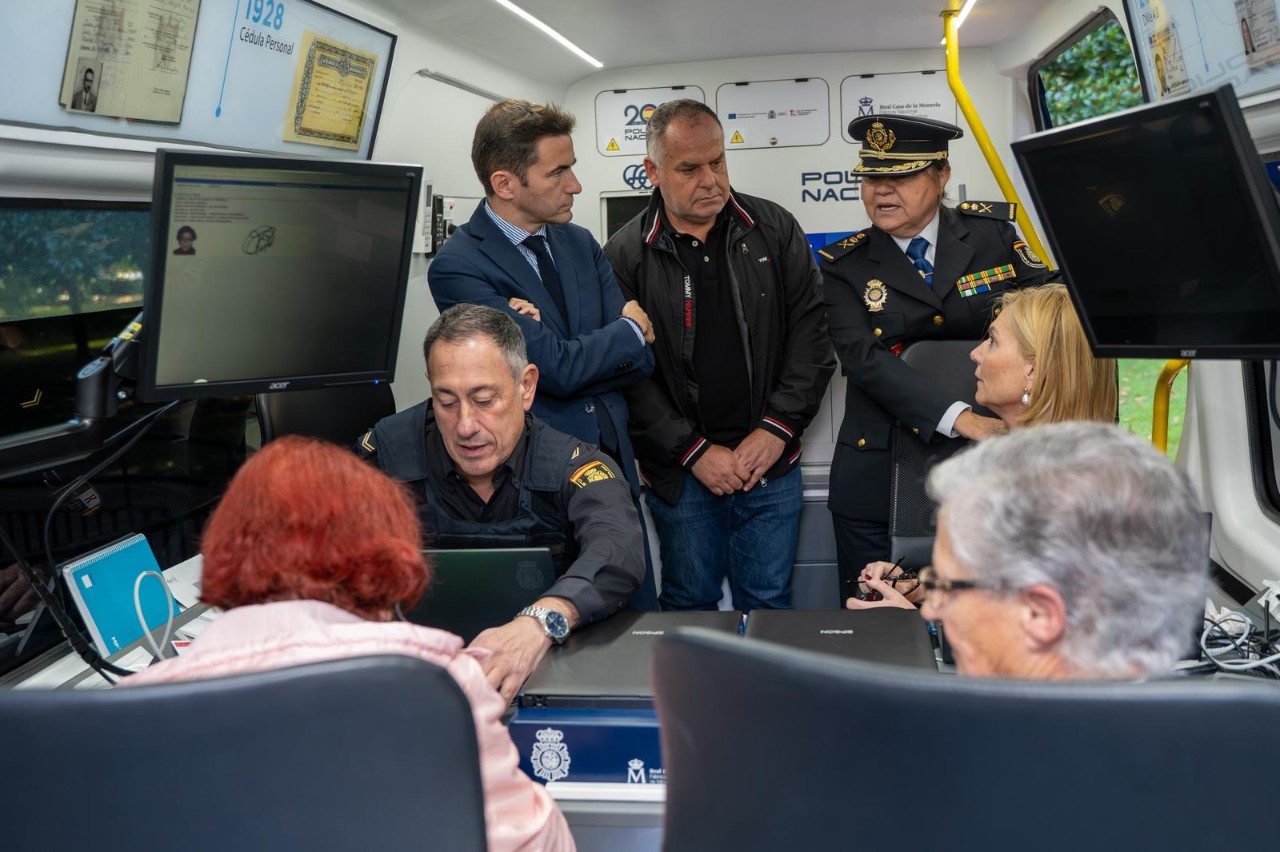
• The government delegate in Cantabria has visited in Cabezón de la Sal the VIDOC, the National Police vehicle that travels through municipalities in the region to facilitate administrative procedures in the rural area
• During his visit to the municipality, Casares also held a meeting with the ROCA Team of the Civil Guard and an institutional meeting with the mayor, Víctor Reinoso, in the City Council
The government delegate in Cantabria, Pedro Casares, has highlighted the usefulness of the mobile unit of the National Police for the issuance of ID and passports and that, since its implementation last January, has issued 3,100 documents, 2,760 identity documents and 340 passports.
Casares has detailed it this Wednesday in Cabezón de la Sal where, together with the Superior Chief of Police of Cantabria, Carmen Martínez; the Mayor, Víctor Reinoso, and the Deputy Mayor, María Jesús García, has visited the VIDOC, the vehicle of the National Police that travels municipalities in the region to facilitate administrative procedures in the rural area.
The government delegate has detailed that, since its launch in January, this mobile unit visits a total of 18 municipalities every month. “Only this month, it has passed through Cabezón de la Sal, Potes, Reinosa, Santoña, Renedo, Laredo, Suances, Villacarriedo, San Vicente de la Barquera, Los Corrales de Buelna, Noja and San Miguel de Meruelo, facilitating that the neighbors of these municipalities have made or renewed their documentation without having to travel to Santander,” he said.
In addition to these municipalities, the unit also periodically moves to the El Dueso penitentiary center, in Santoña, and from next November it will incorporate two new municipalities, Corvera de Toranzo and Comillas, the delegate has announced.
For Casares, this is “one more bet” of the Government of Spain to bring public services closer to citizens, in this case to the most remote places of the large urban centers, where neighbors can obtain or renew their ID or passport “in a single procedure”.
"This initiative of the Ministry of the Interior and the National Police is a step forward to bring essential services closer to citizens, especially in rural and less populated areas, where historically displacement has been a barrier to carrying out administrative procedures," he said.
The government delegate recalled that the VIDOC of the National Police was premiered in Cantabria precisely in Cabezón de la Sal, where it has re-emphasized this Wednesday.
The VIDOC brings two important improvements. The first is the ability to issue a document in just ten minutes, so citizens will not need to go through the three usual procedures so far in mobile units (one day for fingerprinting, one day for printing at a police station and one day for delivery).
The second is the possibility of issuing passports. Until now, this document was made exclusively in the Police Stations, so the VIDOCs will facilitate and equalize in possibilities the population centers that do not have National Police infrastructures, which in Cantabria are all but Santander, Torrelavega and Castro Urdiales.
In this way, this mobile vehicle has the same document issuing capabilities as a physical office and also has PAD to renew the electronic certificates.
VISIT TO THE ROCA TEAM AND MEETING WITH THE MAYOR
On the other hand, during his visit to the municipality, the government delegate in Cantabria has held a meeting with the ROCA Team of the Civil Guard together with the head of the body in Cantabria, Lieutenant Colonel Julio Postigo, and has valued the work of these agents to serve the neighbors of rural areas.
Thus, Casares has highlighted the more than 5,600 interviews that the ROCA Teams of the Civil Guard of Cantabria have conducted with vulnerable people from the rural areas of the community.
In addition, the government delegate held an institutional meeting with the mayor of Cabezón de la Sal in the City Hall, in which they analyzed projects of the Government of Spain in the municipality in terms of roads and railways, actions dependent on the Cantabrian Hydrographic Confederation, as well as on citizen security.
Casares has praised the “important collaboration” that exists between the Government Delegation and the State agencies with the City of Cabezón de la Sal.