
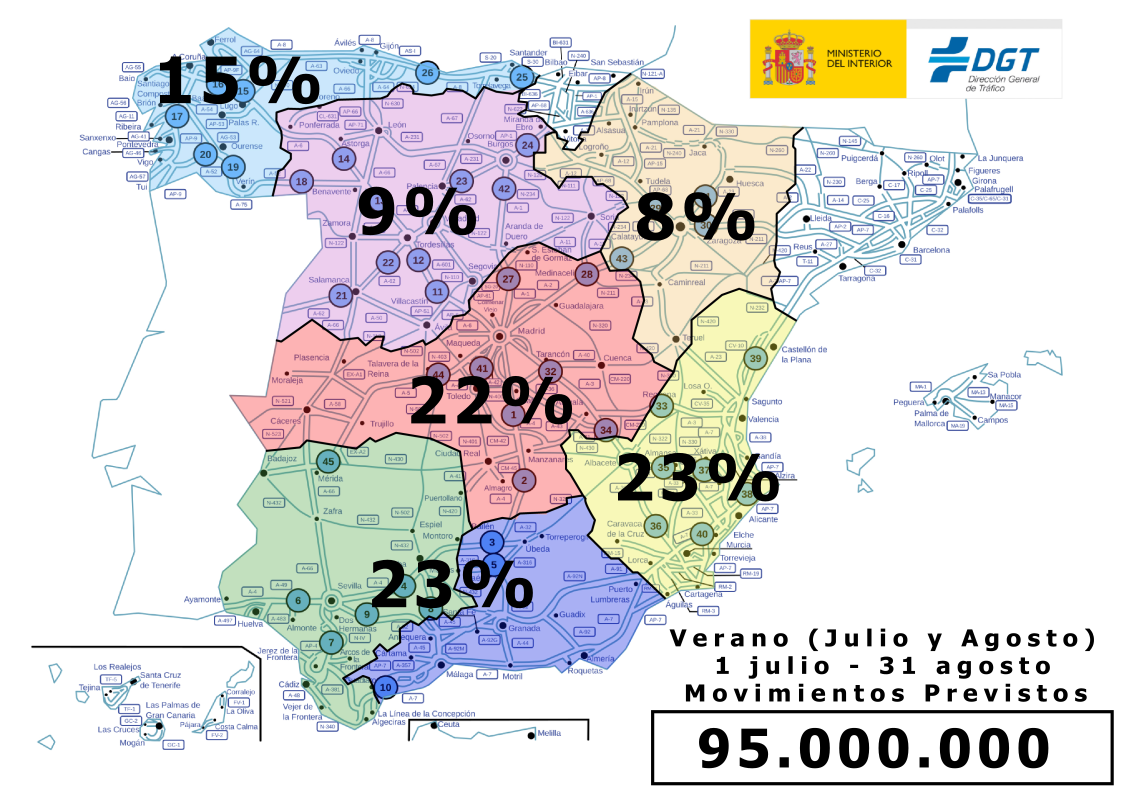
This Friday officially begins the time of year in which the greatest number of trips take place and, with it, the special devices that the General Directorate of Traffic has prepared to cover the more than 94 million long-distance movements planned that will be carried out by road in the coming months of July and August, of which 1,834,000 will be counted on the Asturian roads.
This figure represents an increase of 0.4% compared to the 93.6 million real movements recorded last summer. The expected monthly distribution is 45.7 million trips during the month of July and 48.3 million in August. Of which 832,000 are expected in Asturias in July and 942,000 in August.
This Summer Campaign 2024 has two fundamental objectives: on the one hand, to reinforce the set of actions that the DGT usually carries out to improve road safety levels during the summer months, in which accidents traditionally show an upturn with respect to the rest of the months and, on the other, to facilitate the mobility of citizens by facing both recurrent congestion situations resulting from the increase in the volume of traffic, and those caused by unforeseen incidents that may occur in the road network for reasons intrinsic to the summer circulation (tourist areas, beaches, second residences…) or extrinsic to it (road cuts, forest fires, floods…).
As has been usual in recent years, the departure and return of the holidays is done in a staggered way and in shorter periods, making them coincide on numerous occasions with a weekend.
For this reason, and to cater for the greater number of people who start their holidays at the weekend, and who choose the vehicle as a means of transport, the DGT has established special traffic regulation and control devices during all the weekends of the summer period, intensifying them during the first weekends of each month and giving rise to so-called departure or return operations.
The different Traffic Management Centers will also launch different Autonomous Operations on the occasion of various local events and parties.
In addition, during these summer months, several surveillance campaigns will also be carried out that will intensify control over certain vehicles or risk factors in traffic accidents.
FIRE FIGHTING PLAN
The summer season has unfortunately been accompanied by the appearance of fires, so the General Directorate of Traffic also has the responsibility to intervene in its prevention by paying special attention to the areas with the highest probability of suffering fires, as well as through the management, control and information of the areas affected by fire and its access within the scope of its competences.
This management is carried out through the different Traffic Management Centers that, through the 2,460 luminous variable message panels spread over 16,000 km of roads, provide management, information and prevention coverage in the form of messages to users of a wide network of roads in the possible areas affected by a fire.
THE PRIORITY, ROAD SAFETY
Traffic in summer presents different characteristics to those that occur at another time of the year and that must be taken into account:
● Increase in long-distance commutes on working days and especially during weekends. On the other hand, less conflict in the accesses to the big cities at the peak time of entry and exit from the workplaces on working days.
● Increased traffic of vehicles on secondary roads.
● Increased night travel.
● Conflictive circulation on roads that connect coastal populations and coastal tourist areas with beaches.
● Increased presence of cyclists and pedestrians on the road.
For all these reasons, in order to prevent the summer from becoming a tragic period on the roads, from Traffic insists, once again, that prudence and respect for traffic rules are the only weapons to combat accidents at the wheel.
To this end, with the aim of safeguarding the safety of all road users, the operation has the full availability of means, both human (agents of the Civil Guard Traffic Group, personnel of the Traffic Management Centers, helicopter patrols and personnel in charge of maintaining equipment and installing measures on the road), and technical (fixed and mobile speed control radars, as well as helicopters, drones, cameras and camouflaged vans to control the use of mobile and seat belts) available to the DGT.
In order to encourage traffic in the most sensitive areas during special operations and on weekends, measures will be adopted such as the installation of reversible and additional rails with cones and beaconing during the times of greatest traffic flow and the establishment of alternative itineraries.
Likewise, work on the roads will be paralysed, the holding of sports tests and other events involving the occupation of the road will be limited and the movement of trucks in general and those carrying dangerous goods will be restricted, as well as special transports in certain sections, dates and times.
The DGT always recommends, before starting the trip, planning it by the safest route to avoid unforeseen events and inform itself of the state of the roads.
From the Twitter accounts @informacionDGT and @DGTes or the news bulletins on radio and television, as well as on the phone 011, the traffic situation is reported in real time and any incidents that may exist.
All the device set up as well as tips can be consulted in dgt.es (traffic status/traffic recommendations/special operations).
SUMMER DEVICE IN ASTURIAS
With regard to traffic management and to facilitate road mobility, the Provincial Traffic Headquarters of Asturias, in anticipation of the high number of trips this summer, has implemented the following actions:
● Implementation of a Generic Signage Plan to report high occupancy on beaches.
● Agreement with the State Road Demarcation in Asturias, to provide through the variable messaging panels of this, information related to the occupation of accesses and parking spaces to beaches.
● Signage in the Variable Messaging Panels of the A-8 of the filling of the parking lot of the beach of Rodiles, for which, and in view of the experience of previous years, the agreement reached with the City of Villaviciosa has been renewed.
● Elimination of the third lane of the A-8 among the PPKK. 356+200 to 358+200 sense increasing (stretch coinciding with the exit of the Villaviciosa tunnel) during the weekends and holidays of July and August.
● Dynamic signaling through variable message panels of the main traffic variables.
● Paralysis of the works that affect the roads on all roads to minimize the affection to the traffic during the days of the operation out-return of summer.
TROUBLE SPOTS DURING THE SUMMER
Road Kilometric points Observations
N-630 67 to 87 Occasional detentions in Puerto de Pajares by intensity of circulation on weekends
A-8 355 In both directions, a large influx of vehicles, slowdown arrests in the Villaviciosa tunnel.
A-8 356 to 357 In a growing sense and in the afternoon by return of beaches
A-8 392+000 to 392+500 “Bypass” for works reconditioned roadway (serine knot), circulation channeled in double direction, coming to produce retentions in a-66 pk. 12 to 14 sense decreasing
A-8 306+000 Gulpiyuri Beach, lack of parking
N-634a 341,500 Intersection of the Portazgo, retentions may occur due to the intensity of circulation towards Covadonga.
AS-262 6 Glorieta Covadonga, retentions by circulation intensity
AS-264 1 to 7 Large influx of vehicles to Picos de Europa National Park and Cares route.
ROADS WHERE THERE ARE WORKS IN THE EXECUTION PHASE:
● Placement of acoustic screens in Mieres. A-66, p.k. 53+100 to 52+200 (left margin), permanent cut of the right lane with diversion of traffic by the left lane. The estimated duration is from June 3 to August 31.
● Construction of heavy vehicle parking in Villallana. A-66, p.k. 56. Cut of the right lane in the direction of León for the execution of the new access to the parking area. From Monday to Friday until July 15, opening to traffic on weekends and days of special operations.
● Reconstruction of the firm A-8 p.k. 392,680 knot of Serín, it is expected to finish the works by the end of June.
● Anti-noise performances on the AI-81 p.k. 1+680 to 4+950. Cut the right lane in the direction of Avilés. From Monday to Friday, opening to traffic on weekends and days of special operations.
● Adaptation to Royal Decree 635/2006 tunnels of Niévares and Brañaviella among the P.K. 361+829 and 367+860 of the A-8, where there may be reductions of lanes, temporary detours and punctual cuts of very short duration that will not affect, predictably, the circulation in the days in which the Special Traffic Operations take place.
4.-SPECIAL CIRCULATION MEASURES:
A) ALTERNATIVE ITINERARIES
● Vehicles heading to Cangas de Onís, Covadonga, Picos de Europa Natural Park and Arrionda must travel on the A-8 to exit 319 (Ribadesella) and continue on the N-634 to the town of Arrionda.
● Vehicles heading towards Oviedo from Cangas de Onís and Arriondas, it is recommended to use the A-8
● A-66 and A-8: Oviedo–Gijón by AS-II or AS-I with A-64
(B) OTHER MANAGEMENT MEASURES
● Regulations and surveillance by the Traffic Group of the Civil Guard in conflictive intersections and sections of greater traffic intensity.
● Restriction of access to the CO-4, except authorized vehicles, except on days 25/07/2024 and 08/09/2024.