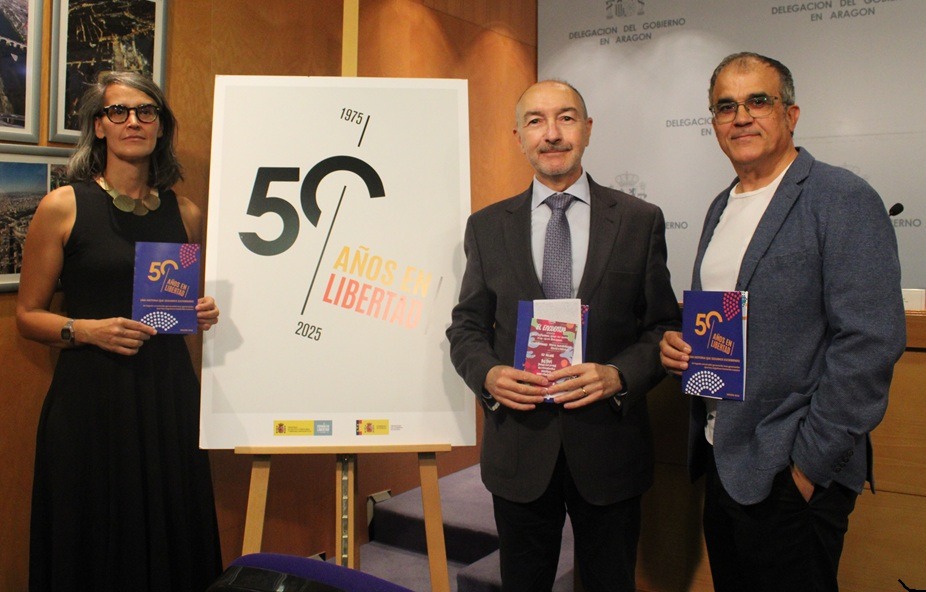
Zaragoza.- The Delegation of the Government of Spain in Aragón has presented the new programming of activities of ‘Spain in Libertad. 50 years’ promoted by the Government of Spain, through the Ministry of Territorial Policy and Democratic Memory, to commemorate the five decades since the beginning of the democratic process in our country. This edition continues with the spirit of the program initiated last year to commemorate the anniversary and incorporates 15 new proposals that will be held until the end of the year in the three Aragonese provinces. The objective is to continue to bring the democratic memory closer to the new generations and promote a critical and conscious citizenship.
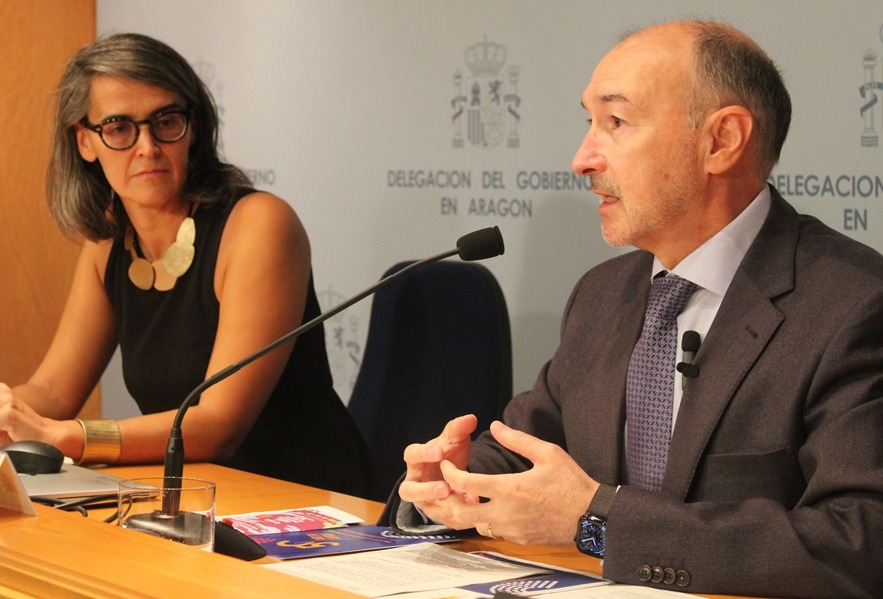
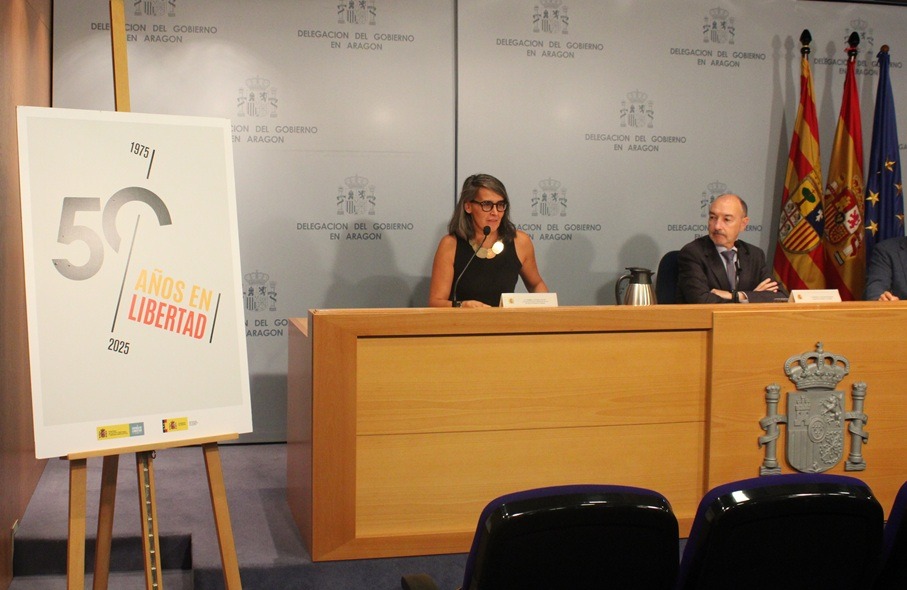
The delegate of the Government of Spain in Aragon, Fernando Beltrán, and the historian and commissioner for the celebration of ‘Spain in Libertad. 50 years’, Carmina Gustrán, have presented the calendar of activities that will travel through Aragon with cultural, educational and participatory proposals linked to democratic memory, rights and freedoms and citizen participation. Also present was the professor of Sociology and principal researcher of the Research, Society, Creativity and Uncertainty Group (GISCI) of the University of Zaragoza, David Pac, which has advanced the keys of the study that is going to be carried out to know the vision of young people on different aspects of democracy.
With this programming, the Delegation of the Government of Spain in Aragon wants the commemoration of ‘Spain in Libertad. 50 years’ be also an opportunity celebrate democracy through culture, knowledge and participation, recognize those who contributed to making democratic progress possible and open new spaces to collectively imagine the future.
Beltrán has highlighted that this commemoration aims to go beyond the memory of an ephemeris. “Democracy cannot be taken for granted. 50 years ago Spain began to collectively build a country of rights and freedoms and today we have the responsibility to know that path, assess what has been achieved and continue to take care of it”, he pointed out.
The delegate has also underlined the will to recognise The thousands of anonymous people who contributed to the democratic advance and to involve especially the generations that did not experience the dictatorship or the Transition. “We want to talk about our past, but above all, we want to do so by looking at the present and the future and listening to young people,” he added.
In this line, the commissioner Carmina Gustrán He stressed that it is a plural commemoration also in the way it is celebrated. “We do not want the 50 years of democracy to be counted from a single place or with a single gaze, but each territory can contribute its own experiences, its protagonists and its questions about the present and the future”, Gustrán has assured us.
"The decentralized nature of the program allows, precisely, that the celebration reaches municipalities, universities, educational centers, cultural spaces and associations, and that the citizenship can be recognized in it," added the commissioner.
Proposals in Zaragoza
One of the main novelties of this edition will be the Preparation of a questionnaire among 900 young people from all over Aragon. The results will be presented in the month of November and will serve to analyze, through different variables, how they see The different aspects of democracy. It will study the situations of coexistence or economic dependence, the role of majorities, the relationship between citizens and elites, the absence of contact opportunities, how issues such as identity and feeling of territorial belonging are addressed or the concern before the social changes in progress, etc.
Among the activities planned, Zaragoza will host "The Encounter", an event co-organized with the Youth Council of Spain (CJE), which will close the DemocraZia programme with Z, a space where young Aragonese people will take the floor, meet and celebrate what they build together. It will be the next Friday, September 18th. The Plaza de San Bruno in Zaragoza It will bring together youth and youth leaders in an entity fair and a live podcast led by David Adújar and María Bouabdellah, on the access of Aragonese youth to leisure and culture. A day to listen, debate and put on the table the realities and challenges of youth, where the music of Begut, Wall with Wall, Multipla, 50007 Fishing Club, Las Macedonias and DJ Hazhe will also play.
In the month of October, it will be developed in the School of Engineering and Architecture of the University of Zaragoza the ‘Atalaya Challenge’, an immersive experience aimed at university students that poses scenarios inspired by real threats and challenges participants to seek innovative solutions.
The activities will also put the focus In the citizenship and in the challenges that this democratic society faces today. El 12 November, the North Station of Zaragoza will host a debate entitled “Housing: crisis and emergency” It will analyze the problems of young people to access a home. El 22 October, The Athenaeum Laico Stanbrook will be the scene of a participatory activity with young people called ‘For another 50 years of free public space’ And focused on the threats and opportunities to enjoy an open and democratic public space.
In addition, from the hand of the Odon of Good Association, the 10 November, the University of Zaragoza will host the presentation of a project on the life of Sadí de Buen, by Antonio Calvo Roy, scientific journalist and biographer of Odón de Buen. El 19 November, at the Civic Center of Zuera, the national amateur theatre and science contest will be presented, ODB Lab Essay, which will bring the performing arts, dissemination and critical thinking to the rural environment.
Programming in Huesca
Culture and artistic expressions will also have a prominent role. El 25 September, Cervantes Square in Huesca will host a session outdoor cinema with the screening of a film linked to the Spanish Transition, accompanied by an introduction and contextualization especially aimed at young audiences. In November the exhibition will arrive in Almudévar ‘Conscious youth. The siege of Huesca and the Italian militiamen during the Civil War’, which will later travel through different municipalities of the province.
During the months of October and November, 15 training centers in the province of Huesca will host theatrical workshops ‘My dear Spain: A Female History Class (1975-2026)’, which will address the memory, rights and freedoms of Spanish women throughout this period.
This year, the Subdelegation of the Government of Spain in Huesca It will reopen its doors to educational centers. The guided tours, organized by the writer Óscar Sipán, will include a talk adapted to the students about the Spanish Transition, the evolution of rights and freedoms, citizen participation and the meaning of democracy in today’s society.
Programming in Teruel
The program will address the youth leadership during the transition from dictatorship to democracy in the province of Teruel. It will do so through a colloquium that will connect the Turolean political and social reality with the Transition process that Spain was going through. María Domínguez Chair of Democratic Memory of the University of Zaragoza.
The program incorporates the cession of the sculpture “Justice and Peace” by Lorenzo Pascual García Isarria to the Pozos de Caudé Memorialist Association. This figure will be installed in a Turolean town after the celebration of a youth debate. Finally, also in Teruel, a recording is going to be made documentary on migration, Bhumeran, It proposes an emotional and historical journey through a reality linked to political exile and that connects the experiences of the past with phenomena that continue to be part of the present.