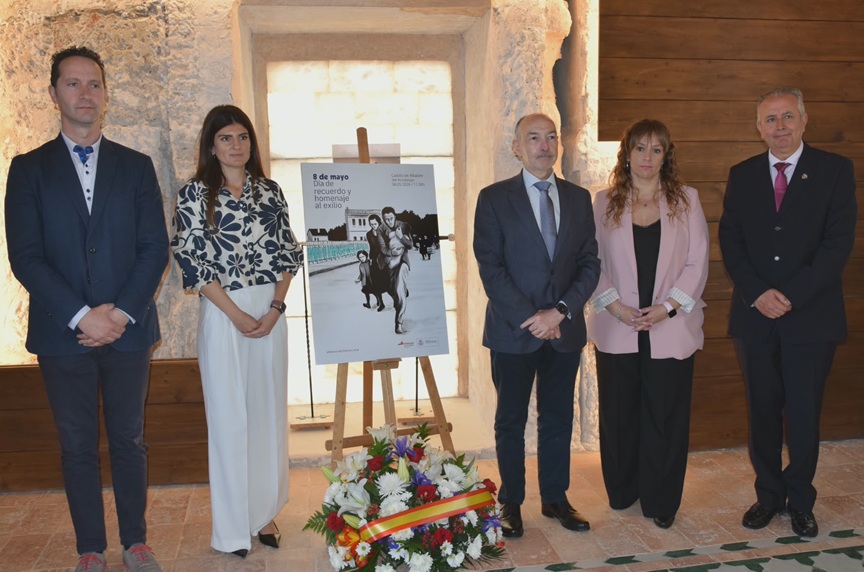
Albalate del Arzobispo.- The Government Delegation in Aragon has commemorated today in the castle of Albalate del Arzobispo the "Day of remembrance and tribute to the men and women who suffered exile as a result of the War and the Dictatorship", as established by Law 20/2022 of Democratic Memory. The government delegate in Aragon, Fernando Beltrán, recalled that this date links our history with that of Europe, with the end of Nazi and fascist barbarity. “But for Spain, and especially for Aragon, it is also a day of intimate memory, names and lives that one day were forced to leave. This act is part of the commitment of the Government of Spain to keep alive, year after year, a tribute and a memory to heal the wound left by the exile,” said Beltrán.
“The regions of Bajo Aragón and Bajo Martín were, in addition, two of the areas of the province with the highest number of exiles. Behind each figure were separate families, interrupted life projects and entire generations marked by absence. It was also the story of the exiled talent: those who had to leave their land to defend freedom, to think differently or simply to survive,” he added.
The Democratic Memory Act establishes the date of May 8 for the memory of exile, since this is the date on which in 1945 there was the European victory over fascism and Nazism, a historical fact to which the men and women of Spanish exile contributed decisively.
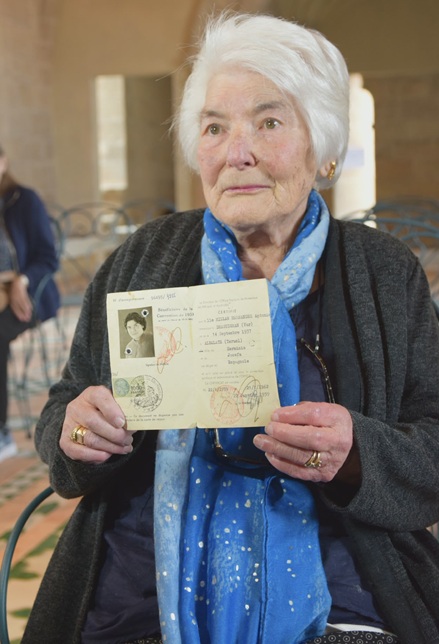
Antonia Millán Hernández, 88, was one of the thousands of Aragonese who left their land. He did it in his parents’ arms when he was only six months old and crossed the border by.
La Junquera in March 1938. Today she has been one of the protagonists of the tribute in her town, Albalate del Arzobispo, to whom she has gone with her refugee card. Antonia has explained that her family walked to France and slept for the first few days in the sand of the beach of Argelès-sur-Mer, to then pass by the concentration camp located there. Afterwards, he was able to start a new life in the Saint Tropez area. More than 70 years later, he returned to his village to stay. “My parents had to leave Spain because they were republicans. I was born in Albalate del Arzobispo and I want to die in the town where I was born,” he said.
For the delegate of the Government of Spain in Aragon, Antonia puts a face to a story that “is not only past”. “We also talk about the present and the future. Because at a time when discourses of denial and hatred are reappearing in Europe and in the world, it is necessary to look back at those who resisted barbarism with dignity,” added Beltrán. In this regard, he stressed that, faced with those who seek to impose a lack of memory, “the Government of Spain will use all means of the rule of law to protect the democratic memory and dignity of the victims of Franco’s regime. It is not a question of reopening wounds, but of closing them from truth, justice and reparation.”
The event has had a historical contextualization of Alberto Sabio, director of the María Domínguez Chair of Democratic Memory, who has also made a semblance of some of the exiles in the area. “This act is a reminder especially for young people because, through democratic memory, we help to make people understand that democracy can always be more transparent, participatory and social, but also that democracy can deteriorate,” said the professor of Contemporary History at the University of Zaragoza. Sabio has highlighted the importance of incorporating into the history of Aragon and Spain the experience of the exiles who are still alive and the perception that their relatives have of exile.
The mayor of Albalate del Arzobispo, Celia Trullén, has also stressed the importance of young people getting to know history and of municipalities also joining in acts that recognize the lives of those who had to flee, that reinforce historical memory and strengthen democracy.
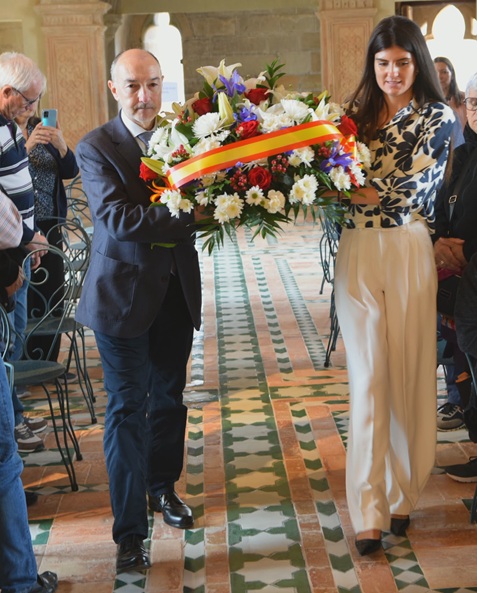
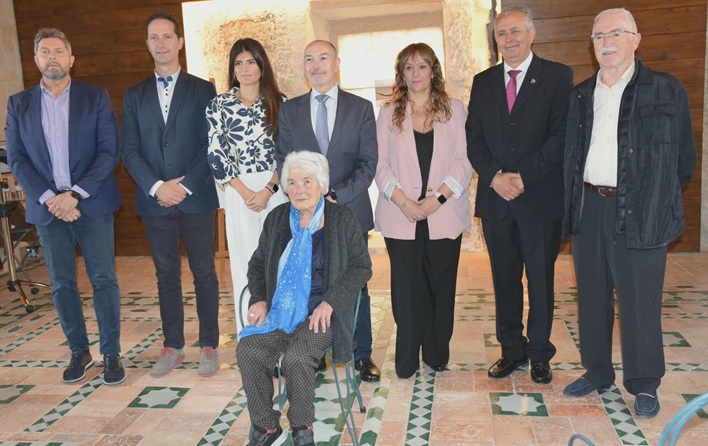
In addition, Francisco Sánchez, representing the Pozos de Caudé Association, took the floor in this tribute. The event ended with a floral offering in which the subdelegates participated in Huesca, Carlos Campo; in Zaragoza, Noelia Herrero, and in Teruel, Enrique Gómez.