
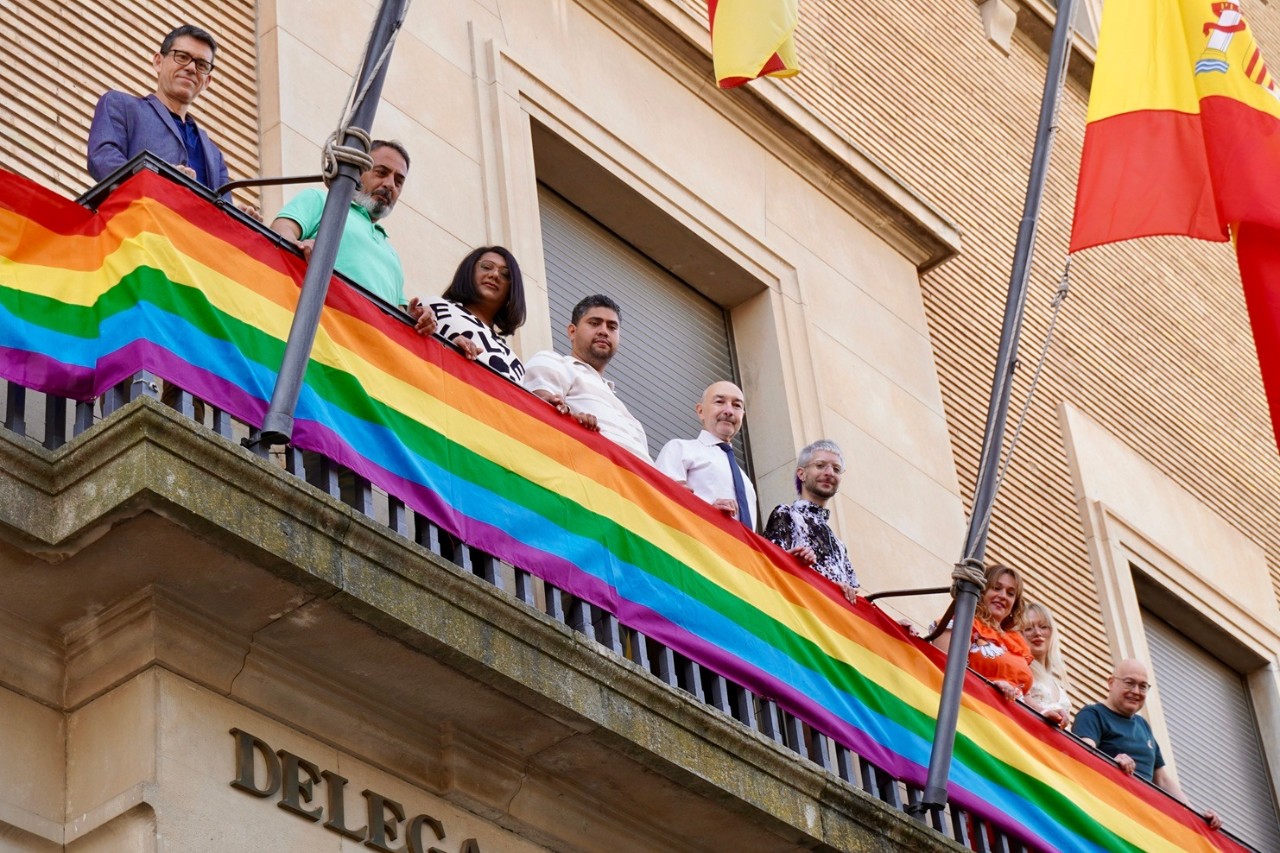
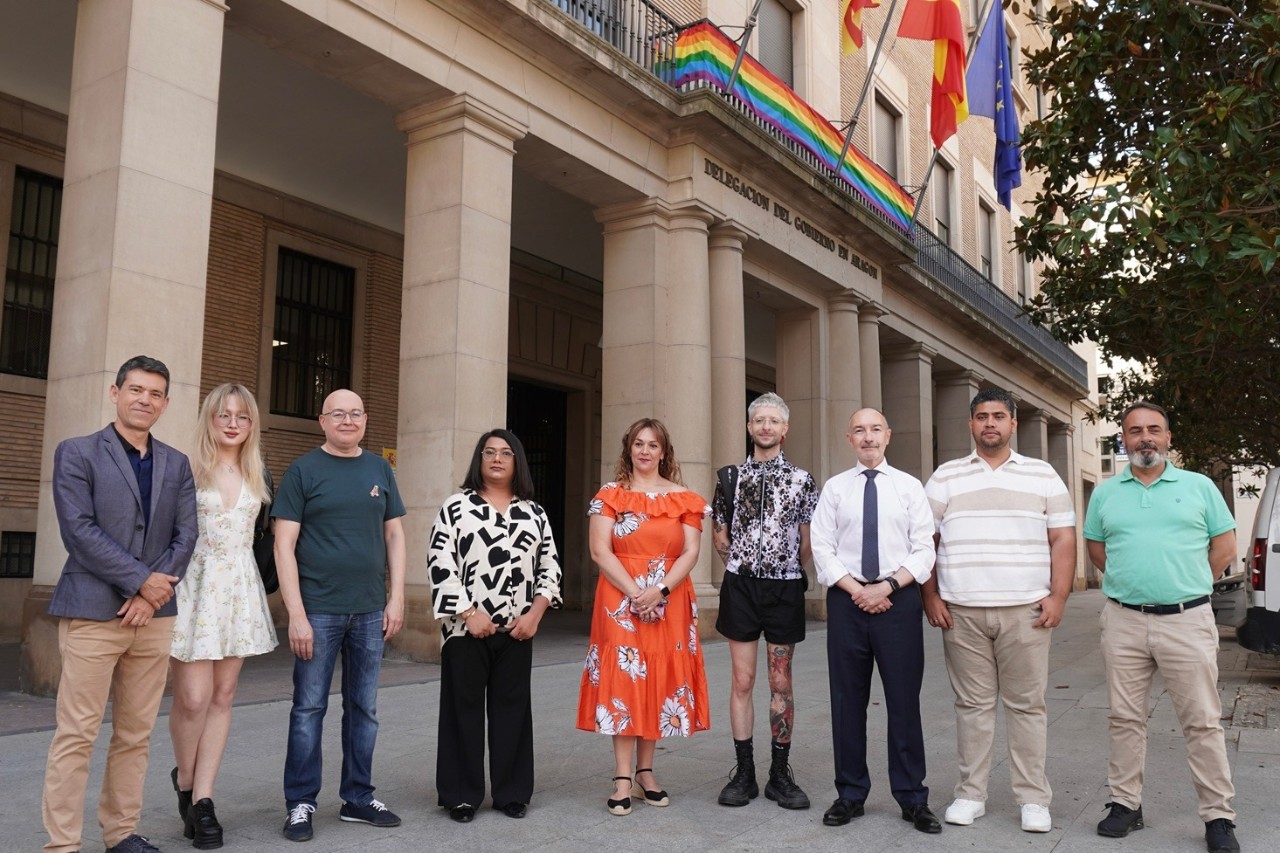
Zaragoza.- Throughout this week, the rainbow flag will shine on the balcony of the Delegation of the Government of Spain in Aragon on the occasion of the celebration of the International Day of Pride LGTBIQ+ on June 28. The government delegate in Aragon, Fernando Beltrán, and the subdelegate in the province of Zaragoza, Noelia Herrero, have hung it this morning accompanied by representatives of the 28-J Assembly and the Free Nicaragua association.
Fernando Beltrán has explained that with The colors of this flag claim all the advances made in “the freedom, equality and dignity of all people” He has highlighted the work carried out throughout the year by the different social entities such as those that have participated in the event today. “All of them will always find this government by their side. Hand in hand with the PSOE, Spain has been a pioneer and courageous in the conquest of rights and will also be so in its defense», he assured.
The delegate added that “the open and tolerant society in which we live is the result of years of progressive public policies and governments that have acted from the deepest conviction of the defense of Human Rights”, but that this society is not something unbreakable, but its strength depends on the commitment of all: “It is our responsibility to build and preserve it every day.”
“We are there to defend that we have to be visible in all spaces: on the street, in institutions… In any public space. Because twenty years have passed since marriage equality, almost fifty of the first LGBT revolutions to defend all our rights. And that’s why it’s so important to show ourselves visible and celebrate this 28J in the streets. We are not going to allow them to take away everything we have already achieved and we are going to achieve more with the collaboration between all people from all areas and from all parts of the world, because we have to be united and collective,” said Rita Loren, as part of the 28-J Zaragoza Assembly.
Wilmer Benavides and Slicht Villachica participated in the event as representatives of the Free Nicaragua association. They are both journalists and They have been forced to leave their country by the persecution and repression of the current government for both their profession and their orientation..
In the case of Wilmer, he arrived in Spain in April 2022 and has been living in Zaragoza for a year and a half as a political asylee. He came to the Aragonese capital because here he has several relatives and because it is the city with the largest Nicaraguan community in the country. Explain that in Nicaragua the situation has gone worse in recent years: “We are totally unprotected. There is no State policy of protection or equal rights. Since 2018 you can’t show any kind of collective on the streets.” To this is added the assaults and hate crimes that are committed, above all, against trans women. «Since I arrived in Spain I feel safe, something I couldn’t feel in Nicaragua. Our rights are recognised here, including that of Equal Marriage, which is still not in many countries.”
Slicht has been in our country for less time, one year and four months, and is awaiting the resolution of its regularization within the extraordinary process opened by the Government. In his case, Spain has also provided an opportunity to be herself: “In Nicaragua there is a greater stigma towards homosexuality, especially for people who express themselves in a more feminine way. In Spain I made the decision to make the transition. I act more freely, I have not had any problems because of how I am or how I look. At work they know my gender choice and accept it».
The fact of having lived the reality of both countries allows you to see «The thin line between defending our rights and the latent homophobic attack that exists». It points out that it is the responsibility of governments to ensure human rights and that in that The Spanish Government is a “spearhead” in Europe.
In this regard, Beltrán has appealed to the responsibility of all parties and political leaders in the preservation and construction of a society in which no one can be discriminated against or discriminated against because of their sexual orientation or gender identity: “It is our duty as citizens, and also as public representatives, not only not to promote hate speech and homophobic and exclusionary ideas but also to curb them in all those who insist on going backwards to other darkest and saddest times in our history. In matters of rights and freedoms we will not take a step backwards or to gather momentum.”
The delegate regretted that there are positions and institutions that in their speeches insist that “they govern for all”, but then, in practice, “either by omission or by complicity” demonstrate the opposite: «Rights are not a matter of a day or a photo. You have to grow them, feel them; be convinced of them and defend them without fissures or hesitation. On the contrary, we see how it also has its reflection and its consequences in the streets.”
“In the cases of Wilmer and Slicht we see how the international protection system or the regularisation process that is about to culminate are An opportunity for people to build a real life project for themselves and contribute to the future of our country», he added.
Phone 028: Rainbow Service
The Ministry of Equality, through the General Directorate for the Real and Effective Equality of LGTBI+ Persons, provides the Telephone Service for Information, Legal Advice and Specialized Immediate Psychosocial Care against All Forms of Violence by LGTBIphobia in number 028.
It is free, confidential and is operational 24 hours a day, 365 days a year. The attention is given in the following languages: Spanish, Catalan, Galician, Basque, English and French. Accessibility is also guaranteed for people with hearing and/or speech disabilities.