
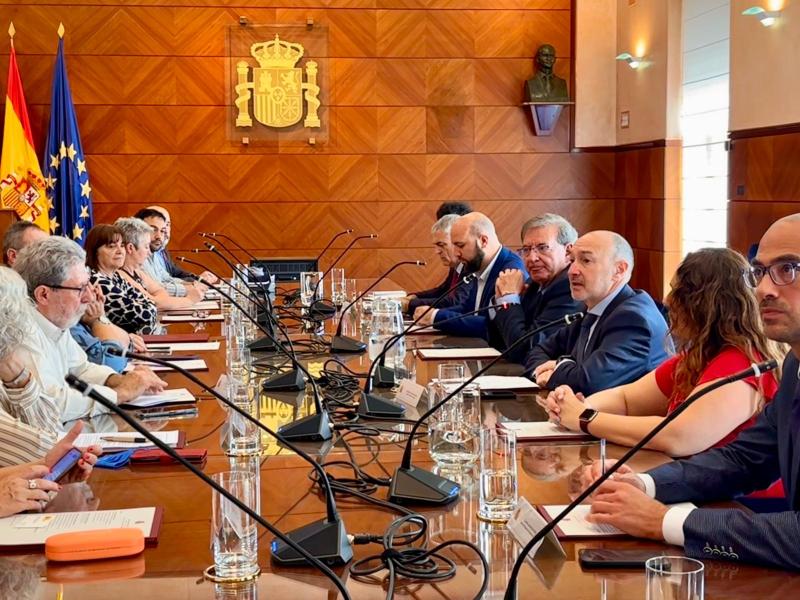
The Secretary of State for Democratic Memory, Fernando Martínez López, has guaranteed in a meeting with the memorialist entities of Aragón that all the places of memory declared in the autonomous community will become part of the state inventory. At the meeting, which was also attended by the Government Delegate in Aragón, Fernando Beltrán, it was recalled that the Government of Spain, following the initiatives by the PP-VOX coalition in Aragón, Castilla y León and the Valencian Community contrary to the values contained in the law of Democratic Memory and which will be subject to appeal before the Constitutional Court if a prior agreement is not reached, will raise this issue “due to its seriousness” to the main European and international bodies.
The Secretary of State recalled that Aragon approved last February a law that repealed the Aragonese Law of Democratic Memory of 2018, a decision that condemns victims to oblivion and directly affects the work of associations and institutions working in the field. “It has taken us a long time to recover democracy after the Transition and we have to preserve it from those who surrender to the theses of the extreme right,” he said, lamenting that “a return to the historical account of Franco’s regime is being sought.”
As it has been transferred to the entities that are part of the Platform for Action for the Memory of Aragon (PAMA) and to different bodies with competence in the matter, the Ministry will try to reach an agreement with Aragon, through the convening of a bilateral commission, but if this consensus is not achieved, it will go to the Constitutional Court and the other international bodies. “The Government of Spain will also go to the European Parliament and the United Nations to defend human rights, the dignity of the victims, international conventions and democratic memory,” he said. For the moment, both in Aragon and in any corner of Spain, the Government will apply the State Law and exhumations will continue to be subsidized from the Ministry of Territorial Policy and Democratic Memory working closely with the memory tissue and the institutions that carry out public memory policies.
The Secretary of State has indicated that Aragon’s repeal law contains aspects such as denying any homage to people who were imprisoned and remanded in Nazi concentration camps; it removes the map of graves and removes the inventory of places of memory that was being implemented in the community. “However, work will continue on this inventory, as well as on the rigorous application of the Democratic Memory Act proactively, because international law and human rights are being violated,” he said.
For his part, the delegate of the Government, Fernando Beltrán, has indicated that the Delegation of the Government has spent several months “working with associations and memory collectives, listening to them and gathering their needs” considering that it is “more necessary than ever because PP and VOX have left our democratic memory orphaned with the repeal of the Aragonese law.” The objective of these meetings is to work on “a common front against an ideological measure and a cession to the far right”.