
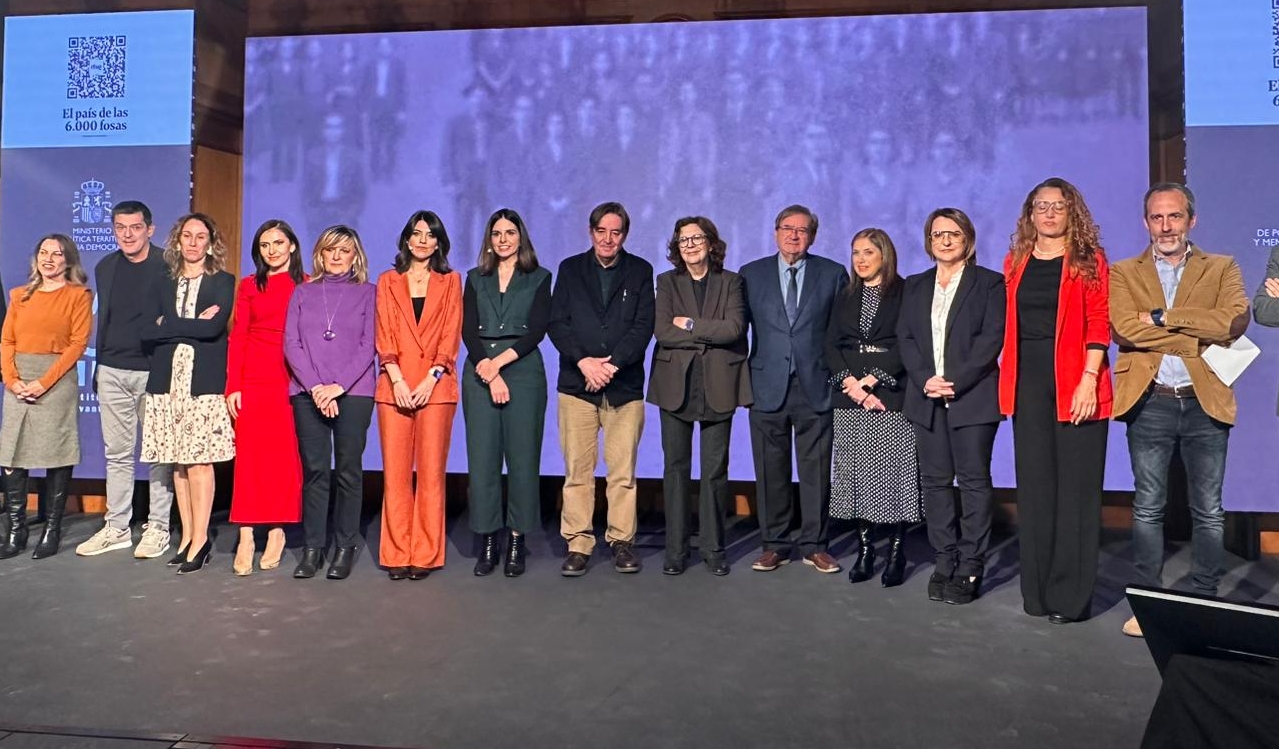
The Secretary of State for Democratic Memory, Fernando Martínez, accompanied by the commissioner for the celebration of 50 years of Spain in Libertad, Carmina Gustrán, has presented the audiovisual map of graves: “El país de las 6.000 fosas”, together with RTVE councillor Rosa León, in an event held at the headquarters of the Cervantes Institute, in which its director, Luis García Montero, was present.
The map presented today is the result of the agreement signed by the Ministry of Territorial Policy and Democratic Memory with RTVE, which provides its documentary and audiovisual funds in the elaboration of this work, and represents the first interactive audiovisual map of the graves of the Spanish War and the dictatorship It allows you to geolocate and discover the approximately 6,000 graves and recover the memory of their victims.
The RTVE News Data team, together with the RTVE archive, completed with the work developed by its territorial centers, has allowed the collection of audiovisual material after a review of the exhumations of the last 25 years.
Multimedia contents
The project has been built in collaboration with the Ministry of Territorial Policy and Democratic Memory, through its team of the Secretary of State for Democratic Memory. Based on its database, an interdisciplinary team of RTVE has reviewed the information, incorporated new data and enriched the map with the audiovisual material of the RTVE file.
You can also see contents ceded by autonomous communities, relatives, entities that carry out exhumations, as well as associations and organizations dedicated to the preservation of memory.
The website includes a search engine that allows to filter the graves by their current status - exhumed, not exhumed or transferred to the Cuelgamuros Valley - as well as by their geographical location by autonomous community, province and municipality and also by the name of the victims.
The audiovisual map, in addition, proposes a navigation through the names and surnames behind the figures and the user can choose the content among six different categories of stories: repressed groups; proper names and prominent characters; women in graves; objects found in exhumations; places used to bury and hide the bodies; and ‘early exhumations’, carried out in the dictatorship or transition.