
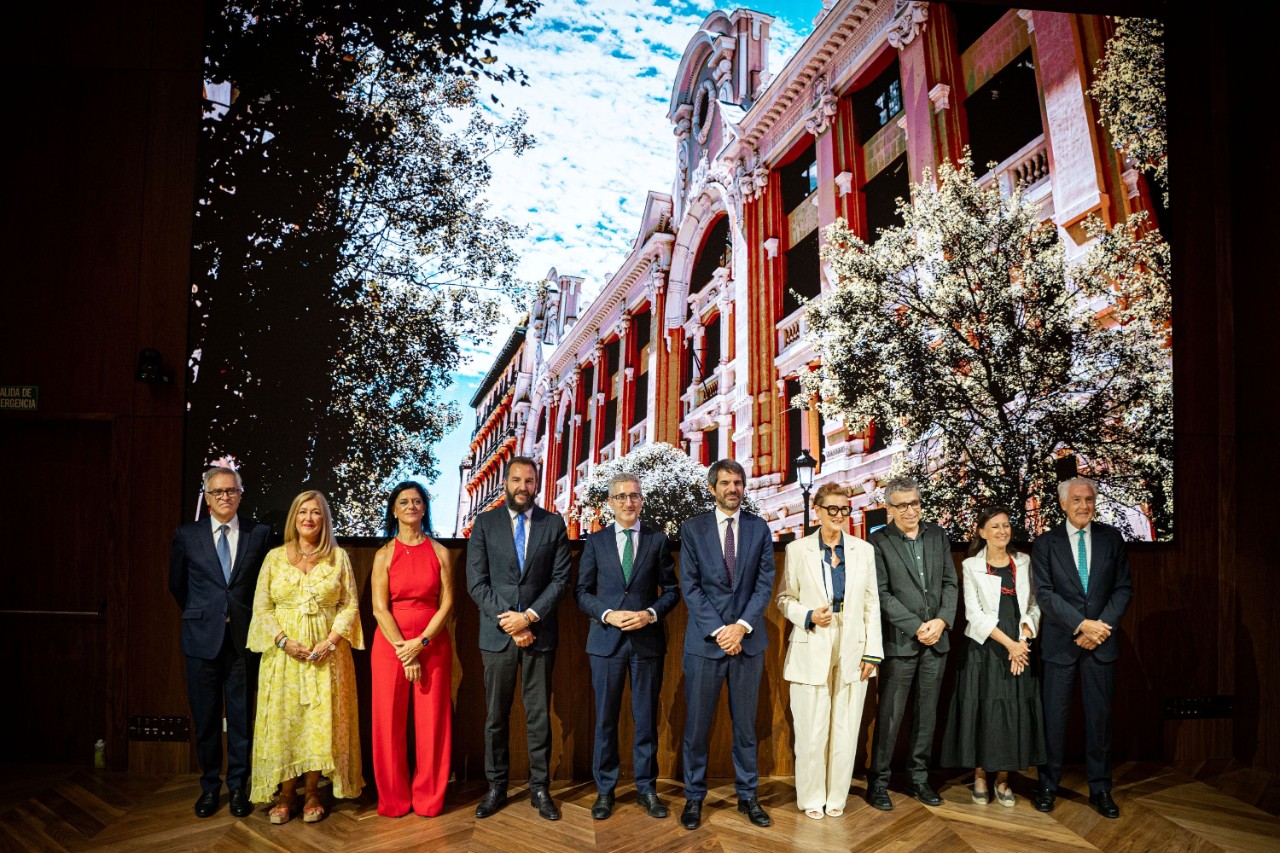
- Ministers Ernest Urtasun and Arcadi Spain have announced today the expansion, which will be done in this building on Duque de Medinaceli Street in Madrid
- This new space will be dedicated to 21st century art and will be dedicated to more than a hundred works that Francesca Thyssen-Bornemisza will donate from his collection
- The Ministry of Finance, which owns the property, will cede it and assume the cost of the rehabilitation
The Minister of Culture, Ernest Urtasun, and the Minister of Finance, Arcadi Spain, today announced the project to expand the Thyssen-Bornemisza National Museum in the building that was the Ice and Automobile Palace on Duque de Medinaceli Street in Madrid.
The property, which will be ceded by the Ministry of Finance for enlargement, will provide the Thyssen-Bornemisza National Museum with 10,000 square meters, which will be dedicated mainly to 21st century art. In this building there will also be a space for the headquarters in Madrid of the Memorial Center of the Victims of Terrorism, which will be added to the one already existing in Vitoria-Gasteiz.
In addition to the ministers, the patrons of the museum Francesca Thyssen-Bornemisza, founder of the TBA21 Collection, and Borja Thyssen-Bornemisza, collector, as well as the managing and artistic directors, Evelio Acevedo and Guillermo Solana, also took part in the presentation ceremony. In their interventions, both have highlighted the sense of continuity of this new stage, as well as the opportunity to consolidate a more participatory model of museum, more linked to society and more concerned with contemporary issues.
The Minister of Culture, Ernest Urtasun, said that “today we are taking the first step towards the expansion of the Thyssen Museum, a giant step to make the Thyssen of the coming decades possible: a larger, more open museum with more capacity to bring art and culture closer to the citizens. Because public museums are, above all, places that belong to people.” And he added that “where today we have a closed building, we want tomorrow there to be exhibitions, schools doing workshops, researchers working, restorers taking care of the works, concerts, conferences and spaces open to the public; because we do not simply want a bigger museum; we want a more useful museum”.
For his part, the Minister of Finance, Arcadi Spain, stressed that, with this project, a new space will be launched “where culture and memory will coexist”.
Arcadi Spain has also explained the origin of the Ice and Automobile Palace, which was inaugurated in 1922 and was one of the first buildings in the city to use reinforced concrete, a state-of-the-art material at the time.
The Minister of Finance, who added that this building housed the Center for Historical Studies and was the first seat of the Higher Council of Scientific Research, recalled that since 2007 it remained unused, so with this performance it is returned “a function equal to its history”.
Hacienda cedes and assumes the rehabilitation of a historic building
Once the transfer is effective by the Ministry of Finance, the Thyssen-Bornemisza National Museum will carry out a study of the Ice Palace, which will allow to establish a guide of the needs and possibilities of the property for the process of rehabilitation of the same.
The integral rehabilitation of the building will be promoted and financed by the Ministry of Finance, through the General Directorate of State Heritage, while the Ministry of Culture and the Thyssen Bornemisza National Museum will take charge of the museography, equipment and endowment of the area. For its part, the Ministry of the Interior will be in charge of providing the space for the Victims of Terrorism Memorial Center, which will be located in the same building.
The building, once renovated, will have a built area of around 19,500 square meters, with a playground-garden of 1,500 square meters open to exhibitions and outdoor events.
Throughout 2026, the program and the call for the architectural project competition for its rehabilitation will be defined; between 2027 and 2028 the winning project will be drafted; and from 2029 onwards the works will be executed, so it is expected that this building can be completed and in use around 2032. The total cost, adding the architectural project and the works is around 90 million euros.
On the enlargement
With the expansion announced today, the Thyssen-Bornemisza National Museum will not only increase its physical space to have a greater exhibition area, but will be able to respond to some needs that have arisen in recent years related to the availability of spaces for educational work, for research and conservation and for greater citizen participation, beyond the limits that currently supposes its headquarters, the historic building of the Villahermosa Palace.
This future extension of the Thyssen Museum will focus on 21st century art, which has been present in the exhibitions of the Museum thanks to the agreement of 2018 with the TBA21 Collection, presided over by Francesca Thyssen Bornemisza, and the exhibitions organized around the collection of Blanca and Borja Thyssen-Bornemisza.
For this new stage that will start with the expansion, the museum will receive the donation of more than 180 works of the TBA21 Collection by Francesca Thyssen-Bornemisza and his heirs, which will extend the permanent collection of the museum to the present. In addition, a long-term loan will be made of almost 180 other works of contemporary art that complement the donation. This donation incorporates 16 million euros in assets to the public artistic heritage, to which is added the loan, valued at 10 million euros.
To this is added the free – and long-term – loan of historical works that Francesca Thyssen-Bornemisza already maintains with the Museo Nacional Thyssen Bornemisza, valued at about 70 million euros, the joint commitment of TBA21 and Francesca Thyssen-Bornemisza with the Spanish State amounts to about 100 million euros.
“The announcement we make here today is more than a donation. It is another step in a commitment that my family has maintained, in one way or another, for more than a century,” explained Francesca Thyssen-Bornemisza. “My father taught me that a collection is not a possession but a conversation with the world, it is a good that is briefly kept in custody.” And he added: “If my great-grandfather’s generation wondered what art could show us about beauty, and my father’s what art could do for peace among nations, our generation wonders what art can do to help us imagine new, just ways to live together on a rapidly changing planet.”
TBA21, which has brought together one of the most influential private collections of contemporary art in the world, focuses its work on the intersection between art, ecology and social justice, and on the desire to expand the canon with artists from the so-called Global South, indigenous creators and voices historically excluded from European stories. It is a collection that naturally dialogues with the funds of the Thyssen-Bornemisza National Museum with the pieces that cover practically all the languages of contemporary art (painting, sculpture, installation, performance, sound, cinema and digital work) and that has artists of the stature of Ai Weiwei, Marina Abramović, John Akomfrah, Monica Bonvicini, Candice Breitz, Janet Cardiff & George Bures Miller, Claudia Comte, Olafur Eliasson, Taloi Havini, Rasyad, Johnson and Hid.
For their part, Borja and Blanca Thyssen-Bornemisza have also made loans of long-term works from their private collection and have organized exhibitions of contemporary art on a regular basis in the museum since 2023. His collection ranges from early 20th century avant-garde masters and post-war modernism to contemporary hyperrealism, and includes modern and contemporary works, the American hyperrealist movement, the art of graffiti, and contemporary painting—with masterpieces by Francis Picabia, Alex Katz, André Butzer, Ross Bleckner, Peter Halley, and Kenny Scharf, all currently on long-term loan at the Thyssen-Bornemisza National Museum. Together, these works provide an essential bridge between the historical collection built by three generations of the family and its continuity towards the next.