The Council of Ministers, at its meeting today, authorized the Ministry of Transport and Sustainable Mobility to tender a contract for the conservation and exploitation of state roads in the Community of La Rioja, with an estimated value of 20.6 million euros (VAT not included).
The duration is three years, with the possibility of an extension of two years and an additional one of a maximum of new months.
This contract includes requirements to promote energy efficiency and emission reduction and is part of the program of this Ministry to maintain the conditions of circulation, road and safety in the State Road Network (RCE), ensuring that it is accessible in the appropriate conditions to all citizens. It includes actions such as the surveillance and attention of accidents, the winter road, the control service of tunnels and communications or the maintenance of facilities.
The works are destined to the maintenance and conservation of 150,224 km of sector nº02 of La Rioja. The roads and service roads included are as follows:
- N-111, along about 70 km between the Piqueras tunnel on the provincial boundary with Soria (km 263) and Logroño (km 324).
- N-113, near Alfaro, between the km 78,840 and 82,340.
- N-232, between the border with Navarre (km 330) to the northwest of Alfaro (km 399).
- N-232A, between km 399 and 402 in Logroño.
Next to the aforementioned roads, the repair of the viaduct of the Cañada Ancha on the N-111, at km 272,300, in Lumbreras, will be the object of the contract.
Reduce emissions
Within the strategy of reducing emissions and improving energy efficiency, the tender documents of the conservation and exploitation contracts (COEX) of the State Road Network include objectives of mitigation and compensation of the carbon footprint, which means that companies must include in their offers the calculation of the carbon footprint that they will generate during the execution of the contract in each stretch of the road.
As early as 2022, energy efficiency measures were incorporated into service facilities such as self-consumption, renewable heating systems, energy saving measures in lighting or the implementation of electric vehicles.
In addition, since 2023, its commitment to submit, during the first six months of the contract, a decarbonization plan with the purpose of reaching the carbon neutral balance at 5 years from the beginning of the contract is included as an assessment criterion.
In this way, the awarding company undertakes to submit such a plan, in which compensation can be made through the absorption projects registered in the carbon footprint, compensation and carbon dioxide absorption projects under the Ministry for the Ecological Transition and the Demographic Challenge or through other options.
The aim is to reduce CO2 by 71,640 tons per year, which, according to calculations made by the General Directorate of Roads, generates the regular operation and maintenance and operation of the State Road Network and reinforces the orientation towards the Sustainable Development Goals (SDGs) to which this Ministry is committed: 9 (promotion of reliable, sustainable and quality infrastructure); 11 (access to safe, accessible and sustainable transport systems); 8 (contribution to economic growth and employment); and 7 (energy efficiency).
Characteristics of the conservation model
The model of mixed contracts (services and works) for the execution of conservation and exploitation operations aims to offer a comprehensive service of mobility to the user, improve the state of the road and network, and optimize public resources.
Through them, works are carried out to help the roads and ordinary conservation of the roads, to allow the infrastructure and its functional elements to have the best possible conditions of circulation and safety. It includes actions such as: status information and programming agenda, operating aid and road safety studies, and maintenance of road elements with adequate levels of quality.
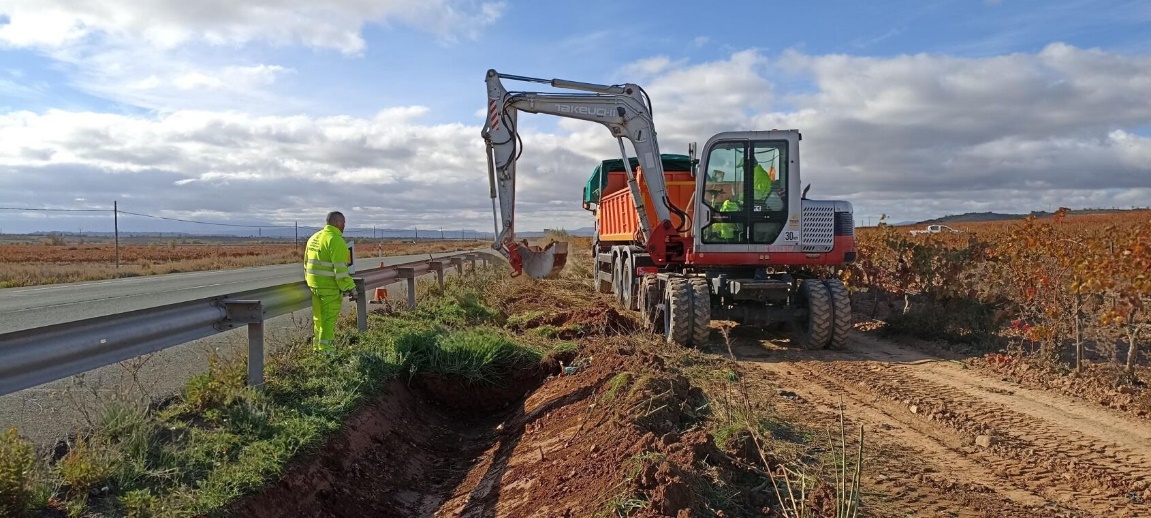
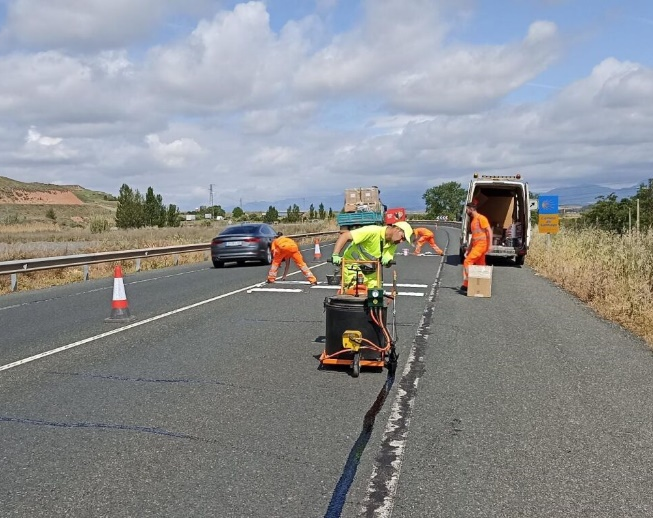
Images of sector nº02, La Rioja