
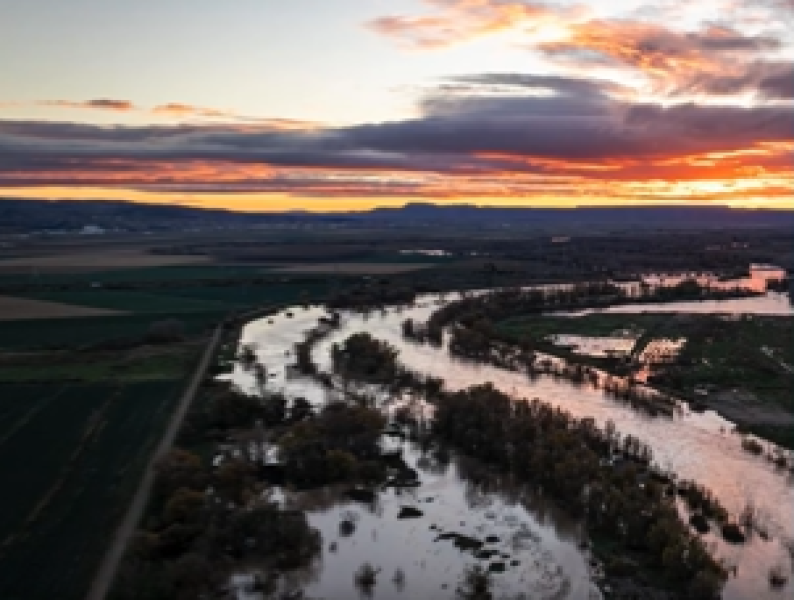
The Ebro Hydrographic Confederation (Ministry for the Ecological Transition and the Demographic Challenge) has launched a program of actions of permeabilization of sediment masses and the reconnection of old river arms for the improvement of the flow of flows on the axis of the Ebro River, in La Rioja, Navarra and Aragón.
European funding through NextGeneration Funds for these actions consists of 4,760,000 euros, and interventions will be developed in 2024 and 2025.
The objective of the interventions is to reduce the negative effects of floods, also considering the improvement of the ecological status of water bodies, thus following the criteria of the Water Framework Directive of the European Union.
Some 20 interventions are planned for the reconnection of old arms of the river, applying natural solutions for the improvement of the flow of flows in places and sotos.
The reconnection with channels that the river has abandoned over time is one of the actions that allow to reduce the risk of flooding, but also, generates positive effects on the ecosystem. The technique includes the permeabilization of large masses of vegetated sediments that pose significant obstructions to the passage of the current, to improve the drainage capacity and reduce the exposure to flooding of riparian nuclei.
Added to this are the complementary interventions to improve hydrological fluence in various points of the River Ebro and its tributaries in Navarra, La Rioja and the province of Zaragoza.
- Removal of unwanted elements deposited within the pipeline and the Hydraulic Public Domain or those that may be likely to diminish the natural capacity of the pipeline in the future.
- Recovery of the morphology of the cauce considered as natural or established as reference.
- Recovery of the continuity of longitudinal and lateral of the river, Reduction of the negative effects of floods, including the stabilization of margins and/or movement of carries within the riverbed.
- Drafting of green infrastructure projects, river restoration and other protective measures.
These new 20 actions will be added to the more than 50 interventions already carried out in the three autonomous communities within the EbroResilience Strategy and the LIFE Ebro Resilience P1 Project.
Sustainable Ebro
This work responds to the axes of management of the CHE for a Sustainable Ebro, in particular, the renewal of the vision of river dynamics (axis 4), which seeks to look at our rivers with a renewed vision that allows to favor their environmental recovery.
The other four axes of action are: the improvement of knowledge (axis 1), which seeks to incorporate the best techniques and the latest research in the management of the hydrographic demarcation of the Ebro and facilitate its dissemination to all citizens; the improvement of its management, seeking greater efficiency in the systems (axis 2); achieving the good state of the water masses with measures to have a water environment and its ecosystems associated with increasingly better environmental conditions (axis 3), and the guarantee of supply to essential uses (axis 5).