
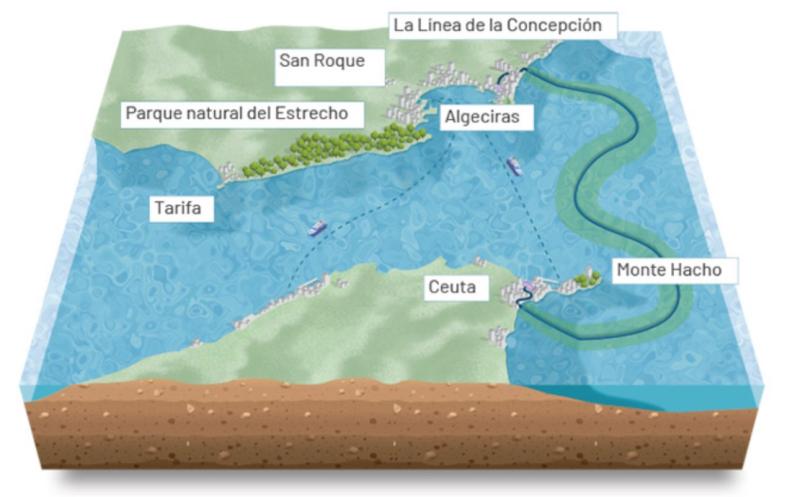
Red Eléctrica, Redeia’s subsidiary responsible for the transport and operation of the electricity system in Spain, has begun work on the electricity interconnection between the peninsula and the Autonomous City of Ceuta, once the project has received the Prior Administrative Authorization from the Ministry of Ecological Transition and Demographic Challenge.
The electricity interconnection project, which already had a favorable Environmental Impact Statement, is included in the Transport Network Development Plan 2021-2026, approved in the council of ministers. The interconnection will substantially improve the safety and quality levels of Ceuta’s electricity supply, constituting a key project in territorial structuring.
The works begin simultaneously at both ends. During its execution, Red Eléctrica will work in a coordinated manner, with the municipalities and authorities involved, to reduce as much as possible the impact of the work on the population and the normal use of public space by the citizens.
A strategic project
The implementation of the interconnection will be decisive for the promotion of the Ceuta economy and the reduction of its dependence on fossil fuels, contributing to the decarbonization of the system and the advancement of the ecological transition of our country.
With this new link, Ceuta will join the peninsular electricity system, benefiting from its share of renewable generation, which will result in a reduction of greenhouse gases, estimated at about 300,000 tons per year, which will result in an improvement in air quality in the autonomous city and throughout the Strait of Gibraltar, contributing to achieving the 2030 objectives of the Integrated National Energy and Climate Plan.
At the same time, the electrical interconnection will favor a more efficient electricity regime that, by replacing high-cost energy from the current thermal power plant of Ceuta with energy from the Peninsula, will allow savings for the electrical system, which will be reflected in the bill of consumers.
The electricity interconnection with Ceuta is a before and after for the Ceuta electricity system and the opportunity framework of the city, as well as a fundamental advance for the achievement of the Energy Transition objectives of our country.
A sustainable and integrated project in the environment
The project has been processed with public information processes that guarantee the participation of the company in its definition. As a result, improvements have been incorporated that have contributed to optimizing the design from a technical, social and environmental point of view.
The submarine cable features an advanced technology design, with dry insulation. It is a double circuit link at 132 kV, with a length of 58 km, that runs along the seabed at a maximum depth of 900 meters below sea level and that will be protected throughout its route from external aggressions. In Ceuta, in the terrestrial part of the route, the cable will be buried. The transition of the land-sea installation is made through the technique of directed horizontal drilling that avoids any condition to the beaches or bathing areas, as well as any condition to protected species in the first water line, following a marine route that allows the installation to be compatible with other aquaculture infrastructures of the area.
On the peninsular side, the project includes actions inside the Algeciras 220 kV substation, inside the existing building, which will be joined by underground connection to a new annexed transformation park, with GIS technology, allowing it to be a very compact solution, four times lower than a standard extension. The modifications that are made in the existing substation, in addition to not expanding the dimensions of it, introduce improvements in the transport network that will allow the municipality to provide the possibility of meeting new electrical demands, essential for its economic and social development.
All the action will be integrated in a space consisting of industrial facilities and infrastructures and that will be regenerated once the works are finished, with improvements in the environment.
On the other hand, the electric lines that link to the underwater section will be completely buried, eliminating any visual impact, beyond the execution of the work itself. This basement, on the peninsular side, follows a periurban route in the municipal area of San Roque, as happens in most of the route that runs through the municipal area of La Linea de la Concepción, taking advantage of infrastructures and roads already consolidated, in parallel with the usual public services.
The land-sea transition of the infrastructure is also carried out by means of directed drilling, which allows the work to be carried out without affecting the beach or the bathing areas.