
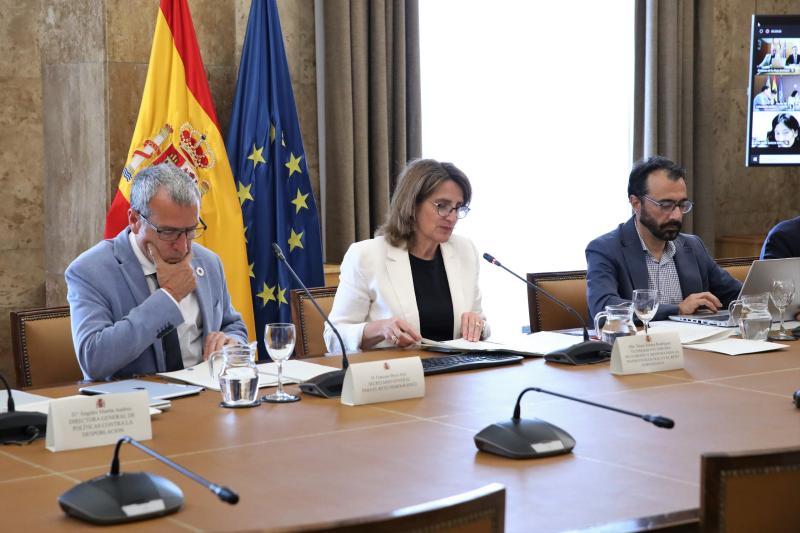
The Sectoral Conference for the Demographic Challenge, chaired by the Vice-President and Minister for Ecological Transition and the Demographic Challenge, Teresa Ribera, and attended by representatives of all the autonomous communities and cities, unanimously approved on Tuesday the distribution of the Territorial Cohesion Fund (FCT) for 2024. After the extension of the General State Budgets of 2023, the Fund will be endowed with 20.2 million euros. This budget, which will be distributed among the different communities and autonomous cities according to population density, economic and social criteria, will finance projects that generate opportunities for economic and social development, consolidating territorial cohesion.
“With the approval of the distribution of the Fund, what we do is give continuity to the work that has been carried out, in a spirit of very important collaboration, between the different levels of administration,” said the Vice-President. “Thus, the funds are consolidated to encourage innovative projects that seek new ways to solve some problems that do not fit into the traditional policies and competences of the autonomous communities, and that are helping us to learn and value many of the enormously innovative initiatives that are being developed in the territories,” said Ribera.
SOCIOECONOMIC DYNAMIZATION IN THE TERRITORIES
The FCT, endowed in 2024 with 20.2 million, is configured as a fundamental tool to articulate in a transversal way a socio-territorial cohesion policy focused on the rebalance of rights and opportunities of citizenship.
Therefore, the objective of this Fund is to promote a polycentric territorial model, promoting an integrated and inclusive local social, economic and environmental development that is prevalent in small and medium-sized towns and cities based on their own potentialities.
To this end, the actions and initiatives selected by the autonomous communities must simultaneously meet several objectives:
· Promover medidas de ordenación del territorio que favorezcan un nuevo modelo productivo-territorial, más integrado, equitativo e inclusivo.
· Address territorial imbalances in terms of citizens’ access to public services (health, education, housing, mobility and territorial connectivity).
· Promote land use planning measures in order to encourage economic activity in areas of demographic decline.
· Ensure the sustainable development and well-being of the inhabitants of their area of influence.
This Fund, from the General State Budgets, was articulated for the first time in the distribution of funds of 2022. Since 2021, 176 million have been distributed at the Sectoral Conference of Demographic Challenge –67 million from the PGE in the period 2021-2024 and 109 million from the Recovery Plan in the years 2022 and 2023–.
In all the exercises the distribution has been approved unanimously by MITECO and the autonomous communities, according to population density, economic and social criteria. On this occasion, the agreed allocation allocates a total of 2,330,938 euros to Castilla-La Mancha.
BOOST TO LOCAL DEVELOPMENT OF 6,700 MUNICIPALITIES
The complexity of the problems related to the depopulation of the territory makes its treatment require that public policies aimed at addressing the needs derived from social inequality and its territorial distribution have as an indispensable objective the promotion of economic activity.
The FTC, which will benefit more than nine million Spaniards living in 6,724 municipalities, seeks to maintain and improve the quality of life of the entire population, as well as reduce the territorial gap, through the financing of tractor projects that promote economic and social development in municipalities less than 20,000 inhabitants outside the Functional Urban Areas.