
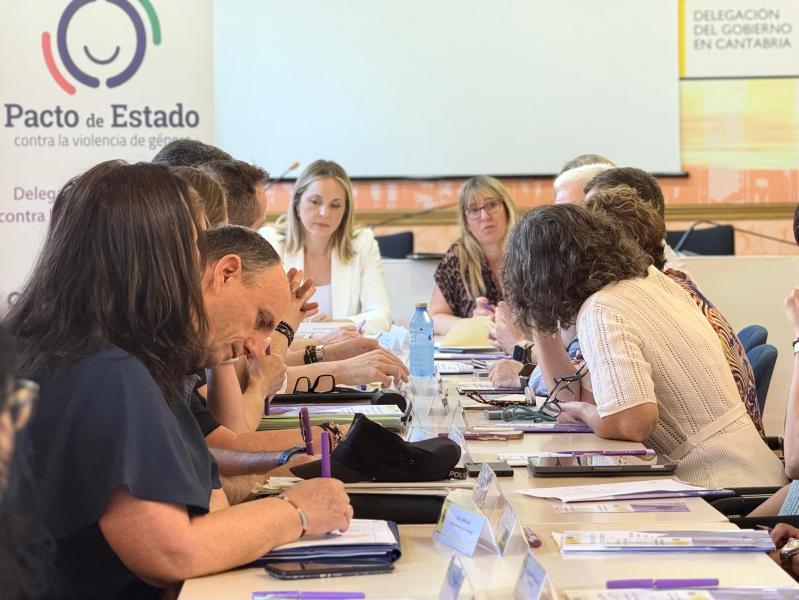
The Police Coordination Committee on gender violence was held this Thursday in Santander with the participation of the Government delegate in Cantabria, Eugenia Gómez de Diego, and the head of the Violence Coordination Unit on Women of the Delegation, Diana Mirones, who has offered a detailed analysis of the current situation in the Cantabrian capital and in the community as a whole.
According to the updated data of the Viogen System, Santander currently records 351 active cases of gender violence. Of these, 229 women have police protection measures and 16 minors have been identified as at risk. In the whole of Cantabria, the number of cases reaches 1,545.
After the session, the delegate of the Government stressed that the 29 Cantabrian municipalities with Local Police are already adhered to the Viogen System, which allows a strengthening of the coordination and follow-up of cases. Santander, which signed the agreement in 2020, has recently renewed its accession, consolidating its collaboration with the National Police through the system.
In his speech, he recalled that since 2003, 1,308 women have been registered in Spain murdered due to gender violence, and that so far in 2025, 14 fatalities have already been recorded, with prior denunciation in only four of the cases.
Both institutional leaders have agreed that the renewed State Pact against Gender Violence, with 462 lines of action, pays special attention to phenomena such as vicarious violence, economic violence and digital violence, the latter clearly rising, especially among the young population. Mirones has warned of the increase in crimes such as cyberbullying or sexting, and has given as an example the recent detention of two individuals for disseminating sexual images of a woman without her consent.
Prevention, training and comprehensive care
To prevent and combat this social scourge, the Government Delegation in Cantabria has intensified its strategy around three axes: prevention, training and care for victims.
In prevention, Gómez de Diego has detailed the reinforcement of the Master Plan for coexistence and security in educational centers, which includes specific training for students and teachers on gender violence, cyberviolence and sexual violence. He also highlighted the extension of the Violeta Points program to institutions such as the University of Cantabria, the Tax Agency, Treasury and Social Security Institute or SEPE, as well as the training offered in several municipalities in the region.
In training, the specialization of police officers is continued, both in access courses and in refresher sessions given by the Unit headed by Mirones.
In the area of care, the delegate has highlighted the improvements in resources such as telephone 016, which now also deals with cases of sexual violence, or the Atenpro service, with 270 women users in Cantabria. In addition, the use of telematics devices for aggressors has been strengthened, an SOS button has been incorporated into the AlertCops application and residence permits have been extended for exceptional circumstances for victims of sexual violence, following the reform of the immigration regulations in May.
In his final speech, Gómez de Diego highlighted the work of the Unit, State security forces and bodies and social entities, and thanked the media for their work of raising awareness, while insisting that the victims “are not alone”. “There is a whole network of professionals trained, sensitized and committed to protect, accompany and help women emerge from the spiral of violence,” he concluded.