
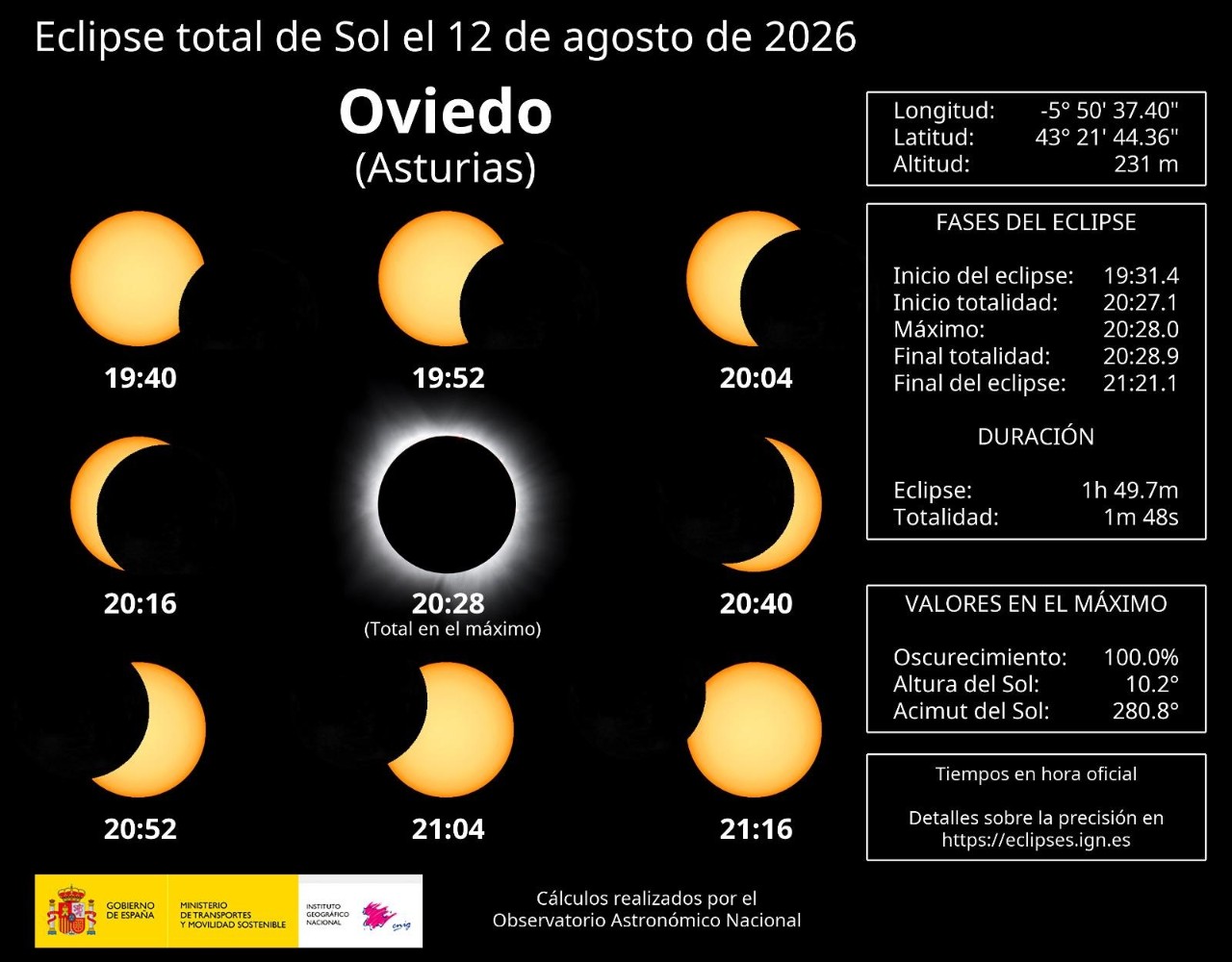
On August 12, Spain will experience one of the most important astronomical events of the last hundred years: a total eclipse of the Sun that can be observed in a wide swathe of the national territory. Asturias will be one of the territories from which the eclipse can be seen in its entirety, which makes the Principality a particularly attractive place for observing this phenomenon.
The coincidence of the eclipse with the summer period, one of the moments of greatest mobility of the year, foresees an extraordinary influx of vehicles to the observation areas. In Asturias, as it can be seen in its entirety, a special concentration of visitors and displacements during that day is foreseen.
The different administrations and agencies involved have worked in a coordinated way to manage the increase in the expected mobility and facilitate a safe observation of the eclipse, making the influx of visitors compatible with the necessary road safety and fluidity of traffic.
SPECIAL DEVICE FOR AN EXCEPTIONAL EVENT
Within this operation, the Directorate General of Traffic considers the eclipse a High Traffic Impact Event (EVAAT) and has designed a specific plan to guarantee road safety that will combine preventive measures, on-site surveillance and permanent information to users.
The device contemplates in our region the continuous monitoring of traffic from the Northwest-Cantabrian Traffic Management Center, which will operate with the maximum level of availability of personnel and resources throughout the day and will permanently monitor the evolution of traffic and any incident that may occur.
The planning has included the development of individualized mobility cards for each of the Preferential Observation Points of Asturias, in order to analyze the conditions of access, circulation and evacuation of each site and anticipate possible traffic conditions.
For its part, the Traffic Group of the Civil Guard will reinforce surveillance on the main routes to the observation areas to channel the movements, avoid dangerous parking on the sides and accesses, order traffic when necessary and facilitate the passage of emergency services. Preventive checks on alcohol and drugs will also be carried out at the points of greatest concentration.
Specific traffic control measures, restrictions on access to certain sites, alternative diversions and capacity controls may also be introduced. Variable message boards will inform drivers of incidents, restrictions and recommendations at all times.
OPERATIONAL MEASURES AT KEY POINTS OF THE ASTURIAN ROAD NETWORK
To guarantee traffic management during the eclipse, the DGT has reviewed and reinforced the intelligent transport systems of the Asturian road network that are composed of 69 surveillance cameras, 62 variable message panels and 32 license plate readers. In addition, additional equipment will be deployed in strategic points such as Villaviciosa, on the A-8 the viaduct of Concha de Artedo, Llovio, Llanes, Luarca, the link of the A-66 with the AS-17 and the port of Pajares.
- Surroundings of Villaviciosa. The N-632 will install a mobile Variable Message Panel (PMV) and a mobile surveillance camera aimed at regulating the incorporation of vehicles from the beach of Rodiles into the A-8.
- Viaduct of Concha de Artedo (A-8, PK 431+850). A mobile surveillance camera will be installed to detect anti-regulatory stops or driver recklessness.
- Port of Pajares and Valgrande-Pajares Station. In view of the extraordinary opening in the afternoon of the station for access to Cuitu Nigru, the DGT will keep the port monitored with a surveillance camera.
- Support parking on the A-66 (A-66, PK 056+000). The winter road bagging area will be enabled as a support area for possible saturations or incidents in the Huerna or Pajares.
- Viewpoint of the Fitu. The Civil Guard Traffic Group will maintain a special reinforced surveillance operation at its entrances.
RECOMMENDATIONS FOR SAFE TRAVEL
Among the main road safety risks associated with eclipse observation trips are vehicle concentration, especially at the end of the totality phase, improvised arrests on the road or on the roadside, distractions at the wheel to observe or photograph it and the presence of pedestrians on the road and in the vicinity of the roads at the observation points.
Therefore, the DGT recommends planning in advance both the displacements and the observation of the eclipse and adopting a series of precautions.
- Avoid unnecessary displacements. All of Asturias is within the band of totality. If you have a good horizon to the west, it is advisable to avoid long trips.
- Plan the trip well in advance. If the trip is necessary, it is advisable to organize it in time and not leave it for the last minute. When possible, it is advisable to use public transport. Before starting the tour, check the state of the roads and weather forecasts and stay informed through official channels and browsers.
- Choose a suitable place of observation. The Government of the Principality has identified 76 recommended locations, https://eclipseasturias2026.ficyt.es/puntos_observacion.php
- It is important to choose the place of observation taking into account its capacity and the conditions of access, avoiding displacements to spaces that may become saturated in the face of a massive arrival of vehicles. In addition, it is necessary to exercise extreme caution due to the risk of fire in those observation points located in the natural environment.
- Absolute prohibition of stopping the vehicle on roadside or roadway to observe the eclipse. To observe the phenomenon, it is necessary to completely abandon the roads and park only in authorized points or in those where it is allowed to do so.
- Recommendations for the transport of goods. In order to promote mobility and reduce possible traffic conditions, it is recommended that the food distribution vehiclesas far as possible, make your morning trips and avoid circulating in the afternoon in the environments of the Preferential Observation Points (MAGPs) and on high-capacity roads.
- It is also recommended that the other heavy vehicles with a maximum authorised mass (MMA) exceeding 7,500 kg Plan your journeys by avoiding the time slots near the beginning and end of the eclipse.
- Turn your attention to the wheel. The eclipse can be an important element of distraction in driving. If it is circulating, it is necessary to take into account some recommendations:
- Increase the safety distance and adapt the speed to the conditions of circulation.
- Not manipulate mobile phones, photo cameras or other Devices for taking pictures.
- Maintain the dipped dipped headlamps during the darkening phase.
- Do not look directly at the Sun or use specific glasses observation while driving.
- Using the parasol of the vehicle, if necessary, for avoid glare.
- Special attention to vulnerable users. Pedestrians can be found on the road in the immediate vicinity of the observation points. Speed must be reduced and special caution must be exercised in the possible presence of vulnerable users.
- Plan the return. Although the arrival at the observation points occurs in a staggered and orderly manner, the return, once the phase of totality is completed, will be a critical moment that can cause retentions, multiplying the risks especially on secondary roads. Whenever possible, it is advisable to stay for a while at the observation site before starting the return trip. Staggering the exit will help to decongest the accesses and the nearest roads. The success of the trip is not to arrive fast, but to return without incident.
- Respect the special traffic measures. Although there is no provision for generalised movement restriction measures by the DGT, it may be necessary to take specific management and regulatory actions in the environment of the observation points to ensure safety and maintain the flow of traffic. Therefore, the indications of the agents, the circumstantial signalling and the messages broadcast through the variable message panels must be respected at all times.
- Consult official information before and during the trip. The Directorate General of Traffic will keep up-to-date information on the state of circulation and possible incidents related to the eclipse through its official channels. Among them are:
-Official web viewer. Map of traffic status and incidents (https://etraffic.dgt.es/etrafficWEB/) where the user can consult the traffic status, cameras, incidents, meteorology and restrictions.
-Social networks officials, such as X (@DGTes)
-Information accessible to traffic information providers (browsers) at the national traffic information access point https://nap.dgt.es/.
It will also be reported through the road message boards, radio bulletins and telephone service 011.
In addition, there are other official resources of interest:
The website https://www.trioeclipses.es/ It collects useful information for citizens, such as health and environmental risks. Also included are logistical safety tips such as planning trips in advance, carrying basic supplies, or establishing family or group protocols.