
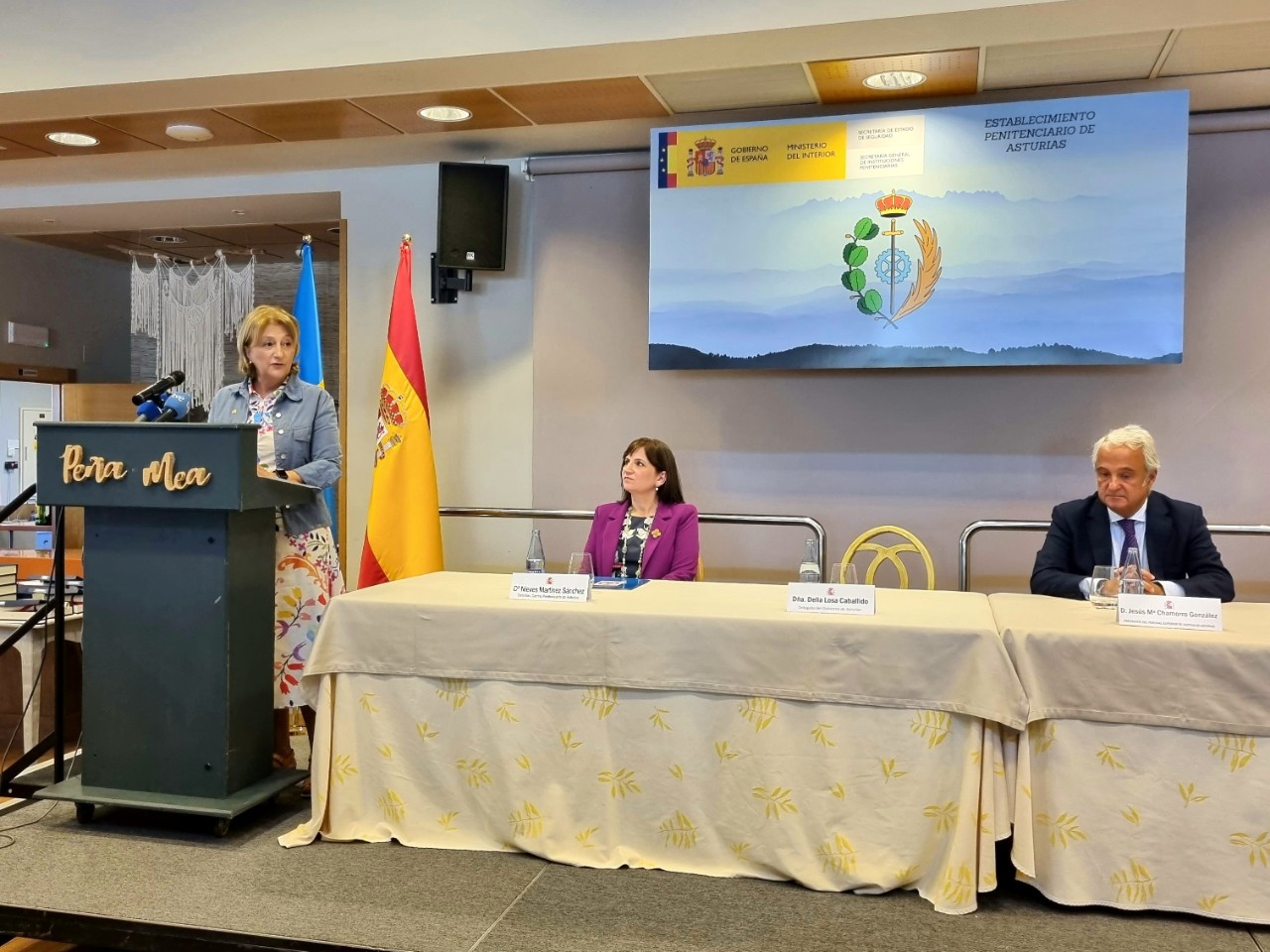
The delegate of the Government, Delia Losa, presided this morning the institutional act on the occasion of the festivity of Our Lady of Mercy, patron of the penitentiary administration.
In her speech, she congratulated the director of the Penitentiary Center of Asturias, Nieves Martínez, for “having managed to create an atmosphere of harmony” in the center, and also congratulated the staff for a “demonstrated vocation of public service” that has managed to place the prison of Asturias “among the penitentiaries with best practices in Spain”. “Nobody can argue that the work in the prison is arduous and hard, which requires a lot of professionalism, but also attitude, willingness and a personal surrender without which this type of work would not have the same result,” said Losa.
The government delegate has not overlooked “the difficulties” in the penitentiary center, “mainly due to the lack of personnel.” After assuring that the Government of Spain is “sensitive” to the demands of the workers, he has insisted that measures are being taken to improve the conditions, and has given as an example the public job offers approved by the current Government of Spain in the last five years: 6,532 places in the different penitentiary bodies and more than 500 work personnel, “360% more than those convened in the previous seven years”.
Losa has highlighted the “important” role played in the daily life of the Penitentiary Center of Asturias by the entities and associations that collaborate in the reintegration of prisoners and prisoners, and has stopped in the work of the Therapeutic and Educational Unit, “a reference throughout the country that represents an alternative model that offers an educational opportunity and that, without a doubt, shapes and reinforces the prisoner’s self-esteem.”
The sum of the work of all the agents involved contributes, according to the delegate of the Government, to the fact that “eight out of ten people imprisoned do not commit crimes again”. These are recent data from the Central Penitentiary of Observation, whose results “invite optimism, to achieve the objective that the passage through the prison is a kind of catharsis for the imprisoned people”.